Magnetism and magnetic effects of electric current — Syllabus
Tamil Nadu Board · Class 12 · Physics
What Magnetism and magnetic effects of electric current covers in Tamil Nadu Board Class 12 Physics: 4 topics, for the 2026-27 session.
Interactive on Super Tutor
Studying Magnetism and magnetic effects of electric current? Get the full interactive chapter.
Quizzes, flashcards, AI doubt-solver and a step-by-step study plan — built for syllabus and more.
Free trial, no card needed.
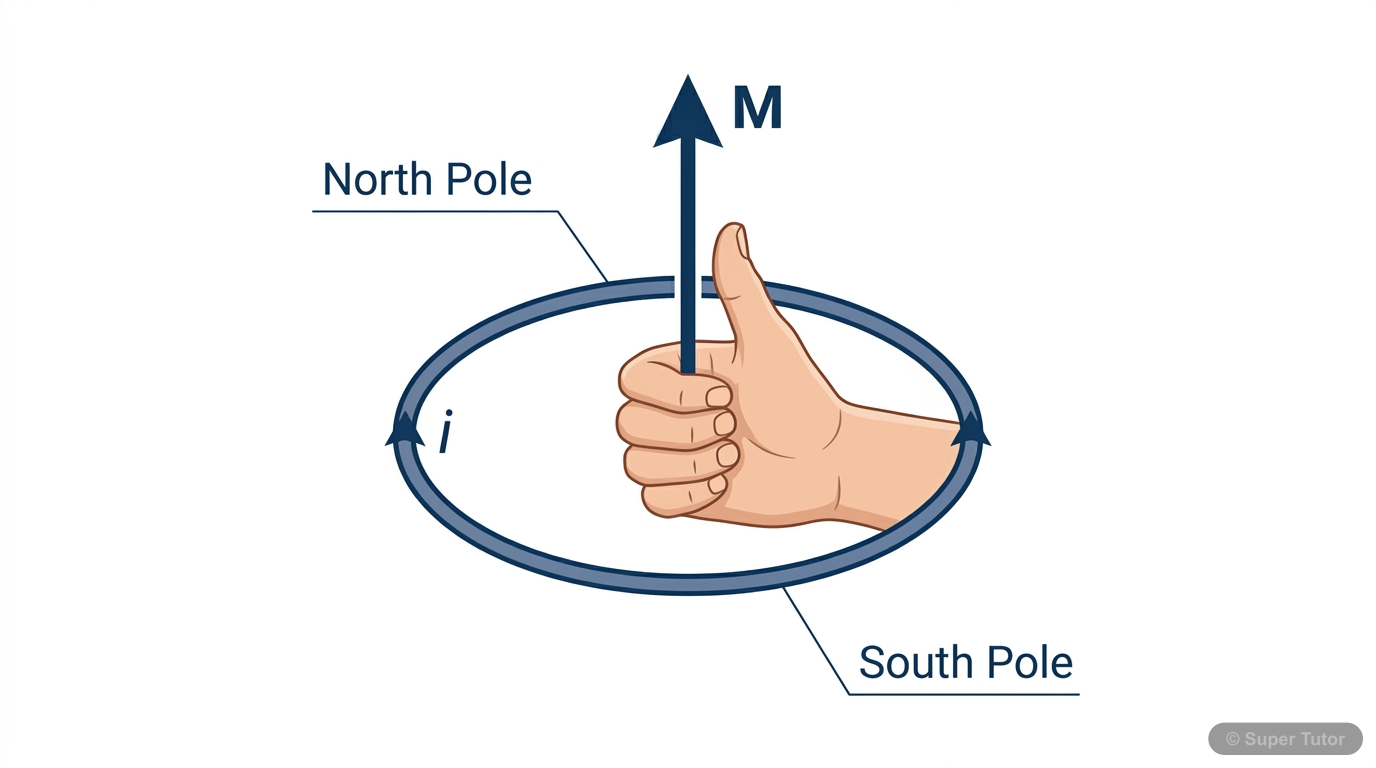
One of 3 illustrations for Magnetism and magnetic effects of electric current in Super Tutor — alongside flashcards, concept maps and practice questions.
Topics in Magnetism and magnetic effects of electric current
Earth's Magnetic Field and Magnetic Elements
- Earth behaves like a gigantic bar magnet with its magnetic south pole near the geographic north pole.
- Three magnetic elements fully describe Earth's field at any point: Declination (D), Dip/Inclination (I), and Horizontal Component (B_H).
- Declination (D): Angle between geographic meridian and magnetic meridian at a point. For Chennai: D = −1°16′ (westward).
Basic Properties of Magnets and Coulomb's Law of Magnetism
- Magnetic dipole moment p_m = q_m × 2l, where q_m is pole strength and 2l is magnetic length. Direction: south to north pole.
- Magnetic length is always less than geometrical length. Ratio = 5/6 ≈ 0.833.
- Magnetic field B = F/q_m. Unit: N A⁻¹ m⁻¹ (or Tesla).
Magnetic Field Due to a Bar Magnet (Axial and Equatorial)
- Axial line: a point on the line joining both poles of the magnet (end-on position).
- Equatorial line: a point on the perpendicular bisector of the magnet (broad-side on position).
- B_axial is in the direction of magnetic moment (S to N); B_equatorial is opposite to magnetic moment.
Torque on a Bar Magnet and Potential Energy
- A bar magnet in uniform field experiences zero net force but a torque that tends to align it with the field.
- Torque: τ = p_m × B sinθ (in magnitude), Vector form: τ⃗ = p⃗_m × B⃗.
- Potential energy: U = −p_m B cosθ = −p⃗_m · B⃗ (reference: θ = 90°).
Key Concepts
Work through every topic in Magnetism and magnetic effects of electric current with notes and quizzes
Start This ChapterFrequently Asked Questions
What are the important topics in Magnetism and magnetic effects of electric current for Tamil Nadu Board Class 12 Physics?
How should I revise Magnetism and magnetic effects of electric current for the Tamil Nadu Board Class 12 board exam?
Sources & Official References
Content is aligned to the official syllabus. Refer to the board website for the latest curriculum.
More resources for Magnetism and magnetic effects of electric current
Practice Quiz
Test yourself with a quick quiz
Important Questions
Exam-style questions with answers
Revision Notes
Key points for last-minute revision
Formula Sheet
The chapter's formulas in one place
Chapter Summary
Understand the chapter at a glance
Concept Maps
See how topics connect
Flashcards
Quick-fire cards for active recall
For serious students
Get the full Magnetism and magnetic effects of electric current chapter — start free.
Quizzes, flashcards, an AI doubt solver and a study plan for Tamil Nadu Board Class 12 Physics. Free to start, no card needed.