Current Electricity — Practice Quiz
Tamil Nadu Board · Class 12 · Physics
Try a 4-question quiz on Current Electricity for Tamil Nadu Board Class 12 Physics: tap an answer to check it and see why.
Interactive on Super Tutor
Studying Current Electricity? Get the full interactive chapter.
Quizzes, flashcards, AI doubt-solver and a step-by-step study plan — built for practice quiz and more.
Free trial, no card needed.
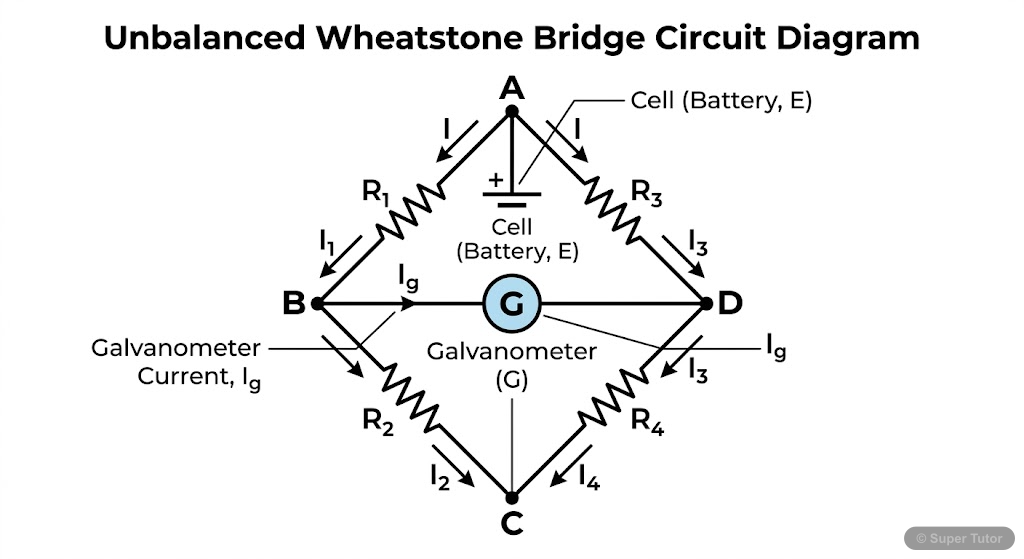
Learn better with visuals Super Tutor pairs illustrations like this with notes and quizzes for Current Electricity.
Quick Quiz: Current Electricity
0/4Tap an answer to check it instantly. No sign-up needed for these 4.
A copper wire of length 2 m and cross-sectional area 2 mm² carries a current of 2 A. Given free electron density n = 8.5 × 10²⁸ m⁻³ and e = 1.6 × 10⁻¹⁹ C. What is the drift velocity of electrons?
A wire of resistance 20 Ω is stretched to double its original length. The new resistance of the wire will be:
In a Wheatstone bridge, P = 100 Ω, Q = 200 Ω, R = 300 Ω. For balanced condition, what should be the value of S?
Two bulbs rated 40W-220V and 60W-220V are connected in SERIES to a 220V supply. The ratio of power dissipated in the 40W bulb to the 60W bulb is:
Sample Questions
A battery of emf 12 V and internal resistance 2 Ω is connected to an external resistance R. The terminal voltage is found to be 10 V. What is the value of R?
Show answer
10 Ω
Step 1: Terminal voltage V = ε - Ir, so 10 = 12 - I × 2. Step 2: 2I = 2, so I = 1 A. Step 3: Terminal voltage = voltage across external resistance: V = IR. Step 4: 10 = 1 × R. Step 5: R = 10 Ω. Option A (5 Ω) results from using wrong current. Option C (6 Ω) results from an error in applying Kirchhoff's law. The physical principle: terminal voltage is always less than emf because of voltage drop across internal resistance.
Four cells each of emf 1.5 V and internal resistance 0.5 Ω are connected in parallel. This combination is connected to an external resistance of 2 Ω. What is the total current through the external resistance?
Show answer
0.68 A
Step 1: For n cells in parallel with same emf ε and internal resistance r: equivalent emf = ε = 1.5 V, equivalent internal resistance r_eq = r/n = 0.5/4 = 0.125 Ω. Step 2: Total resistance = R + r_eq = 2 + 0.125 = 2.125 Ω. Step 3: Total current I = ε / (R + r_eq) = 1.5 / 2.125 = 0.706 ≈ 0.68 A. Step 4: Note that emf does not multiply in parallel — only current capacity increases. Option B (2.73 A) incorrectly multiplies emf. Option C uses wrong formula. The key concept: parallel cells give same voltage but lower internal resistance.
In a meter bridge experiment, the balance point is found at 60 cm from end A when unknown resistance P is in the left gap and standard resistance Q = 10 Ω is in the right gap. If P and Q are interchanged, what will be the new balance length from end A?
Show answer
40 cm
Step 1: With P in left gap: P/Q = l₁/(100-l₁) = 60/40 = 3/2. So P = (3/2) × 10 = 15 Ω. Step 2: When P and Q are interchanged, Q is in left gap (10 Ω) and P in right gap (15 Ω). Step 3: Now Q/P = l₂/(100-l₂). So 10/15 = l₂/(100-l₂). Step 4: 2/3 = l₂/(100-l₂). Cross multiply: 200 - 2l₂ = 3l₂, so 5l₂ = 200, l₂ = 40 cm. Option B assumes balance point doesn't change. Option D makes a ratio error. This tests whether students understand the meter bridge formula deeply.
In a potentiometer experiment, the balancing length for cell of emf ε₁ is 75 cm and for cell of emf ε₂ is 45 cm. If the cells are connected in series aiding (same polarity), the balancing length would be:
Show answer
120 cm
Step 1: In a potentiometer, emf is proportional to balancing length: ε ∝ l. Step 2: ε₁ ∝ 75 cm and ε₂ ∝ 45 cm. Step 3: When cells are connected in series aiding, total emf = ε₁ + ε₂. Step 4: So new balancing length = l₁ + l₂ = 75 + 45 = 120 cm. Step 5: This uses the linearity principle of the potentiometer. Option B (30 cm) is for series opposing. Option C and D arise from incorrect averaging. The potentiometer's linear voltage gradient means emfs directly add as lengths.
+41 more questions on Current Electricity (Tamil Nadu Board Class 12 Physics)
Practise AllFrequently Asked Questions
What are the important topics in Current Electricity for Tamil Nadu Board Class 12 Physics?
How many practice questions are there for Current Electricity?
Sources & Official References
Content is aligned to the official syllabus. Refer to the board website for the latest curriculum.
More resources for Current Electricity
Important Questions
Exam-style questions with answers
Revision Notes
Key points for last-minute revision
Formula Sheet
The chapter's formulas in one place
Chapter Summary
Understand the chapter at a glance
Concept Maps
See how topics connect
Flashcards
Quick-fire cards for active recall
Syllabus
What topics to cover
For serious students
Get the full Current Electricity chapter — start free.
Quizzes, flashcards, an AI doubt solver and a study plan for Tamil Nadu Board Class 12 Physics. Free to start, no card needed.