Electronics and Communication — Practice Quiz
Tamil Nadu Board · Class 12 · Physics
Try a 4-question quiz on Electronics and Communication for Tamil Nadu Board Class 12 Physics: tap an answer to check it and see why.
Interactive on Super Tutor
Studying Electronics and Communication? Get the full interactive chapter.
Quizzes, flashcards, AI doubt-solver and a step-by-step study plan — built for practice quiz and more.
Free trial, no card needed.
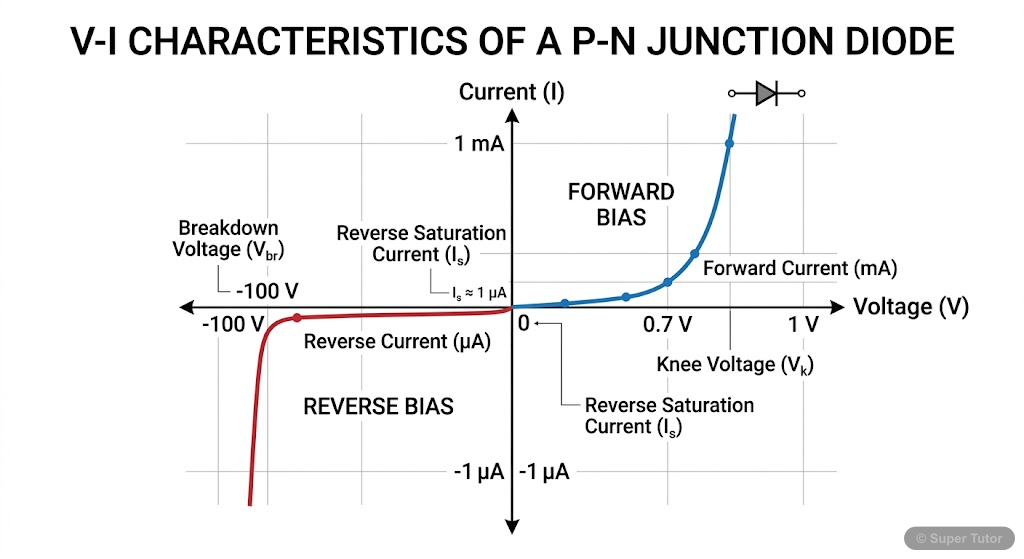
Learn better with visuals Super Tutor pairs illustrations like this with notes and quizzes for Electronics and Communication.
Quick Quiz: Electronics and Communication
0/4Tap an answer to check it instantly. No sign-up needed for these 4.
In an NPN transistor connected in common emitter configuration, the base current is 50 µA and the current gain β = 100. What is the collector current?
The forbidden energy gap for silicon at room temperature is 1.1 eV. What does this value tell us about silicon?
A silicon diode is forward biased with a supply voltage of 10 V and a series resistance of 1 kΩ. Taking the barrier potential of silicon as 0.7 V, what is the current through the circuit?
In a full wave rectifier, what is the efficiency compared to a half wave rectifier?
Sample Questions
For a transistor in common base configuration, α = 0.98 and IE = 2 mA. What is the base current IB?
Show answer
0.04 mA
Step 1: Find IC using the formula α = IC/IE. So IC = α × IE = 0.98 × 2 = 1.96 mA. Step 2: Apply Kirchhoff's current law: IE = IB + IC. Step 3: Rearrange: IB = IE − IC = 2 − 1.96 = 0.04 mA. Option B (1.96 mA) is the collector current, not base current. Option C (2.04 mA) is wrongly adding instead of subtracting. Option D uses incorrect formula.
A Zener diode has a breakdown voltage of 6 V. It is connected in a circuit with a series resistance of 500 Ω and an input voltage of 12 V. What is the current through the series resistor?
Show answer
12 mA
Step 1: In the Zener voltage regulator circuit, the Zener diode maintains a constant voltage equal to its breakdown voltage VZ = 6 V across itself (and the load). Step 2: Voltage across the series resistor = Input voltage − VZ = 12 − 6 = 6 V. Step 3: Current through series resistor I = V/R = 6/500 = 0.012 A = 12 mA. Option B (24 mA) uses full 12 V instead of the voltage drop across Rs. Option C (6 mA) uses 3 V as drop. Option D divides incorrectly.
Which of the following logic gate combinations is known as a 'Universal Gate' and can be used to construct ANY other logic gate?
Show answer
NAND gate alone or NOR gate alone
Step 1: A universal gate is one from which all other basic gates (AND, OR, NOT) can be constructed. Step 2: NAND gate: NOT = A NAND A, AND = (A NAND B) NAND (A NAND B), OR = (A NAND A) NAND (B NAND B). Similarly NOR can be used to make all basic gates. Step 3: AND + OR combination is insufficient because you cannot make a NOT gate from them alone. Ex-OR is a special purpose gate. NOT gate alone can only invert, cannot create AND or OR logic.
An LED is made of GaAsP semiconductor with a forbidden energy gap of 1.875 eV. What is the wavelength of light emitted? (h = 6.6 × 10⁻³⁴ J·s, c = 3 × 10⁸ m/s, 1 eV = 1.6 × 10⁻¹⁹ J)
Show answer
660 nm (Red light)
Step 1: Use the photon energy formula: Eg = hc/λ, so λ = hc/Eg. Step 2: Convert Eg to Joules: Eg = 1.875 × 1.6 × 10⁻¹⁹ = 3.0 × 10⁻¹⁹ J. Step 3: Calculate λ = (6.6 × 10⁻³⁴ × 3 × 10⁸) / (3.0 × 10⁻¹⁹) = 19.8 × 10⁻²⁶ / 3.0 × 10⁻¹⁹ = 6.6 × 10⁻⁷ m = 660 nm. Step 4: 660 nm falls in the red region of the visible spectrum. Option B (330 nm) results from forgetting to convert eV to J. Option C doubles the wavelength. Option D is the green region (~550 nm) corresponding to a different energy gap.
+83 more questions on Electronics and Communication (Tamil Nadu Board Class 12 Physics)
Practise AllFrequently Asked Questions
What are the important topics in Electronics and Communication for Tamil Nadu Board Class 12 Physics?
How many practice questions are there for Electronics and Communication?
Sources & Official References
Content is aligned to the official syllabus. Refer to the board website for the latest curriculum.
More resources for Electronics and Communication
For serious students
Get the full Electronics and Communication chapter — start free.
Quizzes, flashcards, an AI doubt solver and a study plan for Tamil Nadu Board Class 12 Physics. Free to start, no card needed.