Electrostatics — Practice Quiz
Tamil Nadu Board · Class 12 · Physics
Try a 4-question quiz on Electrostatics for Tamil Nadu Board Class 12 Physics: tap an answer to check it and see why.
Interactive on Super Tutor
Studying Electrostatics? Get the full interactive chapter.
Quizzes, flashcards, AI doubt-solver and a step-by-step study plan — built for practice quiz and more.
Free trial, no card needed.
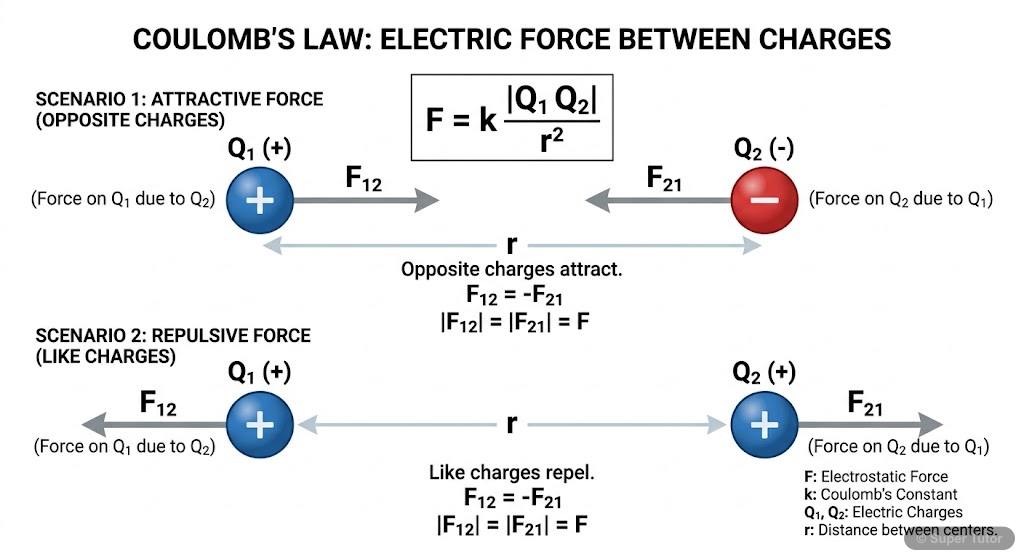
An illustration from Super Tutor's Electrostatics chapter — alongside flashcards, concept maps and practice questions.
Quick Quiz: Electrostatics
0/4Tap an answer to check it instantly. No sign-up needed for these 4.
Two point charges +4 μC and -1 μC are placed 3 m apart. At what point on the line joining them (measured from the +4 μC charge) is the electric field zero?
A parallel plate capacitor of capacitance C₀ is charged to potential V₀ and then disconnected from the battery. A dielectric slab of dielectric constant εᵣ = 4 is inserted to fill the space completely. What is the ratio of the new electrostatic energy to the original energy?
Three identical charges q = +2 μC are placed at the corners of an equilateral triangle of side 1 m. What is the magnitude of the resultant electric force on any one charge? (k = 9×10⁹ Nm²C⁻²)
An electric dipole of dipole moment p = 5×10⁻²⁹ Cm is placed in a uniform electric field E = 10⁴ NC⁻¹. The dipole is initially aligned anti-parallel to the field. What is the work done to rotate it to be parallel to the field?
Sample Questions
A spherical conducting shell of radius R carries a surface charge density σ. A point charge +q is placed at its centre. What is the electric field at a point just outside the shell? (Given: total charge on shell = Q)
Show answer
(Q + q)/(4πε₀R²) directed outward
Step 1: Apply Gauss's law using a spherical Gaussian surface of radius r just greater than R. Step 2: The enclosed charge = charge on shell (Q) + point charge at centre (q) = Q + q. Step 3: By Gauss's law: E × 4πr² = (Q + q)/ε₀. Step 4: As r → R: E = (Q + q)/(4πε₀R²). Step 5: The shell does NOT shield the field outside — Gauss's law considers all enclosed charges. Option (a) is wrong because σ/ε₀ ignores the interior charge. Option (c) ignores the shell charge.
The electric potential in a region is given by V = 6x² - 4y, where V is in volts and x, y are in metres. What is the electric field vector at the point (1, 2)?
Show answer
(-12î + 4ĵ) NC⁻¹
Step 1: Use E⃗ = -(∂V/∂x î + ∂V/∂y ĵ). Step 2: ∂V/∂x = 12x. At x=1: ∂V/∂x = 12. Step 3: ∂V/∂y = -4 (constant, independent of y). Step 4: E⃗ = -(12î + (-4)ĵ) = -12î + 4ĵ NC⁻¹. Step 5: Option (b) is wrong because it forgets the negative sign. Option (c) is wrong in the ĵ component sign. Electric field always points in the direction of decreasing potential.
Consider the Gauss's law statement: 'The net electric flux through any closed surface equals Q_enclosed/ε₀.' Which of the following is the CORRECT interpretation?
Show answer
The net flux depends only on enclosed charges; E on the surface is due to all charges.
Step 1: Gauss's law states ∮E⃗·dA⃗ = Q_enclosed/ε₀. Step 2: The E in the surface integral is the TOTAL electric field, contributed by ALL charges (inside and outside the surface). Step 3: However, the NET flux (the closed surface integral) depends ONLY on the enclosed charge — contributions from outside charges cancel perfectly. Step 4: Option (a) is a very common misconception — E itself is from all sources. Step 5: Option (c) is wrong — Gauss's law is universal, but it's most USEFUL for symmetric charge configurations. Option (d) is wrong — the shape doesn't affect total flux.
A capacitor of capacitance 8 μF is charged to 200 V. It is then connected in parallel to an uncharged capacitor of capacitance 4 μF. What is the common potential and the loss of energy after connection?
Show answer
V = 133.3 V, ΔU = 8.9×10⁻² J
Step 1: Initial charge Q = C₁V = 8×10⁻⁶ × 200 = 1600×10⁻⁶ C = 1.6×10⁻³ C. Step 2: Common potential V_common = Q/(C₁+C₂) = 1.6×10⁻³/(8+4)×10⁻⁶ = 1.6×10⁻³/12×10⁻⁶ = 133.3 V. Step 3: Initial energy U_i = ½C₁V² = ½×8×10⁻⁶×(200)² = 0.16 J. Step 4: Final energy U_f = ½(C₁+C₂)V_c² = ½×12×10⁻⁶×(133.3)² ≈ 0.1067 J. Step 5: Energy loss ΔU = 0.16 - 0.1067 ≈ 0.053 J... Recalculation: ΔU = C₁C₂(V₁-V₂)²/[2(C₁+C₂)] = 8×4×10⁻¹²×(200)²/(2×12×10⁻⁶) = 6400×10⁻¹²×40000/24×10⁻⁶ = 8.89×10⁻² J. Energy is lost as heat during charge redistribution.
+41 more questions on Electrostatics (Tamil Nadu Board Class 12 Physics)
Practise AllFrequently Asked Questions
What are the important topics in Electrostatics for Tamil Nadu Board Class 12 Physics?
How many practice questions are there for Electrostatics?
Sources & Official References
Content is aligned to the official syllabus. Refer to the board website for the latest curriculum.
More resources for Electrostatics
Important Questions
Exam-style questions with answers
Revision Notes
Key points for last-minute revision
Formula Sheet
The chapter's formulas in one place
Chapter Summary
Understand the chapter at a glance
Concept Maps
See how topics connect
Flashcards
Quick-fire cards for active recall
Syllabus
What topics to cover
For serious students
Get the full Electrostatics chapter — start free.
Quizzes, flashcards, an AI doubt solver and a study plan for Tamil Nadu Board Class 12 Physics. Free to start, no card needed.