Current Electricity — Flashcards
Tamil Nadu Board · Class 12 · Physics
30 flashcards for Current Electricity (Tamil Nadu Board Class 12 Physics) to test yourself on key terms and facts.
Interactive on Super Tutor
Studying Current Electricity? Get the full interactive chapter.
Quizzes, flashcards, AI doubt-solver and a step-by-step study plan — built for flashcards and more.
Free trial, no card needed.
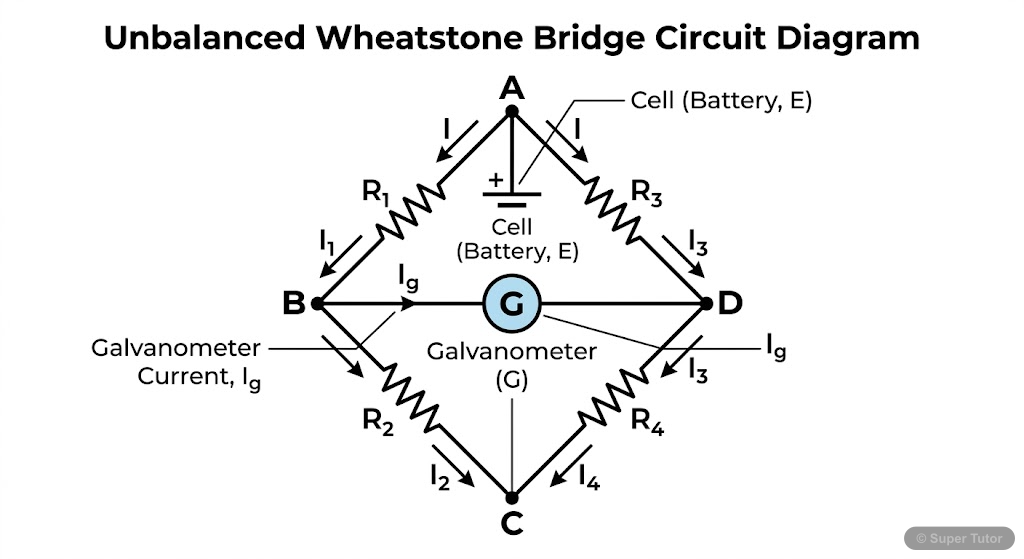
Learn better with visuals Super Tutor pairs illustrations like this with notes and quizzes for Current Electricity.
Define electric current and state its SI unit. What does 1 ampere represent?
Answer
Electric current (I) is defined as the rate of flow of electric charge through a cross-sectional area of a conductor. It is given by I = dQ/dt. SI unit: Ampere (A). 1 Ampere = 1 Coulomb/1 second. This…
A charge of 120 C flows through a copper wire in 1 minute. Calculate the electric current.
Answer
Given: Charge (Q) = 120 C, Time (t) = 1 minute = 60 seconds. Using formula: I = Q/t. Step 1: I = 120 C / 60 s. Step 2: I = 2 C/s. Step 3: I = 2 A. Answer: The electric current is 2 amperes.
What is the difference between conventional current and electron flow? Why do they flow in opposite directions?
Answer
Conventional current flows from the positive terminal to the negative terminal of a battery (direction a positive charge would move). Electron flow is the actual movement of electrons from the negativ…
What is drift velocity? Why is the drift velocity of electrons in a typical wire very small (~10⁻⁴ m/s) yet lights glow immediately when you switch on a circuit?
Answer
Drift velocity is the average velocity acquired by free electrons in a conductor when subjected to an electric field. It is calculated as: vd = eτE/m, where e is electron charge, τ is mean free time, …
A copper wire of cross-sectional area 0.5 mm² carries a current of 0.2 A. If the free electron density in copper is 8.4 × 10²⁸ m⁻³, calculate the drift velocity of free electrons.
Answer
Given: Cross-sectional area (A) = 0.5 mm² = 0.5 × 10⁻⁶ m², Current (I) = 0.2 A, Free electron density (n) = 8.4 × 10²⁸ m⁻³, Electron charge (e) = 1.6 × 10⁻¹⁹ C. Using formula: vd = I/(neA). Step 1: vd…
State Ohm's Law in both microscopic and macroscopic forms.
Answer
Microscopic Form: J = σE, where J is current density (A/m²), σ is conductivity (S/m), and E is electric field (V/m). This relates current density to electric field in a material. Macroscopic Form: V =…
A potential difference of 12 V is applied across a 24 Ω resistor. Calculate the current through the resistor.
Answer
Given: Potential difference (V) = 12 V, Resistance (R) = 24 Ω. Using Ohm's Law: I = V/R. Step 1: I = 12 V / 24 Ω. Step 2: I = 0.5 A. Answer: The current through the resistor is 0.5 amperes.
Define electrical resistivity and resistance. How are they related? What are their SI units?
Answer
Resistance (R) is the opposition offered by a material to the flow of electric current through it. It depends on the material's nature, length, and cross-sectional area. Formula: R = ρl/A. Resistivity…
+22 more flashcards
Practise AllFrequently Asked Questions
What are the important topics in Current Electricity for Tamil Nadu Board Class 12 Physics?
How many flashcards are available for Current Electricity?
How should I revise Current Electricity for the Tamil Nadu Board Class 12 board exam?
Sources & Official References
Content is aligned to the official syllabus. Refer to the board website for the latest curriculum.
More resources for Current Electricity
Practice Quiz
Test yourself with a quick quiz
Important Questions
Exam-style questions with answers
Revision Notes
Key points for last-minute revision
Formula Sheet
The chapter's formulas in one place
Chapter Summary
Understand the chapter at a glance
Concept Maps
See how topics connect
Syllabus
What topics to cover
For serious students
Get the full Current Electricity chapter — start free.
Quizzes, flashcards, an AI doubt solver and a study plan for Tamil Nadu Board Class 12 Physics. Free to start, no card needed.