Probability — Chapter Summary
Tamil Nadu Board · Class 9 · Mathematics
Summary of Probability for Tamil Nadu Board Class 9 Mathematics. Part of the Tamil Nadu Board Class 9 Mathematics syllabus.
Interactive on Super Tutor
Studying Probability? Get the full interactive chapter.
Quizzes, flashcards, AI doubt-solver and a step-by-step study plan — built for chapter summary and more.
Free trial, no card needed.
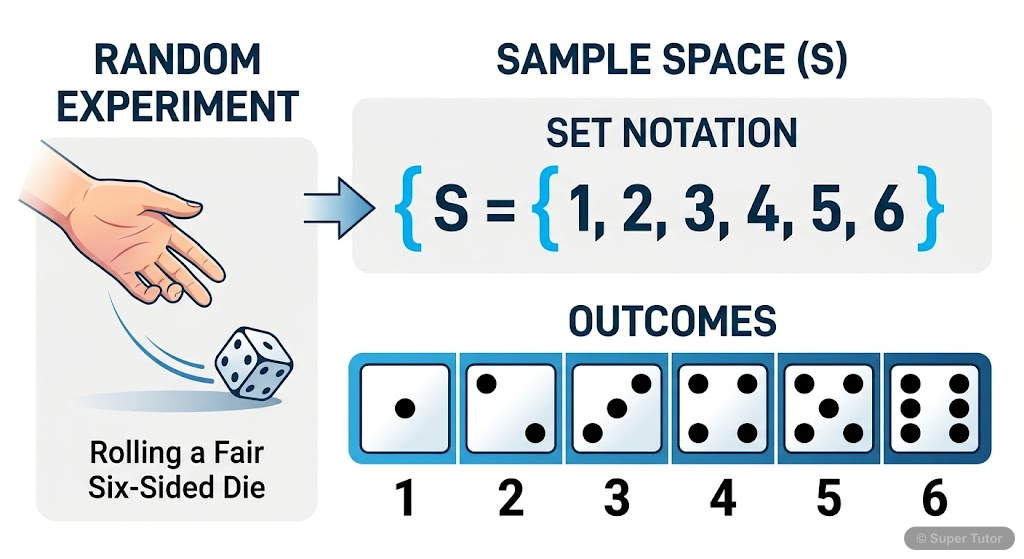
Learn better with visuals Super Tutor pairs illustrations like this with notes and quizzes for Probability.
Overview
Probability is the mathematical study of uncertainty and chance. It helps us quantify the likelihood of events occurring in our daily lives. From weather forecasts to medical treatments, sports predictions to quality control in manufacturing, probability plays a crucial role. In this chapter, we lea
Key Concepts
An experiment whose outcomes cannot be
An experiment whose outcomes cannot be predicted with certainty in advance, even when performed under identical conditions. Examples include rolling a
The set of all possible outcomes
The set of all possible outcomes of a random experiment. For a coin flip: S = {H, T}. For a single dice roll: S = {1, 2, 3, 4, 5, 6}. For two coins: S
Any subset of the sample space
Any subset of the sample space. It can be a single outcome or a combination of multiple outcomes. For example, when rolling a dice, getting an even nu
Also called theoretical probability
Also called theoretical probability, it calculates probability using the formula: P(E) = n(E)/n(S), where n(E) is the number of favorable outcomes and
Also called experimental or relative frequency
Also called experimental or relative frequency probability, it calculates probability based on actual experimental data using the formula: P(E) = r/n,
Learning Objectives
- Understand the basic concepts of probability including trials, outcomes, sample space, and events
- Learn the classical (theoretical) approach to calculating probability
- Learn the empirical (experimental) approach to calculating probability
- Distinguish between different types of events: equally likely, certain, impossible, mutually exclusive, and complementary
- Apply probability concepts to solve real-world problems
Frequently Asked Questions
What are the important topics in Probability for Tamil Nadu Board Class 9 Mathematics?
How should I revise Probability for Class 9 exams?
Sources & Official References
Content is aligned to the official syllabus. Refer to the board website for the latest curriculum.
More resources for Probability
For serious students
Get the full Probability chapter — start free.
Quizzes, flashcards, an AI doubt solver and a study plan for Tamil Nadu Board Class 9 Mathematics. Free to start, no card needed.