Chapter 9 of 9
Revision Notes
Probability — Revision Notes
Tamil Nadu Board · Class 9 · Mathematics
Probability revision notes for Tamil Nadu Board Class 9 Mathematics: 4 topics in quick points. Part of the Tamil Nadu Board Class 9 Mathematics syllabus.
44 questions28 flashcards5 formulas & key relations5 concepts
Interactive on Super Tutor
Studying Probability? Get the full interactive chapter.
Quizzes, flashcards, AI doubt-solver and a step-by-step study plan — built for revision notes and more.
Free trial, no card needed.
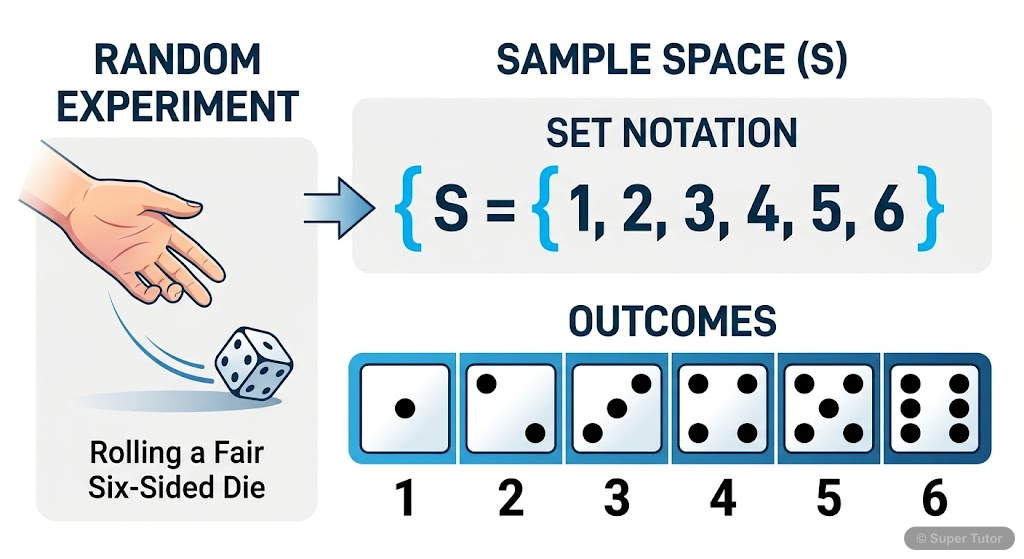
Super Tutor
Learn better with visuals Super Tutor pairs illustrations like this with notes and quizzes for Probability.
Key Topics to Revise
1
Basic Concepts and Terminology
- A random experiment is one whose outcome cannot be predicted in advance, even under identical conditions. Example: rolling a dice, flipping a coin.
- A deterministic experiment always gives the same result under identical conditions. Example: verifying Ohm's law.
- A trial is a single performance of a random experiment. Example: tossing a coin once.
2
Classical Approach to Probability
- Classical probability is used when all outcomes in the sample space are equally likely.
- The formula is: P(E) = Number of favourable outcomes / Total number of outcomes = n(E) / n(S).
- The probability of any event E always satisfies: 0 ≤ P(E) ≤ 1.
3
Empirical (Experimental) Approach to Probability
- Empirical probability is based on actual experiments and observations, not theoretical calculation.
- It is also called 'relative frequency' or 'experimental probability'.
- Formula: P(E) = r/n, where r = number of times event E occurred, n = total number of trials.
4
Types of Events
- Equally Likely Events: Two or more events that have the same probability of occurring. Example: Getting Head or Tail when tossing a fair coin.
- Sure (Certain) Event: An event that will definitely happen. P(E) = 1. Example: Getting a number between 1 and 6 when rolling a dice.
- Impossible Event: An event that can never happen. P(E) = 0. Example: Getting 7 on a standard dice.
Get complete notes with diagrams and examples
Full NotesKey Concepts
An experiment whose outcomes cannot beThe set of all possible outcomesAny subset of the sample spaceAlso called theoretical probabilityAlso called experimental or relative frequency
Frequently Asked Questions
What are the important topics in Probability for Tamil Nadu Board Class 9 Mathematics?
Key topics in Probability include Basic Concepts and Terminology, Classical Approach to Probability, Empirical (Experimental) Approach to Probability, Types of Events. Study these first, then practise questions on each for Class 9 exams.
How should I revise Probability for Class 9 exams?
Learn the core ideas first, then work through the 44 practice questions on Probability. Revise definitions regularly and use flashcards for quick recall before the exam.
Sources & Official References
Content is aligned to the official syllabus. Refer to the board website for the latest curriculum.
More resources for Probability
For serious students
Get the full Probability chapter — start free.
Quizzes, flashcards, an AI doubt solver and a study plan for Tamil Nadu Board Class 9 Mathematics. Free to start, no card needed.