Motion — Practice Quiz
Tamil Nadu Board · Class 9 · Science
Try a 4-question quiz on Motion for Tamil Nadu Board Class 9 Science: tap an answer to check it and see why. 44 questions in the full chapter test.
Interactive on Super Tutor
Studying Motion? Get the full interactive chapter.
Quizzes, flashcards, AI doubt-solver and a step-by-step study plan — built for practice quiz and more.
Free trial, no card needed.
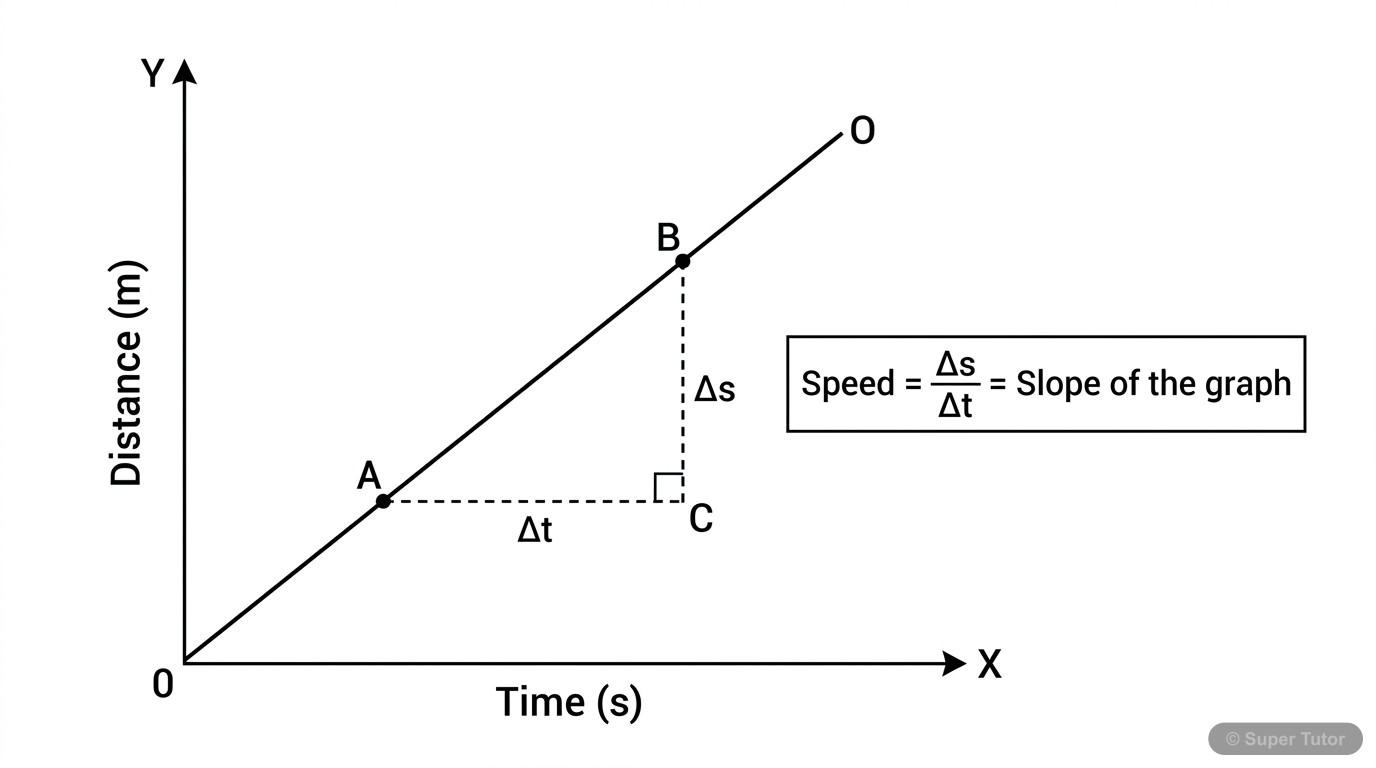
One of 3 illustrations for Motion in Super Tutor — alongside flashcards, concept maps and practice questions.
Quick Quiz: Motion
0/4Tap an answer to check it instantly. No sign-up needed for these 4.
A car starts from rest and accelerates uniformly at 4 ms⁻² for 5 seconds, then moves with uniform velocity for 10 seconds, and finally decelerates uniformly to rest in 4 seconds. What is the total distance covered by the car?
A velocity-time graph for a uniformly accelerated body is a straight line. The area of the trapezium formed under this graph between t=0 and t=T represents which physical quantity?
An object is thrown vertically upward with an initial velocity of 20 ms⁻¹. Taking g = 10 ms⁻², what is the displacement of the object after 3 seconds from the point of projection?
A stone tied to a string is whirled in a horizontal circle. If the speed of the stone is doubled while the radius of the circle remains the same, how does the centripetal force change?
Sample Questions
Which of the following correctly distinguishes between distance and displacement?
Show answer
Distance can never be zero if the body has moved; displacement can be zero even if the body has moved
Step 1: Distance is the total path length traveled, regardless of direction. It is a scalar quantity and always positive or zero. Step 2: Displacement is the shortest straight-line distance from the initial to the final position, and it is a vector quantity. Step 3: If a person walks in a circle and returns to the starting point, the distance traveled equals the circumference of the circle (non-zero), but displacement = 0 because initial and final positions are the same. Step 4: Distance can never decrease or be zero (unless no movement), while displacement CAN be zero after movement. Step 5:
From a velocity-time graph of a uniformly accelerated body, the acceleration can be calculated as:
Show answer
Slope of the velocity-time graph
Step 1: Acceleration is defined as the rate of change of velocity, i.e., a = Δv/Δt = (v-u)/t. Step 2: On a velocity-time graph, the Y-axis is velocity and the X-axis is time. The slope of any graph = change in Y / change in X. Step 3: Therefore, slope of v-t graph = Δv/Δt = acceleration. For uniform acceleration, this slope is constant and gives a straight line. Step 4: The area under the v-t graph gives displacement (not acceleration). Step 5: The slope of the distance-time graph gives speed. The ratio of total displacement to total time gives average velocity. These are commonly confused qua
A car accelerates from rest. In the first second it travels 10 m. Assuming uniform acceleration, what distance will it cover in the third second alone (not cumulative)?
Show answer
50 m
Step 1: The car starts from rest (u=0). In the first second, s = ½at² → 10 = ½×a×1² → a = 20 ms⁻². Step 2: Distance covered in 3 seconds total: s₃ = ½×20×9 = 90 m. Step 3: Distance covered in 2 seconds total: s₂ = ½×20×4 = 40 m. Step 4: Distance covered in the 3rd second ALONE = s₃ - s₂ = 90 - 40 = 50 m. Step 5: A key concept is that for uniform acceleration from rest, distances covered in successive seconds are in the ratio 1:3:5:7... (odd numbers). First second = 10 m, second second = 30 m, third second = 50 m – confirming our answer. Wrong options arise from confusing cumulative distance wi
An object moves in a circular path of radius 7 m with a uniform speed and completes one revolution in 11 seconds. What is the speed of the object? (Use π = 22/7)
Show answer
4 ms⁻¹
Step 1: For uniform circular motion, speed v = 2πr/T, where r is the radius and T is the time period for one revolution. Step 2: Given: r = 7 m, T = 11 s, π = 22/7. Step 3: v = 2 × (22/7) × 7 / 11 = 2 × 22 / 11 = 44/11 = 4 ms⁻¹. Step 4: Note that even though the speed is constant (uniform circular motion), the velocity direction keeps changing at every point, so this is still an accelerated motion. Step 5: Common mistake – students forget to multiply by 2 in 2πr (full circumference = 2πr, NOT πr). πr is only half the circumference. Option 2 ms⁻¹ results from using πr instead of 2πr.
+40 more questions on Motion (Tamil Nadu Board Class 9 Science)
Practise AllFrequently Asked Questions
What are the important topics in Motion for Tamil Nadu Board Class 9 Science?
How many practice questions are there for Motion?
Sources & Official References
Content is aligned to the official syllabus. Refer to the board website for the latest curriculum.
More resources for Motion
For serious students
Get the full Motion chapter — start free.
Quizzes, flashcards, an AI doubt solver and a study plan for Tamil Nadu Board Class 9 Science. Free to start, no card needed.