Motion — Chapter Summary
Tamil Nadu Board · Class 9 · Science
Summary of Motion for Tamil Nadu Board Class 9 Science. Key concepts: In physics, Distance is the actual length and Speed is the rate at.
Interactive on Super Tutor
Studying Motion? Get the full interactive chapter.
Quizzes, flashcards, AI doubt-solver and a step-by-step study plan — built for chapter summary and more.
Free trial, no card needed.
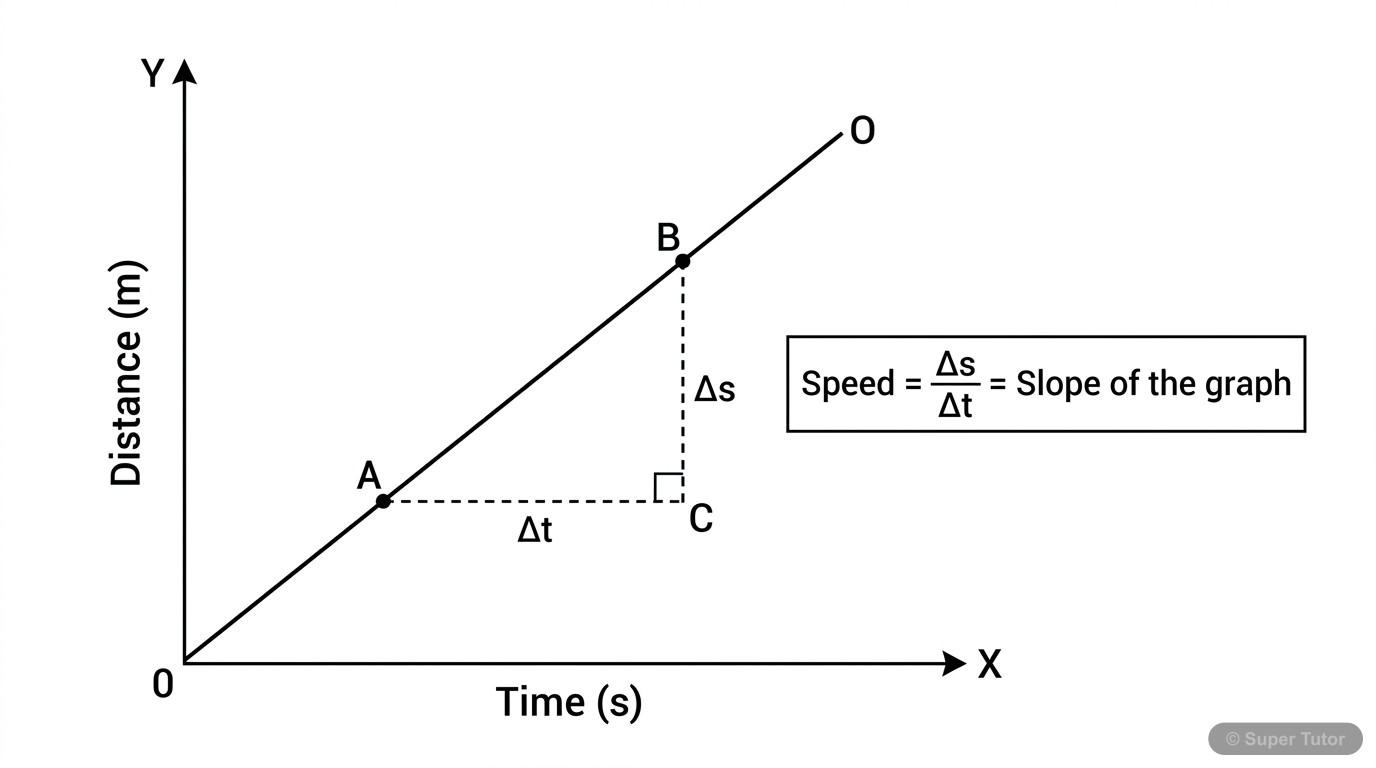
One of 3 illustrations for Motion in Super Tutor — alongside flashcards, concept maps and practice questions.
Overview
Motion is one of the fundamental concepts in physics that describes how objects change their position over time. Everything in the universe is in motion - from the smallest atoms to the largest celestial bodies. Even objects that appear stationary are actually moving because Earth itself is in const
Key Concepts
In physics
In physics, an object is at rest if it does not change its position relative to its surroundings, while an object is in motion if it continuously chan
Distance is the actual length
Distance is the actual length of the path traveled by a moving object, regardless of direction. It is always positive and is a scalar quantity (having
Speed is the rate at
Speed is the rate at which an object covers distance - it is distance traveled divided by time taken. Speed is a scalar quantity measured in meters pe
Acceleration is the rate of change
Acceleration is the rate of change of velocity - it measures how quickly velocity changes. Mathematically, acceleration = (Final velocity - Initial ve
Uniform motion occurs when an object
Uniform motion occurs when an object travels equal distances in equal intervals of time. In this type of motion, the velocity remains constant - neith
Learning Objectives
- Identify objects at rest and objects in motion, understanding motion as a relative phenomenon
- Distinguish between distance and displacement with clear examples and calculations
- Understand and calculate distance covered by objects on circular paths
- Classify motion into uniform and non-uniform types with real-world examples
- Differentiate between speed and velocity, recognizing scalar and vector quantities
Frequently Asked Questions
What are the important topics in Motion for Tamil Nadu Board Class 9 Science?
How should I revise Motion for Class 9 exams?
Sources & Official References
Content is aligned to the official syllabus. Refer to the board website for the latest curriculum.
More resources for Motion
For serious students
Get the full Motion chapter — start free.
Quizzes, flashcards, an AI doubt solver and a study plan for Tamil Nadu Board Class 9 Science. Free to start, no card needed.