Matter around us — Practice Quiz
Tamil Nadu Board · Class 9 · Science
Try a 4-question quiz on Matter around us for Tamil Nadu Board Class 9 Science: tap an answer to check it and see why.
Interactive on Super Tutor
Studying Matter around us? Get the full interactive chapter.
Quizzes, flashcards, AI doubt-solver and a step-by-step study plan — built for practice quiz and more.
Free trial, no card needed.
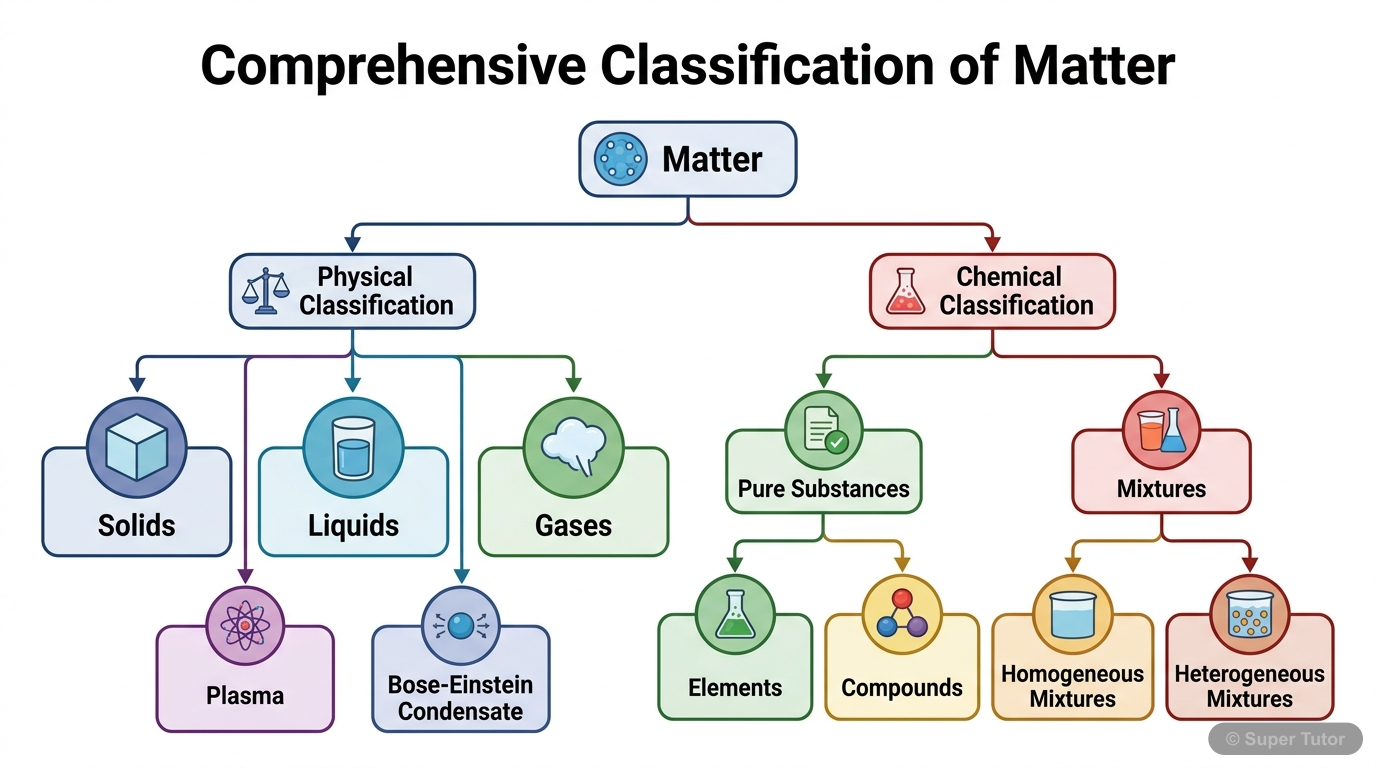
Learn better with visuals Super Tutor pairs illustrations like this with notes and quizzes for Matter around us.
Quick Quiz: Matter around us
0/4Tap an answer to check it instantly. No sign-up needed for these 4.
Which of the following is a pure substance?
Iron and sulphur are mixed together and then heated strongly. The black solid formed is iron sulphide. Which property correctly describes iron sulphide?
In which of the following methods is the principle of difference in boiling points used to separate a mixture?
Tyndall effect is observed in which type of solution?
Sample Questions
Brass is an alloy of approximately 70% copper and 30% zinc. Which category does brass belong to?
Show answer
Homogeneous mixture
Step 1: Brass is made by physically mixing copper and zinc metals together – no chemical reaction occurs. Step 2: Since it contains two different substances physically combined, it is a mixture. Step 3: In brass, copper and zinc are uniformly distributed throughout the alloy – you cannot see separate components. Step 4: A mixture with uniform composition throughout is called a homogeneous mixture. Step 5: Since the composition of brass can vary (it is not in a fixed ratio), and it can be physically separated, it is a homogeneous mixture (alloy), not a compound.
Which separation technique is best suited to separate cream from milk in a dairy?
Show answer
Centrifugation
Step 1: Cream and milk are not easily separated by simple filtration because cream particles are very fine and not trapped by filter paper. Step 2: Centrifugation uses a machine called a centrifuge that spins the mixture at very high speed. Step 3: Due to centrifugal force, the denser components (milk) move outward and settle at the bottom, while lighter cream rises to the top. Step 4: This allows easy separation of cream from milk. Step 5: This same principle is used in washing machines to remove water from wet clothes and in labs to separate blood cells from plasma.
The particle size of colloidal particles falls in which range?
Show answer
1 nm to 100 nm
Step 1: Solutions are classified based on the particle size of the solute dissolved in them. Step 2: True solutions have the smallest particles – less than 1 nm – and appear transparent. Step 3: Colloidal solutions have particles between 1 nm and 100 nm – they appear translucent or semi-transparent. Step 4: Suspensions have the largest particles – greater than 100 nm – they appear opaque and particles settle on standing. Step 5: The particle size of colloids (1–100 nm) is large enough to scatter light (Tyndall effect) but small enough to not settle under gravity.
Paper chromatography is used to separate components of a mixture based on which property?
Show answer
Difference in solubility of components in the same solvent
Step 1: In paper chromatography, a spot of the mixture (e.g., black ink) is placed on chromatography paper. Step 2: The paper is placed in a solvent which slowly moves up the paper by capillary action. Step 3: Different components of the mixture have different solubility in the solvent, so they travel different distances up the paper. Step 4: The more soluble component moves farther up, while the less soluble component stays closer to the starting spot. Step 5: This separates the mixture into its components, showing, for example, that black ink contains multiple dyes of different colours.
+41 more questions on Matter around us (Tamil Nadu Board Class 9 Science)
Practise AllFrequently Asked Questions
What are the important topics in Matter around us for Tamil Nadu Board Class 9 Science?
How many practice questions are there for Matter around us?
Sources & Official References
Content is aligned to the official syllabus. Refer to the board website for the latest curriculum.
More resources for Matter around us
For serious students
Get the full Matter around us chapter — start free.
Quizzes, flashcards, an AI doubt solver and a study plan for Tamil Nadu Board Class 9 Science. Free to start, no card needed.