Cellular Organelles — Study Plan
CBSE · Class 11 · Biotechnology
A step-by-step study plan for Cellular Organelles, CBSE Class 11 Biotechnology: what to learn first, what to practise and when to revise.
Interactive on Super Tutor
Studying Cellular Organelles? Get the full interactive chapter.
Quizzes, flashcards, AI doubt-solver and a step-by-step study plan — built for study plan and more.
Free trial, no card needed.
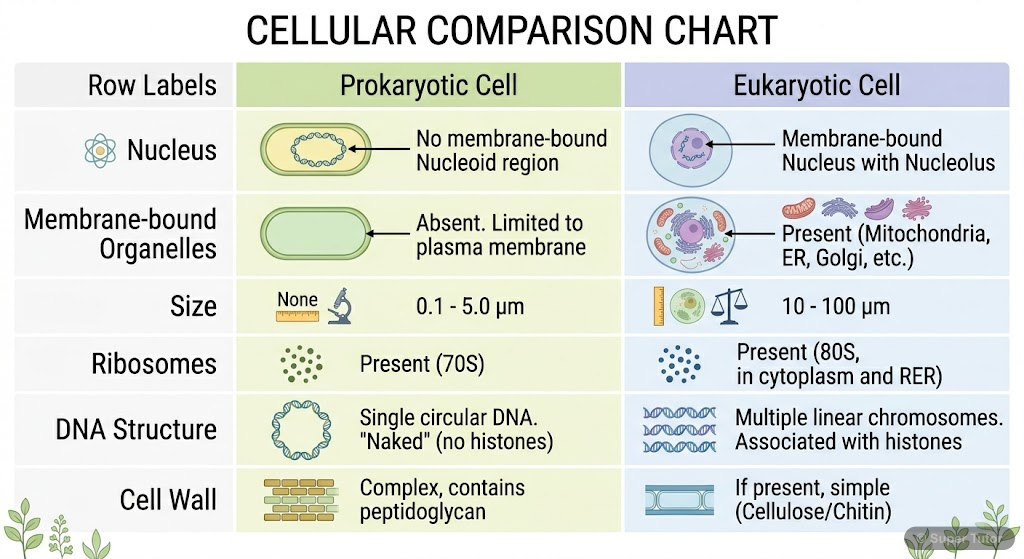
One of 2 illustrations for Cellular Organelles in Super Tutor — alongside flashcards, concept maps and practice questions.
Study Plan
Learn the Theory
Read the textbook chapter carefully. Note down definitions, formulas and key ideas. Focus on: 1. Plasma Membrane, 2. Cell Wall, 3. Endomembrane System.
Practise
Solve the textbook exercises and extra practice questions. There are 93 questions available for this chapter.
Revise & Test
Revise key points without looking at your notes. Take a practice quiz and mark weak areas for another pass.
Spaced Revision
Come back to Cellular Organelles after a week. Use flashcards for quick recall and try past exam questions on this chapter.
What to Focus On
- Plasma membrane is selectively permeable.
- Fluid Mosaic Model was proposed by Singer and Nicolson in 1972.
- Phospholipid bilayer gives the membrane its basic structure.
- Cell wall is absent in animal cells.
- Bacterial wall contains peptidoglycan cross-linked by tetrapeptides.
- Antibiotics can inhibit peptidoglycan cross-linking.
- Endomembrane system includes ER, Golgi complex, lysosomes, and vacuole.
- ER is present only in eukaryotic cells.
- RER has ribosomes; SER lacks ribosomes.
Common Mistakes to Avoid
The plasma membrane and cell wall are the same structure.
The fluid mosaic model means the membrane is solid and fixed in place.
Facilitated diffusion, symport, antiport, and active transport all mean the same thing.
Memory Tips
Fluid Mosaic Model of plasma membrane
Plasma membrane composition varies in different cells
Peripheral and integral membrane proteins
Mesosomes increase membrane surface area
Want a personalised study plan?
Super Tutor builds a day-by-day plan for CBSE Class 11 Biotechnology that fits your exam date and pace.
Create My Study PlanFrequently Asked Questions
What are the important topics in Cellular Organelles for CBSE Class 11 Biotechnology?
How should I revise Cellular Organelles for Class 11 exams?
Sources & Official References
- NCERT Official — ncert.nic.in
- CBSE Academic — cbseacademic.nic.in
- CBSE Official — cbse.gov.in
- National Education Policy 2020 — education.gov.in
Content is aligned to the official syllabus. Refer to the board website for the latest curriculum.
More resources for Cellular Organelles
Practice Quiz
Test yourself with a quick quiz
Important Questions
Exam-style questions with answers
Revision Notes
Key points for last-minute revision
Chapter Summary
Understand the chapter at a glance
Concept Maps
See how topics connect
Flashcards
Quick-fire cards for active recall
Syllabus
What topics to cover
NCERT Solutions
Every textbook question solved step by step
For serious students
Get the full Cellular Organelles chapter — start free.
Quizzes, flashcards, an AI doubt solver and a study plan for CBSE Class 11 Biotechnology. Free to start, no card needed.