Cellular Organelles — Chapter Summary
CBSE · Class 11 · Biotechnology
Summary of Cellular Organelles for CBSE Class 11 Biotechnology. Part of the CBSE Class 11 Biotechnology syllabus.
Interactive on Super Tutor
Studying Cellular Organelles? Get the full interactive chapter.
Quizzes, flashcards, AI doubt-solver and a step-by-step study plan — built for chapter summary and more.
Free trial, no card needed.
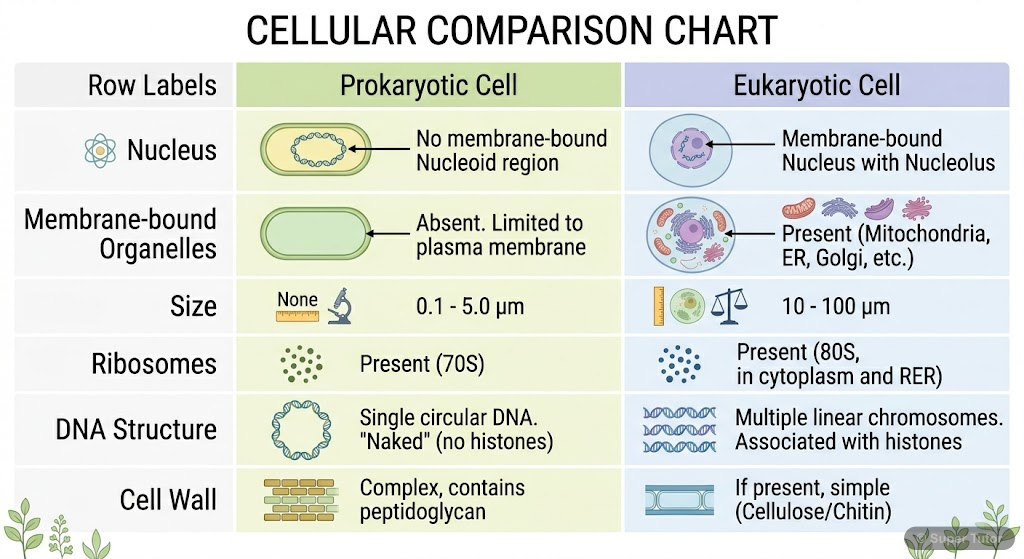
One of 2 illustrations for Cellular Organelles in Super Tutor — alongside flashcards, concept maps and practice questions.
Overview
Cellular organelles are specialised structures inside cells that perform specific functions needed for life. Prokaryotic cells lack an organised nucleus and membrane-bound organelles, while eukaryotic cells have a well-defined nucleus and many membranous organelles. The plasma membrane, cell wall, e
Key Concepts
The plasma membrane forms the boundary
The plasma membrane forms the boundary of the cytoplasm and is selectively permeable. The Fluid Mosaic Model proposed by Seymour Jonathan Singer and G
Small molecules may move passively by
Small molecules may move passively by diffusion and osmosis. Facilitated movement uses carrier proteins or channel proteins. Active transport needs AT
The cell wall is found
The cell wall is found in bacteria, algae, fungi, and higher plants, but not in animal cells. Bacterial cell wall is made of polysaccharide chains cro
The endomembrane system includes the endoplasmic
The endomembrane system includes the endoplasmic reticulum, Golgi complex, lysosomes, and vacuoles. These organelles work together in synthesis, modif
ER is present only in eukaryotic
ER is present only in eukaryotic cells. Rough ER has ribosomes on its cytosolic surface and helps in protein synthesis and transport. Smooth ER lacks
Learning Objectives
- Understand the basic difference between prokaryotic and eukaryotic cell organisation.
- Describe the structure and functions of the plasma membrane and cell wall.
- Explain the endomembrane system and the roles of ER, Golgi apparatus, lysosomes, and vacuoles.
- Recognise the structure and function of mitochondria, plastids, ribosomes, microbodies, cytoskeleton, cilia and flagella, centrosome and centrioles, nucleus, and chromosomes.
- Relate the structure of organelles to their functions in the cell.
Frequently Asked Questions
What are the important topics in Cellular Organelles for CBSE Class 11 Biotechnology?
How should I revise Cellular Organelles for Class 11 exams?
Sources & Official References
- NCERT Official — ncert.nic.in
- CBSE Academic — cbseacademic.nic.in
- CBSE Official — cbse.gov.in
- National Education Policy 2020 — education.gov.in
Content is aligned to the official syllabus. Refer to the board website for the latest curriculum.
More resources for Cellular Organelles
Practice Quiz
Test yourself with a quick quiz
Important Questions
Exam-style questions with answers
Revision Notes
Key points for last-minute revision
Concept Maps
See how topics connect
Study Plan
Step-by-step plan for this chapter
Flashcards
Quick-fire cards for active recall
Syllabus
What topics to cover
NCERT Solutions
Every textbook question solved step by step
For serious students
Get the full Cellular Organelles chapter — start free.
Quizzes, flashcards, an AI doubt solver and a study plan for CBSE Class 11 Biotechnology. Free to start, no card needed.