Chapter 2 of 12
NCERT Solutions

Cellular Organelles

CBSE · Class 11 · Biotechnology

NCERT Solutions for Cellular Organelles — CBSE Class 11 Biotechnology.

5 concepts

Interactive on Super Tutor

Studying Cellular Organelles? Get the full interactive chapter.

Quizzes, flashcards, AI doubt-solver and a step-by-step study plan — built for ncert solutions and more.

1,000+ Class 11 students started this chapter today

13 Questions Solved · 1 Section

EXERCISES — Cellular Organelles

1The Fluid Mosaic Model has been proposed by
(a) Robert Brown
(b) Schleiden and Schwann
(c) Robert Virchow
(d) Singer and Nicolson
Show solution
Correct Option: (d) Singer and Nicolson

The Fluid Mosaic Model of the plasma membrane was proposed by S.J. Singer and G.L. Nicolson in 1972. According to this model, the membrane is a fluid phospholipid bilayer in which proteins are embedded (like a mosaic), and both lipids and proteins can move laterally. Robert Brown discovered the nucleus; Schleiden and Schwann proposed the Cell Theory; Virchow proposed 'Omnis cellula e cellula'.
2Ribosomes are composed of
(a) only rRNA
(b) rRNA and proteins
(c) rRNA, proteins and DNA
(d) lipids, proteins and DNA
Show solution
Correct Option: (b) rRNA and proteins

Ribosomes are ribonucleoprotein particles composed of ribosomal RNA (rRNA) and proteins. They do not contain DNA or lipids. Each ribosome consists of two subunits (large and small), both made of rRNA molecules associated with specific ribosomal proteins. They are the sites of protein synthesis in the cell.
3Tonoplast is
(a) a membrane covering the cell wall in plant cells
(b) the inner membrane of the mitochondria
(c) a membrane covering the vacuoles
(d) a membrane covering the plastids
Show solution
Correct Option: (c) a membrane covering the vacuoles

The tonoplast is the single membrane that surrounds the central vacuole in plant cells. It regulates the movement of ions and molecules between the vacuole and the cytoplasm, thereby maintaining turgor pressure and playing a key role in osmoregulation.
4Describe the various mechanisms of transport across plasma membrane with the help of labelled diagrams.Show solution
Transport Across the Plasma Membrane

The plasma membrane is selectively permeable and regulates the movement of substances into and out of the cell. The major mechanisms are:

---

I. Passive Transport (No energy/ATP required; movement along concentration gradient)

(a) Simple Diffusion:
- Small, non-polar molecules (O₂, CO₂, ethanol) move directly through the lipid bilayer from a region of higher concentration to lower concentration.
- Formula for net flux: J=Dd[C]dxJ = -D \frac{d[C]}{dx} (Fick's Law)

(b) Facilitated Diffusion:
- Polar or charged molecules (glucose, amino acids, ions) cannot cross the lipid bilayer directly.
- They move through specific channel proteins (form pores) or carrier proteins (undergo conformational change).
- Movement is still along the concentration gradient; no ATP is needed.
- Example: Glucose transport into red blood cells via GLUT transporters.

(c) Osmosis:
- Movement of water molecules across a selectively permeable membrane from a region of higher water potential (lower solute concentration) to a region of lower water potential (higher solute concentration).
- Water potential: Ψ=Ψs+Ψp\Psi = \Psi_s + \Psi_p

---

II. Active Transport (Requires energy/ATP; movement against concentration gradient)

- Substances move from lower to higher concentration using energy (ATP) and specific carrier proteins (pumps).
- Example: Sodium-Potassium pump (Na⁺/K⁺-ATPase) — pumps 3 Na⁺ out and 2 K⁺ into the cell per ATP molecule hydrolysed.

---

III. Bulk Transport (for large molecules/particles)

(a) Endocytosis: Cell engulfs external material by infolding of the plasma membrane.
- Phagocytosis ('cell eating'): Engulfment of solid particles (e.g., bacteria by macrophages).
- Pinocytosis ('cell drinking'): Engulfment of liquid droplets.
- Receptor-mediated endocytosis: Specific molecules bind to receptors on the membrane surface, triggering vesicle formation.

(b) Exocytosis: Vesicles fuse with the plasma membrane and release their contents outside the cell (e.g., secretion of hormones, neurotransmitters).

---

Summary Table:

| Mechanism | Energy Required | Direction | Example |
|---|---|---|---|
| Simple Diffusion | No | High → Low conc. | O₂, CO₂ |
| Facilitated Diffusion | No | High → Low conc. | Glucose |
| Osmosis | No | High → Low water potential | Water |
| Active Transport | Yes (ATP) | Low → High conc. | Na⁺/K⁺ pump |
| Endocytosis | Yes | Into cell | Phagocytosis |
| Exocytosis | Yes | Out of cell | Hormone secretion |

*(Note: Labelled diagrams should show the lipid bilayer with embedded proteins, arrows indicating direction of movement, and vesicle formation for bulk transport.)*
5Match the following:
Column I — Column II
(a) Nucleolus — (i) Alcohol detoxification
(b) Mesosome — (ii) Infoldings of inner mitochondrial membrane
(c) Vacuoles — (iii) Protein synthesis
(d) Cristae — (iv) Disc shaped sacs in Golgi
(e) Ribosomes — (v) rRNA synthesis
(f) Thylakoid — (vi) Membranous extensions of plasma membrane
(g) Peroxisomes — (vii) Storage and structural support
(h) Cisternae — (viii) Membranous sacs in chloroplast
Show solution
Correct Matching:

| Column I | Column II |
|---|---|
| (a) Nucleolus | (v) rRNA synthesis |
| (b) Mesosome | (vi) Membranous extensions of plasma membrane |
| (c) Vacuoles | (vii) Storage and structural support |
| (d) Cristae | (ii) Infoldings of inner mitochondrial membrane |
| (e) Ribosomes | (iii) Protein synthesis |
| (f) Thylakoid | (viii) Membranous sacs in chloroplast |
| (g) Peroxisomes | (i) Alcohol detoxification |
| (h) Cisternae | (iv) Disc shaped sacs in Golgi |

Brief Justifications:
- Nucleolus: Site of rRNA transcription and ribosome assembly.
- Mesosome: Infoldings/extensions of the plasma membrane in prokaryotes; involved in cell wall formation and DNA segregation.
- Vacuoles: Store water, ions, nutrients; provide structural support (turgor).
- Cristae: Shelf-like infoldings of the inner mitochondrial membrane; increase surface area for oxidative phosphorylation.
- Ribosomes: Translate mRNA into proteins.
- Thylakoid: Flattened membranous sacs in chloroplasts; site of light reactions of photosynthesis.
- Peroxisomes: Contain oxidative enzymes; involved in detoxification of alcohol and other harmful substances.
- Cisternae: Flattened, disc-shaped membranous sacs stacked in the Golgi apparatus.
6What is the significance of the ratio of protein and lipids in membranes? How does varying the concentration of lipids in a membrane affect its function?Show solution
Significance of Protein : Lipid Ratio in Membranes:

The ratio of proteins to lipids in a membrane varies depending on the type of membrane and its function:

- Myelin sheath (electrically insulating): ~80% lipid, ~20% protein — high lipid content provides insulation.
- Plasma membrane: ~50% lipid, ~50% protein — balanced for selective permeability and signalling.
- Inner mitochondrial membrane: ~25% lipid, ~75% protein — high protein content due to numerous enzyme complexes (ETC, ATP synthase) needed for oxidative phosphorylation.

General Significance:
1. Proteins serve as channels, carriers, receptors, enzymes, and structural anchors. A higher protein content increases the membrane's functional capacity (transport, signalling, catalysis).
2. Lipids (mainly phospholipids and cholesterol) form the structural bilayer, determine fluidity, and act as a barrier to polar molecules.
3. The ratio thus determines the permeability, fluidity, and functional specialisation of the membrane.

Effect of Varying Lipid Concentration:

1. Increased lipid (especially cholesterol) concentration:
- Increases membrane rigidity and decreases fluidity at higher temperatures.
- Reduces permeability to small polar molecules.
- Cholesterol acts as a 'fluidity buffer' — prevents membranes from becoming too rigid at low temperatures or too fluid at high temperatures.

2. Decreased lipid concentration:
- Membrane becomes more fluid and permeable.
- Structural integrity is compromised.
- Transport of non-polar molecules may increase, but selective permeability is lost.
- The membrane may become leaky, disrupting ion gradients essential for cellular functions (e.g., nerve impulse transmission, ATP synthesis).

Conclusion: The protein-to-lipid ratio is a key determinant of membrane identity and function. Any alteration in lipid concentration directly impacts membrane fluidity, permeability, and the ability to carry out specialised functions.
7State the importance of cell wall in prokaryotic cells.Show solution
Importance of Cell Wall in Prokaryotic Cells:

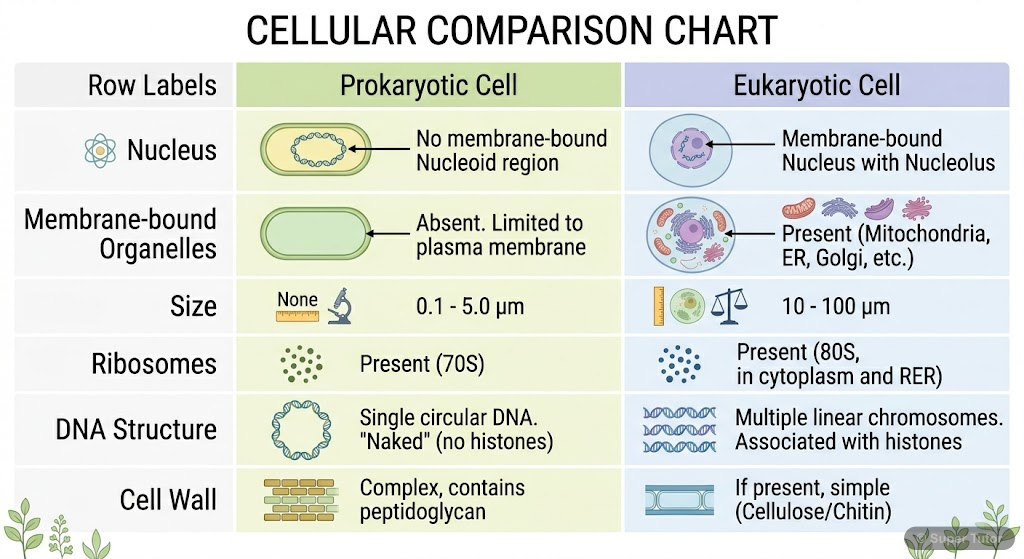
Prokaryotic cells (bacteria) possess a rigid cell wall, primarily composed of peptidoglycan (murein) — a polymer of sugars (NAG and NAM) cross-linked by short peptide chains.

Functions:

1. Mechanical Protection: The cell wall provides a rigid framework that protects the cell from physical damage and mechanical stress.

2. Osmotic Protection: It prevents the cell from bursting (lysis) due to osmotic pressure when the cell is in a hypotonic environment. The wall withstands the turgor pressure generated by water entering the cell.

3. Maintenance of Cell Shape: The cell wall gives the bacterium its characteristic shape (cocci, bacilli, spirilla), which is important for its identification and function.

4. Protection from Harmful Substances: It acts as a selective barrier, preventing entry of certain toxic molecules and large enzymes.

5. Role in Cell Division: The cell wall participates in septum formation during binary fission, ensuring proper division of daughter cells.

6. Pathogenicity and Virulence: The cell wall components (e.g., lipopolysaccharides in Gram-negative bacteria) can act as antigens and are involved in the pathogenic mechanisms of bacteria.

7. Target for Antibiotics: The unique composition of the prokaryotic cell wall (peptidoglycan absent in eukaryotes) makes it an ideal target for antibiotics like penicillin, which inhibit peptidoglycan synthesis without harming the host.

Note: Gram-positive bacteria have a thick peptidoglycan layer; Gram-negative bacteria have a thin peptidoglycan layer surrounded by an outer lipopolysaccharide membrane.
8A eukaryotic cell contains organelles which may be bound by a single-membrane; double-membrane or non-membrane bound organelles. Classify the various eukaryotic organelles into these three types.Show solution
Classification of Eukaryotic Organelles by Membrane Bound Status:

---

I. Double Membrane-Bound Organelles:
These organelles are enclosed by two phospholipid bilayers (outer and inner membrane).

| Organelle | Key Feature |
|---|---|
| Mitochondria | Inner membrane folded into cristae; site of cellular respiration |
| Chloroplasts | Inner membrane encloses stroma with thylakoids; site of photosynthesis |
| Nucleus | Outer membrane continuous with ER; contains genetic material |

---

II. Single Membrane-Bound Organelles:
These organelles are enclosed by a single phospholipid bilayer.

| Organelle | Key Feature |
|---|---|
| Endoplasmic Reticulum (ER) | Network of membranes; rough ER has ribosomes |
| Golgi Apparatus | Stack of cisternae; sorting and packaging of proteins |
| Lysosomes | Contain hydrolytic enzymes; intracellular digestion |
| Vacuoles | Storage; tonoplast is the bounding membrane |
| Peroxisomes | Contain oxidative enzymes; detoxification |
| Glyoxysomes | Contain glyoxylate cycle enzymes; fat metabolism |

---

III. Non-Membrane Bound Organelles:
These organelles lack a surrounding membrane.

| Organelle | Key Feature |
|---|---|
| Ribosomes | Made of rRNA and proteins; protein synthesis |
| Centrioles | Made of microtubules; involved in cell division |
| Cytoskeleton (microtubules, microfilaments, intermediate filaments) | Structural support and cell movement |
| Nucleolus | Within nucleus; rRNA synthesis (not membrane-bound itself) |
9Mention the different types of vacuoles.Show solution
Types of Vacuoles:

Vacuoles are membrane-bound (tonoplast) organelles filled with cell sap, water, or other substances. They are found in both plant and animal cells, though they are most prominent in plant cells.

1. Sap Vacuoles (Central Vacuoles):
- Found in mature plant cells.
- Occupy up to 90% of the cell volume.
- Contain cell sap (water, dissolved salts, sugars, pigments, waste products).
- Maintain turgor pressure, which provides rigidity to the plant.

2. Contractile Vacuoles:
- Found in freshwater protists (e.g., *Amoeba*, *Paramecium*).
- Function in osmoregulation — they collect excess water from the cytoplasm and expel it outside the cell by rhythmic contraction.

3. Food Vacuoles:
- Formed during phagocytosis when a cell engulfs food particles.
- The food vacuole fuses with lysosomes for intracellular digestion.
- Found in protists like *Amoeba* and in some white blood cells (macrophages).

4. Gas Vacuoles:
- Found in prokaryotes (cyanobacteria, some archaea).
- Filled with gas; provide buoyancy to aquatic prokaryotes, allowing them to float at optimal depths for light absorption.

5. Autophagic Vacuoles:
- Involved in the breakdown and recycling of damaged organelles and macromolecules within the cell (autophagy).
- Formed when a membrane surrounds a portion of the cytoplasm or an organelle.

Summary:

| Type | Location | Function |
|---|---|---|
| Sap/Central vacuole | Mature plant cells | Storage, turgor pressure |
| Contractile vacuole | Freshwater protists | Osmoregulation |
| Food vacuole | Protists, phagocytes | Intracellular digestion |
| Gas vacuole | Cyanobacteria | Buoyancy |
| Autophagic vacuole | Eukaryotic cells | Recycling of cell components |
10Peroxisomes share similarities as well as differences with mitochondria and chloroplast. Comment.Show solution
Peroxisomes vs. Mitochondria and Chloroplasts:

---

Similarities:

| Feature | Peroxisomes | Mitochondria | Chloroplasts |
|---|---|---|---|
| Membrane-bound | Yes | Yes | Yes |
| Involved in oxidation reactions | Yes | Yes | Yes (light reactions) |
| Contain enzymes | Yes | Yes | Yes |
| Present in eukaryotic cells | Yes | Yes | Yes |
| Involved in energy metabolism | Yes (indirectly) | Yes (ATP production) | Yes (ATP via photophosphorylation) |

Specific Similarity: All three organelles are involved in oxidative reactions within the cell. Peroxisomes use molecular oxygen to oxidise substrates (producing H₂O₂, which is then broken down by catalase). Mitochondria use oxygen in the electron transport chain. Chloroplasts produce oxygen during the light reactions.

---

Differences:

| Feature | Peroxisomes | Mitochondria | Chloroplasts |
|---|---|---|---|
| Number of membranes | Single membrane | Double membrane | Double membrane |
| Own DNA/ribosomes | No | Yes | Yes |
| Origin | ER or self-replication | Endosymbiotic (semi-autonomous) | Endosymbiotic (semi-autonomous) |
| Primary function | Oxidation and detoxification | ATP synthesis (cellular respiration) | Photosynthesis |
| By-product of oxidation | H₂O₂ (toxic, broken down by catalase) | H₂O | O₂ |
| Presence | All eukaryotic cells | All aerobic eukaryotic cells | Only plant cells and algae |
| Internal membrane system | Absent (no cristae/thylakoids) | Cristae (inner membrane folds) | Thylakoids and grana |
| Evolutionary origin | Not endosymbiotic | Endosymbiotic (from α-proteobacteria) | Endosymbiotic (from cyanobacteria) |

Conclusion: While peroxisomes, mitochondria, and chloroplasts all participate in oxidative metabolism, peroxisomes are structurally simpler (single membrane, no genome) and are not considered semi-autonomous organelles, unlike mitochondria and chloroplasts which have their own DNA, ribosomes, and endosymbiotic origin.
11What are glyoxysomes? Where are these present? Mention their functions.Show solution
Glyoxysomes:

Definition:
Glyoxysomes are specialised peroxisomes (a type of microbody) that contain the enzymes of the glyoxylate cycle in addition to the usual peroxisomal enzymes.

---

Location (Where are they present?):
- Glyoxysomes are found in the fat-storing tissues of germinating seeds (e.g., castor bean — *Ricinus communis*, sunflower seeds).
- They are particularly abundant in the endosperm and cotyledons of oil-rich seeds during germination.
- They are also found in some fungi and algae.
- They are absent in animal cells (animals cannot convert fats into carbohydrates).

---

Functions:

1. Fat (Lipid) Metabolism — Conversion of Fats to Carbohydrates:
- Glyoxysomes are the site of the glyoxylate cycle, which allows plants to convert stored fatty acids into sucrose (carbohydrates) during seed germination.
- This is critical because germinating seedlings need carbohydrates for energy and growth before photosynthesis begins.

2. β-Oxidation of Fatty Acids:
- Glyoxysomes carry out β-oxidation of fatty acids, breaking them down into acetyl-CoA units.
- These acetyl-CoA units then enter the glyoxylate cycle.

3. Glyoxylate Cycle:
- Key enzymes: Isocitrate lyase and Malate synthase (unique to glyoxysomes; absent in animals).
- Net result: 2 molecules of acetyl-CoA → 1 molecule of succinate → (via gluconeogenesis) → glucose/sucrose.
- This allows the seedling to use fat reserves as a carbon and energy source.

4. Hydrogen Peroxide Detoxification:
- Like other peroxisomes, glyoxysomes contain catalase, which breaks down the toxic H₂O₂ produced during oxidation reactions:
2H2O2catalase2H2O+O22H_2O_2 \xrightarrow{\text{catalase}} 2H_2O + O_2

---

Summary:
Glyoxysomes are specialised peroxisomes present in oil-rich germinating seeds. They enable the conversion of stored fats into carbohydrates via the glyoxylate cycle, providing energy and carbon skeletons to the growing seedling.
12Cell is the structural and functional unit of life. Justify the statement.Show solution
Cell as the Structural and Functional Unit of Life:

The Cell Theory, proposed by Schleiden (1838) and Schwann (1839) and later modified by Virchow (1855), states that:
- All living organisms are composed of cells.
- The cell is the basic unit of life.
- All cells arise from pre-existing cells.

This statement can be justified on two grounds:

---

I. Cell as the Structural Unit of Life:

1. Smallest unit of life: The cell is the smallest unit that can be called 'living'. No sub-cellular component (organelle, molecule) alone can sustain life.

2. Building block of organisms:
- Unicellular organisms (bacteria, *Amoeba*, *Paramecium*) consist of a single cell that performs all life functions.
- Multicellular organisms (plants, animals, fungi) are made up of millions of cells organised into tissues, organs, and organ systems.

3. Organised structure: Each cell has a definite structure — plasma membrane, cytoplasm, and genetic material (DNA) — that forms the structural basis of all living matter.

4. Diversity of cell types: Different cell types (nerve cells, muscle cells, epithelial cells, etc.) have specialised structures suited to their specific functions, forming the structural diversity of multicellular organisms.

---

II. Cell as the Functional Unit of Life:

1. Metabolism: All metabolic reactions (respiration, photosynthesis, protein synthesis, digestion) occur within cells or are carried out by cellular organelles.
- Mitochondria → cellular respiration and ATP production
- Ribosomes → protein synthesis
- Chloroplasts → photosynthesis
- Lysosomes → intracellular digestion

2. Reproduction: Cells reproduce by cell division (mitosis/meiosis), enabling growth, repair, and reproduction of organisms.

3. Heredity: The nucleus contains DNA, which carries genetic information. This information is passed from cell to cell and from generation to generation.

4. Response to stimuli: Cells respond to environmental stimuli (chemical, physical, electrical) through membrane receptors and signalling pathways.

5. Homeostasis: Cells maintain a stable internal environment through selective permeability of the plasma membrane, active transport, and enzymatic regulation.

6. Growth and Development: In multicellular organisms, differentiation of cells from a single fertilised egg (zygote) leads to the development of the entire organism.

---

Conclusion:
Since all structural organisation and all life processes originate at the cellular level, the cell is rightly called the structural and functional unit of life. Without cells, there is no life.
13Distinguish between
(a) cilia and flagella
(b) primary and secondary cell wall
(c) lysosomes and vacuoles
(d) microtubules and actin filaments
(e) active and passive transport
Show solution
Distinctions:

---

(a) Cilia and Flagella:

| Feature | Cilia | Flagella |
|---|---|---|
| Size | Short (2–10 µm) | Long (up to 200 µm) |
| Number per cell | Many (hundreds) | Few (one to several) |
| Distribution | Cover the entire cell surface | Usually at one or both poles of the cell |
| Movement | Coordinated, oar-like (power and recovery stroke) | Whip-like, undulating or rotary motion |
| Function | Movement of cell or movement of substances over cell surface (e.g., mucus in trachea) | Locomotion of the cell (e.g., sperm, *Euglena*) |
| Internal structure | Both have 9+2 arrangement of microtubules (axoneme) | Same 9+2 arrangement |
| Examples | *Paramecium*, tracheal epithelium | Sperm cells, *Chlamydomonas* |

---

(b) Primary and Secondary Cell Wall:

| Feature | Primary Cell Wall | Secondary Cell Wall |
|---|---|---|
| Formation | Formed first during cell growth | Formed after the cell stops growing, inside the primary wall |
| Thickness | Thin and flexible | Thick and rigid |
| Composition | Cellulose, hemicellulose, pectin | Cellulose, hemicellulose, lignin (in most cases) |
| Lignification | Absent | Present (especially in xylem cells) |
| Plasticity | Extensible (allows cell expansion) | Non-extensible (provides mechanical strength) |
| Metabolic activity | Metabolically active | Less metabolically active |
| Presence | All plant cells | Cells requiring extra strength (xylem, sclerenchyma) |

---

(c) Lysosomes and Vacuoles:

| Feature | Lysosomes | Vacuoles |
|---|---|---|
| Origin | Formed from Golgi apparatus | Formed from ER, Golgi, or plasma membrane |
| Membrane | Single membrane | Single membrane (tonoplast in plants) |
| Contents | Hydrolytic enzymes (proteases, lipases, nucleases) | Cell sap, water, pigments, waste products, food |
| Function | Intracellular digestion, autophagy, apoptosis | Storage, osmoregulation, turgor maintenance |
| Size | Small (0.1–1.2 µm) | Large (especially in plant cells — up to 90% of cell volume) |
| pH | Acidic (~pH 5) | Variable |
| Occurrence | Mainly in animal cells | Prominent in plant cells; also in fungi and protists |

---

(d) Microtubules and Actin Filaments:

| Feature | Microtubules | Actin Filaments (Microfilaments) |
|---|---|---|
| Protein subunit | Tubulin (α and β tubulin dimers) | Actin (G-actin monomers → F-actin) |
| Diameter | ~25 nm | ~7 nm |
| Structure | Hollow cylindrical tubes | Solid, double-stranded helical filaments |
| Rigidity | More rigid | More flexible |
| Functions | Cell division (spindle fibres), cilia/flagella structure, intracellular transport, cell shape | Cell movement, muscle contraction, cytokinesis, cell shape |
| Associated proteins | Dynein, kinesin (motor proteins) | Myosin (motor protein) |
| Polarity | Yes (+ and − ends) | Yes (+ and − ends) |

---

(e) Active and Passive Transport:

| Feature | Active Transport | Passive Transport |
|---|---|---|
| Energy requirement | Requires ATP (energy) | No energy required |
| Direction of movement | Against concentration gradient (low → high) | Along concentration gradient (high → low) |
| Carrier proteins | Required (pumps) | May or may not be required |
| Selectivity | Highly selective | Less selective (simple diffusion) or selective (facilitated diffusion) |
| Examples | Na⁺/K⁺ pump, H⁺ pump, Ca²⁺ pump | Diffusion of O₂, CO₂; osmosis; facilitated diffusion of glucose |
| Speed | Can be faster (against gradient) | Depends on concentration gradient |
| Saturation | Can be saturated (limited carriers) | Simple diffusion not saturable; facilitated diffusion can be saturated |
| Inhibitors | Inhibited by metabolic poisons (e.g., cyanide) | Not affected by metabolic inhibitors |

Stuck on a step?

Ask Super Tutor AI to explain any solution on this page in a simpler way — free, 24x7.

Ask a Doubt Free

Frequently Asked Questions

What are the important topics in Cellular Organelles for CBSE Class 11 Biotechnology?
Key topics in Cellular Organelles include Cellular Organelles — Complete Chapter Overview, Overview of Cellular Organelles, Overview of Cellular Organelles. These are the concepts CBSE Class 11 examiners draw on most — study them first, then practise related questions.
How to score full marks in Cellular Organelles — CBSE Class 11 Biotechnology?
Start by understanding all key concepts. Practise previous year questions from this chapter. Revise formulas and definitions regularly. Use flashcards for quick revision before the exam.
Where can I get free NCERT Solutions for Cellular Organelles Class 11 Biotechnology?
This page has free step-by-step NCERT Solutions for every exercise question in Cellular Organelles (CBSE Class 11 Biotechnology) — written the way examiners award marks: given, formula, working, answer.

Sources & Official References

Content is aligned to the official syllabus. Refer to the board website for the latest curriculum.

For serious students

Get the full Cellular Organelles chapter — for free.

Quizzes, flashcards, AI doubt-solver and a step-by-step study plan for CBSE Class 11 Biotechnology.