Accounting for Partnership: Basic Concepts
CBSE · Class 12 · Accountancy
Complete topic list for Accounting for Partnership: Basic Concepts in CBSE Class 12 Accountancy. Key concepts, sub-topics, and what to focus on for board exams.
Interactive on Super Tutor
Studying Accounting for Partnership: Basic Concepts? Get the full interactive chapter.
Quizzes, flashcards, AI doubt-solver and a step-by-step study plan — built for syllabus and more.
1,000+ Class 12 students started this chapter today
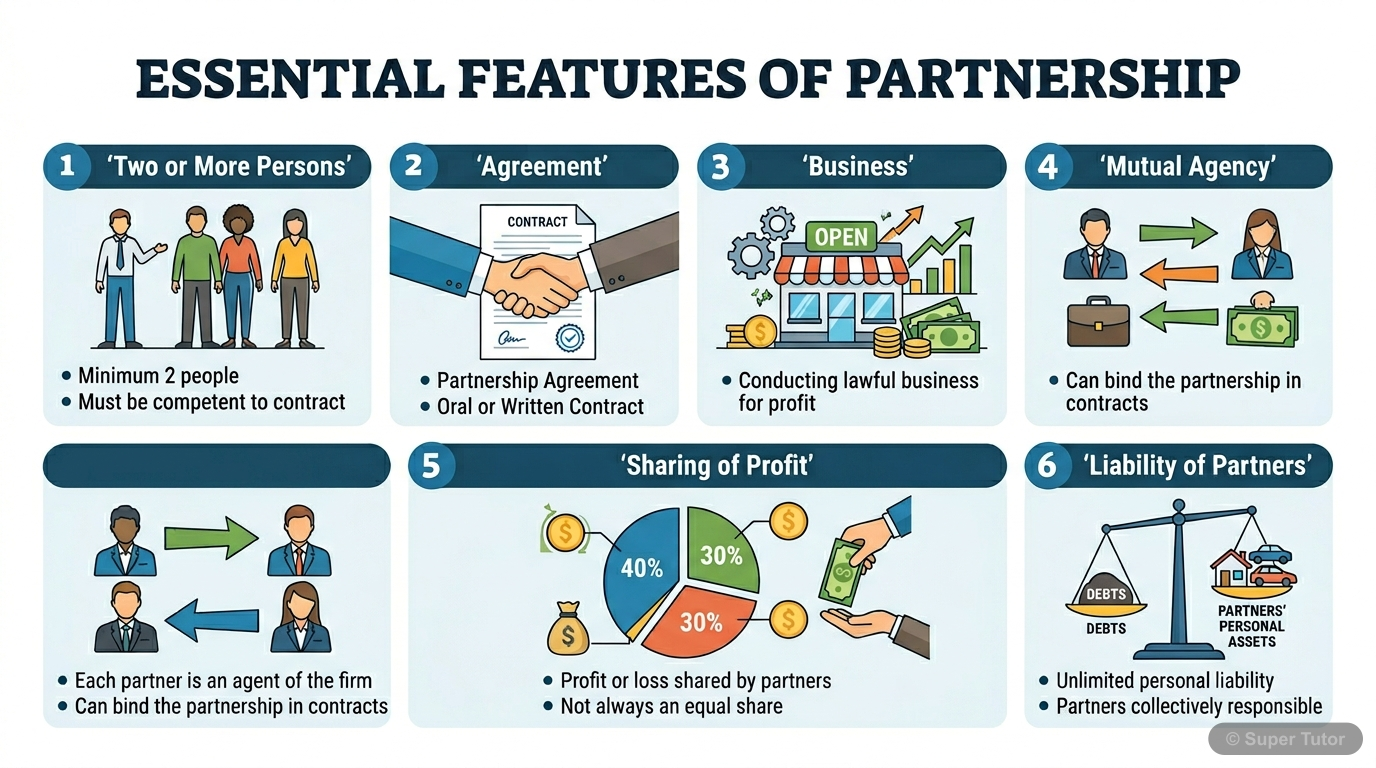
Learn better with visuals Super Tutor has hundreds of illustrations like this across every chapter — all free to try.
Get startedTopics in Accounting for Partnership: Basic Concepts
1. Nature of Partnership
- Partnership is the relation between persons who have agreed to share the profits of a business carried on by all or any of them acting for all.
- A partnership firm has no separate legal entity apart from the partners constituting it.
- The minimum number of partners is two.
2. Partnership Deed and Default Rules
- The partnership deed contains the terms and conditions of partnership.
- The deed may include capital contribution, profit-sharing ratio, interest on capital, interest on loan, salaries, commission, and rules for admission, retirement, death, and dissolution.
- The deed can be altered only with the consent of all partners.
3. Capital Accounts of Partners
- All transactions relating to partners are recorded through capital accounts.
- There are two methods: fixed capital method and fluctuating capital method.
- Under fixed capital method, two accounts are maintained for each partner: capital account and current account.
4. Distribution of Profit and Loss
- Profits and losses are distributed among partners in the agreed ratio.
- If the deed is silent, profits and losses are shared equally.
- Profit and Loss Appropriation Account is prepared to show distribution of profit among partners.
Key Concepts
Central concept: Partnership accounting basics: definition, deed rules, capital accounts, profit appropriation, interest calculations, guarantees, and past adjustments
Frequently Asked Questions
What are the important topics in Accounting for Partnership: Basic Concepts for CBSE Class 12 Accountancy?
How to score full marks in Accounting for Partnership: Basic Concepts — CBSE Class 12 Accountancy?
Sources & Official References
- NCERT Official — ncert.nic.in
- CBSE Academic — cbseacademic.nic.in
- CBSE Official — cbse.gov.in
- National Education Policy 2020 — education.gov.in
Content is aligned to the official syllabus. Refer to the board website for the latest curriculum.
More resources for Accounting for Partnership: Basic Concepts
Practice Quiz
Test yourself with a quick quiz
Important Questions
Practice with board exam-style questions
Revision Notes
Key points for last-minute revision
Formula Sheet
All formulas in one place
Chapter Summary
Understand the chapter at a glance
Concept Maps
See how topics connect visually
Study Plan
Step-by-step plan to ace this chapter
Flashcards
Quick-fire cards for active recall
NCERT Solutions
Every textbook question solved step by step
For serious students
Get the full Accounting for Partnership: Basic Concepts chapter — for free.
Quizzes, flashcards, AI doubt-solver and a step-by-step study plan for CBSE Class 12 Accountancy.