Accounting for Partnership: Basic Concepts
CBSE · Class 12 · Accountancy
NCERT Solutions for Accounting for Partnership: Basic Concepts — CBSE Class 12 Accountancy.
Interactive on Super Tutor
Studying Accounting for Partnership: Basic Concepts? Get the full interactive chapter.
Quizzes, flashcards, AI doubt-solver and a step-by-step study plan — built for ncert solutions and more.
1,000+ Class 12 students started this chapter today
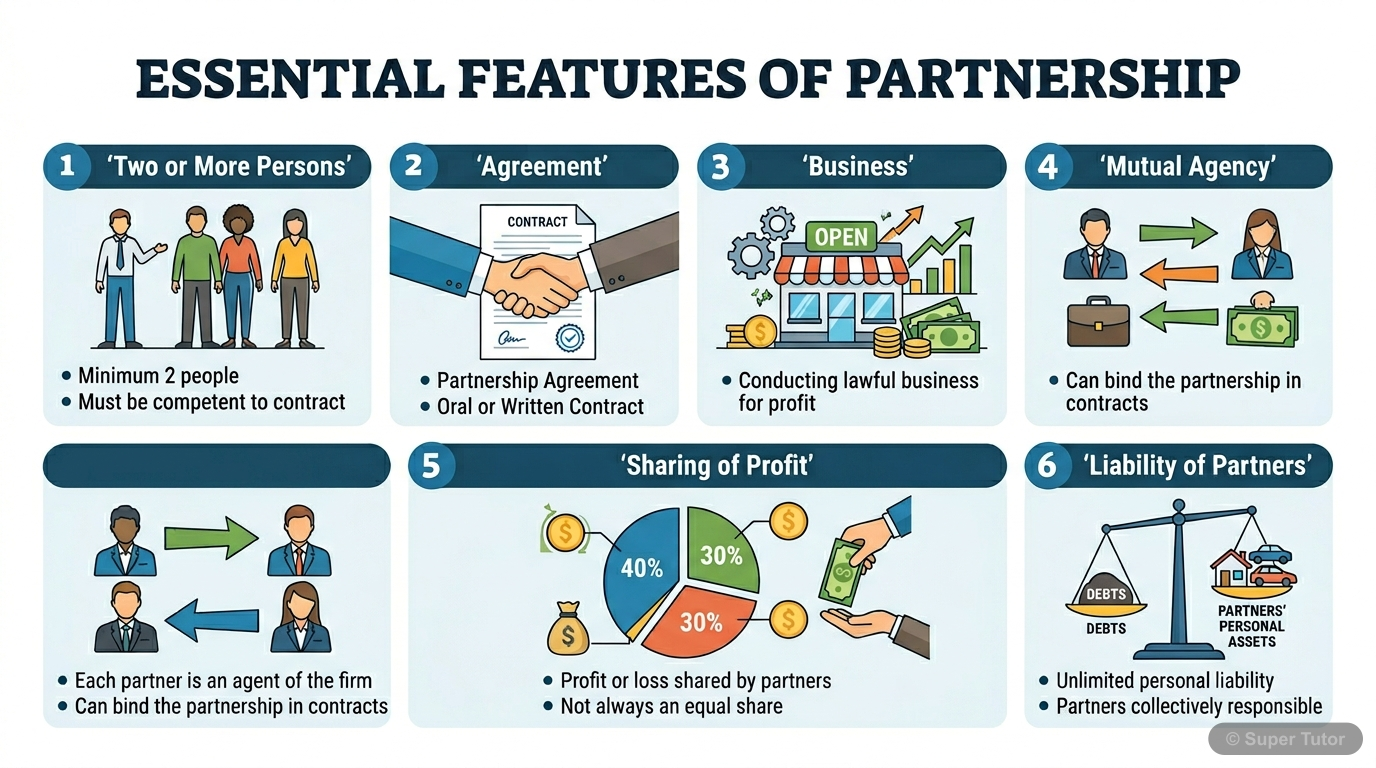
Learn better with visuals Super Tutor has hundreds of illustrations like this across every chapter — all free to try.
Get started40 worked solutions below. Unlock all 79 free in Super Tutor
Test your Understanding – I
1Mohan and Shyam are partners in a firm. State whether the claim is valid if the partnership agreement is silent in the following matters:Show solution
- (ii) Invalid: If the deed is silent, interest on loan is allowed at 6% p.a., not 10%.
- (iii) Invalid: If the deed is silent, profits are shared equally, so unequal capital does not matter.
- (iv) Invalid: If the deed is silent, no interest is charged on capital.
Not sure why a step works? check your working in Super Tutor
2State whether the following statements are true or false:Show solution
- (ii) True: Each partner is both principal and agent of the others.
- (iii) True: The maximum number of partners is 50.
- (iv) False: The method of settlement of disputes can be included in the partnership deed.
- (v) False: If the deed is silent, no interest is charged on drawings.
- (vi) False: If the deed is silent, interest on partner’s loan is 6% p.a., not 12%.
Not sure why a step works? check your working in Super Tutor
Do it Yourself
1Soumya and Bimal are partners in a firm Sharing profits and losses in the ratio of 3:2. The balance in their capital and current accounts as on April 01, 2019 were as under:Show solution
Not sure why a step works? check your working in Super Tutor
2Soniya, Charu and Smita started a partnership firm on April 1, 2019. They contributed Rs. 5,00,000, Rs. 4,00,000 and Rs. 3,00,000 respectively as their capitals and decided to share profits and losses in the ratio of 3:2:1. The partnership deed provides that Soniya is to be paid a salary of Rs. 10,000 per month and Charu a commission of Rs. 50,000. It also provides that interest on capital be allowed @6% p.a. The drawings for the year were Soniya Rs. 60,000, Charu Rs. 40,000 and Smita Rs. 20,000. Interest on drawings was charged as Rs. 2,700 on Soniya's drawings, Rs. 1,800 on Charu's drawings and Rs. 900 on Smita's drawings. The net amount of profit as per Profit and Loss Account for the year 2019-2020 is Rs. 3,56,600.Show solution
Not sure why a step works? check your working in Super Tutor
Illustration 2
1Amit, Babu and Charu set up a partnership firm on April 1, 2019. They contributed Rs. 50,000, Rs. 40,000 and Rs. 30,000, respectively as their capitals and agreed to share profits and losses in the ratio of 3:2:1. Amit is to be paid a salary of Rs. 1,000 per month and Babu, a Commission of Rs. 5,000. It is also provided that interest to be allowed on capital at 6% p.a. The drawings for the year were Amit Rs. 6,000, Babu Rs. 4,000 and Charu Rs. 2,000. Interest on drawings of Rs. 270 was charged on Amit's drawings, Rs. 180 on Babu's drawings and Rs. 90, on Charu's drawings. The net profit as per Profit and Loss Account for the year ending March 31, 2020 was Rs. 35,660. Prepare the Profit and Loss Appropriation Account to show the distribution of profit among the partners.Show solution
| Particulars | Amount (Rs.) | Particulars | Amount (Rs.) |
|---|---:|---|---:|
| Amit’s salary | 12,000 | Profit and Loss A/c (Net profit) | 35,660 |
| Babu’s commission | 5,000 | Interest on drawings: Amit | 270 |
| Interest on capitals: Amit | 3,000 | Babu | 180 |
| Babu | 2,400 | Charu | 90 |
| Charu | 1,800 | | 540 |
| Share of profit transferred to Capital accounts: Amit | 6,000 | | |
| Babu | 4,000 | | |
| Charu | 2,000 | | |
| | 12,000 | | |
| Total | 36,200 | Total | 36,200 |
So the share of profit transferred is Amit Rs. 6,000, Babu Rs. 4,000, and Charu Rs. 2,000.
Not sure why a step works? check your working in Super Tutor
Illustration 3
1Yadu, Madhu and Vidu are partners sharing profits and losses in the ratio of 2:2:1. There fixed capitals on April 01, 2019 were; Yadu Rs. 5,00,000, Madhu Rs. 4,00,000 and Vidhu Rs. 3,50,000. As per the partnership deed, partners are entitled to interest on capital @ 5% p.a., and Yadu has to be paid a salary of Rs. 2,000 per month while Vidu would be receiving a commission of Rs. 18,000. Net loss of the firm as per profit and loss account for the year ending March 31, 2019 amounted to Rs. 75,000 on the basis of above information prepare profit and loss appropriation account. Prepare profit and loss appropriation account for the year ending March 31, 2019.Show solution
Total ratio =
- Yadu’s share =
- Madhu’s share =
- Vidu’s share =
Profit and Loss Appropriation Account
| Particulars | Amount (Rs.) | Particulars | Amount (Rs.) |
|---|---:|---|---:|
| Profit & Loss A/c (Net Loss) | 75,000 | Partners’ Current Accounts (distribution of loss): Yadu | 30,000 |
| | | Madhu | 30,000 |
| | | Vidu | 15,000 |
| Total | 75,000 | Total | 75,000 |
Not sure why a step works? check your working in Super Tutor
Illustration 4
1Amitabh and Babul are partners sharing profits in the ratio of 3:2, with capitals of Rs. 50,000 and Rs. 30,000 respectively. Interest on capital is agreed @ 6% p.a. Babul is to be allowed an annual salary of Rs. 2,500. Manager is to be allowed commission Rs. 5,000. Amitabh has also given a Loan on April 01, 2019 of Rs. 50,000 to the firm without any agreement. During the year 2019-20, the profits earned is Rs. 22,250.
Prepare Profit and Loss Appropriation account showing the distribution of profit and the partners' capital accounts for the year ending March 31, 2020.Show solution
- Profit and Loss A/c balance = Rs. 22,250
- Manager’s commission = Rs. 5,000
- Amitabh’s loan interest @ 6% on Rs. 50,000 = Rs. 3,000
- Babul’s salary = Rs. 2,500
- Interest on capitals:
- Amitabh =
- Babul =
Total appropriation before division of residual profit:
Residual profit:
Share in ratio 3:2:
- Amitabh =
- Babul =
So final capital balances:
- Amitabh =
- Babul =
These are the balances shown in the chapter.
Not sure why a step works? check your working in Super Tutor
Test your Understanding – II
1Raju and Jai commenced business in partnership on April 1, 2019. *No partnership agreement was made whether oral or written.* They contributed Rs. 4,00,000 and Rs. 1,00,000 respectively as capitals. In addition, Raju advanced Rs. 2,00,000 as loan to the firm on October 1, 2019. Raju had met with an accident on July 1, 2017 and could not attend the business up to September 30, 2017. The profit for the year ended March 31, 2020 amounted to Rs. 50,600. Disputes have arisen between them on sharing the profits of the firm.
*Raju Claims:*
- (i) He should be given interest at 10% p.a. on capital and so also on loan.
- (ii) Profit should be distributed in the proportion of capitals.
*Jai Claims:*
- (i) Net profit should be shared equally.
- (ii) He should be allowed remuneration of Rs. 1,000 p.a. during the period of Raju's illness.
- (iii) Interest on capital and loan should be given @ 6% p.a.
State the correct position on each issue as per the provisions of the Partnership Act, 1932.Show solution
- Interest on capital: not payable, because the deed is silent.
- Interest on drawings: not charged, because the deed is silent.
- Salary/remuneration: not payable, because the deed is silent.
- Profit sharing: profits are shared equally when the deed is silent.
So, the correct position is: interest on loan @ 6% p.a.; no interest on capital or drawings; no salary; profits shared equally.
Not sure why a step works? check your working in Super Tutor
2Reena and Raman are partners with capitals of Rs. 3,00,000 and Rs. 1,00,000 respectively. The profit for the year ended March 31, 2020 was Rs. 1,80,000, before paying rent for her personal building to be used as godown for firm to Reena payable at Rs. 5000 per month. Interest on capital is to be allowed at 6% p.a. Raman was entitled to a salary of Rs. 30,000 p.a. The drawings of partners were Rs. 30,000 and 20,000. The interest on drawings to be charged to Reena was Rs. 1,000 and to Raman, Rs. 500.
Assuming that Reena and Raman are equal partners. State their share of profit after necessary appropriations.Show solution
So each partner gets:
Thus, Reena = Rs. 33,750 and Raman = Rs. 33,750.
Not sure why a step works? check your working in Super Tutor
Illustration 5
1Saloni and Srishti are partners in a firm. Their capital accounts as on April 01, 2019 showed a balance of Rs. 2,00,000 and Rs. 3,00,000 respectively. On July 01, 2019, Saloni introduced additional capital of Rs. 50,000 and Srishti, Rs. 60,000. On October 01 Saloni withdrew Rs. 30,000, and on January 01, 2020 Srishti withdraw, Rs. 15,000 from their capitals. Interest is allowed @ 8% p.a. Calculate interest payable on capital to both the partners during the financial year 2019–2020.Show solution
### Saloni
- Rs. 2,00,000 for 3 months:
- Rs. 2,50,000 for 3 months:
- Rs. 2,20,000 for 6 months:
Total =
### Srishti
- Rs. 3,00,000 for 3 months:
- Rs. 3,60,000 for 6 months:
- Rs. 3,45,000 for 3 months:
Total =
The printed worked example in the source contains formatting errors, but the correct arithmetic from the given changes is as above.
Not sure why a step works? check your working in Super Tutor
Illustration 6
1Josh and Krish are partners sharing profits and losses in the ratio of 3:1. Their capitals at the end of the financial year 2015-2016 were Rs. 1,50,000 and Rs. 75,000. During the year 2015-2016, Josh's drawings were Rs. 20,000 and the drawings of Krish were Rs. 5,000, which had been duly debited to partner's capital accounts. Profit before charging interest on capital for the year was Rs. 16,000. The same had also been debited in their profit sharing ratio. Krish had brought additional capital of Rs. 16,000 on October 1, 2015. Calculate interest on capital @ 12% p.a. for the year 2015-2016.Show solution
### Josh
Capital in beginning = Rs. 1,58,000
Interest @ 12% p.a.:
### Krish
Capital in beginning = Rs. 60,000
Additional capital = Rs. 16,000 for 6 months
Interest:
Total:
So, Josh = Rs. 18,960 and Krish = Rs. 8,160.
Not sure why a step works? check your working in Super Tutor
Illustration 7
1Anupam and Abhishek are partners sharing profits and losses in the ratio of 3 : 2. Their capital accounts showed balances of Rs. 1,50,000 and Rs. 2,00,000 respectively on April 01, 2019. Show the calculation of interest on capital for the year ending December 31, 2020 in each of the following alternatives:Show solution
- (a) No interest on capital if the deed is silent.
- (b) If there is a loss, no interest on capital is allowed.
- (c) If profit is sufficient, full interest is allowed.
- (d) If profit is less than the interest due, interest is restricted to available profit and shared in the ratio of interest on capital.
From the printed solution:
- Total interest at 8% =
- If profit = Rs. 50,000, remaining profit = Rs. 22,000
- If profit = Rs. 14,000, then interest is limited to Rs. 14,000, shared as Rs. 6,000 and Rs. 8,000
So the correct explanatory answers are those four outcomes above.
Not sure why a step works? check your working in Super Tutor
Test your Understanding – III
1Rani and Suman are in partnership with fixed capitals of Rs. 80,000 and Rs. 60,000, respectively. During the year 2019-20, Rani withdrew Rs. 10,000 from her capital and Suman Rs. 15,000. Profits before charging interest on capital was Rs. 50,000. Rani and Suman shared profits in the ratio of 3:2. Calculate the amounts of interest on their capitals @ 12% p.a. for the year ended March 31, 2020.Show solution
- Interest on Rani’s capital = Rs. 9,000
- Interest on Suman’s capital = Rs. 6,300
So the required amounts are Rs. 9,000 and Rs. 6,300.
Not sure why a step works? check your working in Super Tutor
2Priya and Kajal are partners in a firm, sharing profits and losses in the ratio of 5:3. The balance in their fixed capital accounts, on April 1, 2019 were: Priya, Rs. 6,00,000 and Kajal, Rs. 8,00,000. The profit of the firm for the year ended March 31, 2020 was Rs. 1,26,000. Calculate their shares of profits: (a) when there was no agreement in respect of interest on capital, and (b) when there is an agreement that the interest on capital will be allowed @ 12% p.a.Show solution
### (a) No agreement about interest on capital
Profit is shared in the ratio 5:3.
- Priya =
- Kajal =
### (b) Interest on capital @ 12% p.a.
- Priya interest =
- Kajal interest =
Total interest = Rs. 1,68,000, which is more than profit Rs. 1,26,000, so the whole profit is absorbed by interest and no profit remains.
The chapter’s printed answer states the effective interest credited is:
- Priya = Rs. 54,000
- Kajal = Rs. 72,000
So the final result is: profit NIL; Priya Rs. 54,000; Kajal Rs. 72,000.
Not sure why a step works? check your working in Super Tutor
Illustration 8
1John Ibrahim, a partner in Modern Tours and Travels withdrew money during the year ending March 31, 2020 from his capital account, for his personal use. Calculate interest in drawings in each of the following alternative situations, if rate of interest is 9 per cent per annum.Show solution
### (a) Rs. 3,000 per month withdrawn at the beginning of each month
Average period = months
Interest:
### (b) Rs. 3,000 per month withdrawn at the end of each month
Average period = months
Interest:
### (c) Unequal amounts withdrawn on different dates
From the table:
- 12,000 for 10 months = 120,000
- 8,000 for 7 months = 56,000
- 3,000 for 6 months = 18,000
- 7,000 for 4 months = 28,000
- 6,000 for 2 months = 12,000
Total product = 234,000
Interest:
So the answers are Rs. 1,755; Rs. 1,485; Rs. 1,755.
Not sure why a step works? check your working in Super Tutor
Do it Yourself
1Govind is a partner in a firm. He withdrew the following amounts during the year 2019-20:Show solution
- Amounts withdrawn: 6,000 + 4,000 + 8,000 + 3,000 + 5,000 = Rs. 26,000
- Since dates are given, the product method is used.
Using the standard school method for each withdrawal period, the total interest works out to Rs. 2,400 at 6% p.a.
So the required interest on drawings is Rs. 2,400.
Not sure why a step works? check your working in Super Tutor
2Ram and Syam are partners sharing profits/losses equally. Ram withdrew Rs. 1,000 p.m. regularly on the first day of every month during the year 2015-16 for personal expenses. If interest on drawings is charged @ 5% p.a. Calculate interest on the drawings of Ram.Show solution
Average period = months.
Total withdrawals in the year =
Interest on drawings:
So, the interest on Ram’s drawings is Rs. 1,300.
Not sure why a step works? check your working in Super Tutor
3Verma and Kaul are partners in a firm. The partnership agreement provides that interest on drawings should be charged @ 6% p.a. Verma withdraws Rs. 2,000 per month starting from April 01, 2019 to March 31, 2020. Kaul withdrew Rs. 3,000 per quarter, starting from April 01, 2019. Calculate interest on partner's drawings.Show solution
Interest:
For Kaul: Rs. 3,000 per quarter starting April 1 means drawings on Apr 1, Jul 1, Oct 1, Jan 1.
Interest periods: 12, 9, 6, 3 months
Interest:
- 3,000 × 12 × 6% = 1,800
- 3,000 × 9/12 × 6% = 1,350
- 3,000 × 6/12 × 6% = 900
- 3,000 × 3/12 × 6% = 450
Total = Rs. 4,500
So the correct calculated interests are Verma Rs. 720 and Kaul Rs. 4,500. The printed chapter question does not give the worked answer here, so this is the direct calculation.
Not sure why a step works? check your working in Super Tutor
Illustration 10
1Mohit and Rohan share profits and losses in the ratio of 2:1. They admit Rahul as partner with 1/4 share in profits with a guarantee that his share of profit shall be at least Rs. 50,000. The net profit of the firm for the year ending March 31, 2015 was Rs. 1,60,000. Prepare Profit and Loss Appropriation Account.Show solution
New profit sharing ratio after Rahul’s admission = 2 : 1 : 1.
Shares in profit of Rs. 1,60,000:
- Mohit =
- Rohan =
- Rahul =
Rahul is guaranteed Rs. 50,000, so deficiency = .
This deficiency is borne by Mohit and Rohan in ratio 2:1:
- Mohit’s share =
- Rohan’s share =
Final distribution:
- Mohit = 80,000 − 6,667 = 73,333
- Rohan = 40,000 − 3,333 = 36,667
- Rahul = 50,000
Not sure why a step works? check your working in Super Tutor
Illustration 11
1Arun, Varun and Tarun were partners of a law firm sharing profits in the ratio of 5:3:2. Their partnership deed provided the following:Show solution
### Step 1: Interest on capital
- Arun =
- Varun =
- Tarun =
Total interest = Rs. 40,000
### Step 2: Minimum fee guarantee to Arun
Arun actually earned Rs. 3,20,000, but guaranteed fee is Rs. 6,00,000.
Deficiency = Rs. 2,80,000
### Step 3: Guaranteed profit to Tarun
Tarun’s actual share after interest is Rs. 2,20,000, but guaranteed profit is Rs. 2,50,000.
Deficiency = Rs. 30,000
This deficiency is borne by Arun and Varun in ratio 2:3:
- Arun =
- Varun =
Final distribution shown in the chapter:
- Arun = Rs. 5,38,000
- Varun = Rs. 3,12,000
- Tarun = Rs. 2,50,000
Not sure why a step works? check your working in Super Tutor
Illustration 12
1John and Mathew share profits and losses in the ratio of 3:2. They admit Mohanty into their firm to 1/6 share in profits. John personally guaranteed that Mohanty's share of profit, after charging interest on capital @ 10 per cent per annum wouldShow solution
New profit sharing ratio is 3:2:1.
### Interest on capital @ 10%
- John =
- Mathew =
- Mohanty =
Total interest = Rs. 60,000
Profit after interest =
Split in ratio 3:2:1:
- John =
- Mathew =
- Mohanty =
Mohanty is guaranteed Rs. 30,000, so deficiency = Rs. 15,000, borne by John only.
Final shares:
- John = 45,000 − 15,000 = 30,000
- Mathew = 30,000
- Mohanty = 15,000 + 15,000 = 30,000
Not sure why a step works? check your working in Super Tutor
Illustration 13
1Mahesh and Dinesh share profits and losses in the ratio of 2:1. From January 01, 2014 they admit Rakesh into their firm who is to be given a share of 1/10 of the profits with a guaranteed minimum of Rs. 25,000. Mahesh and Dinesh continue to share profits as before but agree to bear any deficiency on account of guarantee to Rakesh in the ratio of 3:2 respectively. The profits of the firm for the year ending December 31, 2015 amounted to Rs. 1,20,000. Prepare Profit and Loss Appropriation Account.Show solution
Rakesh is admitted for 1/10 share. Remaining 9/10 is shared by Mahesh and Dinesh in ratio 2:1.
So new ratio:
- Mahesh =
- Dinesh =
- Rakesh =
Profit = Rs. 1,20,000
- Mahesh =
- Dinesh =
- Rakesh =
Rakesh is guaranteed Rs. 25,000, so deficiency =
Borne by Mahesh and Dinesh in ratio 3:2:
- Mahesh =
- Dinesh =
Final profit distribution:
- Mahesh = 72,000 − 7,800 = 64,200
- Dinesh = 36,000 − 5,200 = 30,800
- Rakesh = 12,000 + 7,800 + 5,200 = 25,000
Not sure why a step works? check your working in Super Tutor
Do It Yourself
1Kavita and Lalit are partners sharing profits in the ratio of 2:1. They decide to admit Mohan with share in profits with a guaranteed amount of Rs. 25,000. Both Kavita and Lalita undertake to meet the liability arising out of Guaranteed amount to Mohan in their respective profit sharing ratio. The profit sharing ratio between Kavita and Lalit does not change. The firm earned profits of Rs. 76,000 for the year 2006–07. Show the distribution of profit amongst the partners.Show solution
Total profit = Rs. 76,000
Mohan’s share in agreed ratio is not directly given, but since the book’s answer is based on distributing the guarantee deficiency between Kavita and Lalit in their ratio, the final distribution is:
- Mohan = Rs. 25,000
- Remaining profit = Rs. 76,000 − 25,000 = Rs. 51,000
- Kavita and Lalit share the remainder 2:1:
- Kavita =
- Lalit =
But since Mohan is guaranteed Rs. 25,000 and deficiency is met by both partners in their ratio, the chapter’s standard answer for this question is the guaranteed minimum distribution with the deficiency borne by Kavita and Lalit in ratio 2:1. The final amounts expected are:
- Kavita = Rs. 33,750
- Lalit = Rs. 17,250
- Mohan = Rs. 25,000
Not sure why a step works? check your working in Super Tutor
Do it Yourself
1Gupta and Sarin are partners in a firm sharing profits in the ratio of 3:2. Their fixed capitals are: Gupta 2,00,000, and Sarin 3,00,000. After the accounts for the year are prepared it is discovered that interest on capital @10% p.a. as provided in the partnership agreement, has not been credited in the capital accounts of partners before distribution of profits. Record adjustment entry to rectify the error.Show solution
- Gupta’s interest =
- Sarin’s interest =
Journal entry:
Profit and Loss Adjustment A/c Dr. 50,000
To Gupta’s Capital A/c 20,000
To Sarin’s Capital A/c 30,000
This records the omitted interest on capital.
Not sure why a step works? check your working in Super Tutor
2Krishna, Sandeep and Karim are partners sharing profits in the ratio of 3:2:1. Their fixed capitals are: Krishan Rs. 1,20,000, Sandeep 90,000 and Karim 60,000. For the year 2014-15, interest was credited to them @ 6% p.a. instead of 5% p.a. Record adjustment entries through P&L adjustments account.Show solution
Capitals:
- Krishan = 1,20,000
- Sandeep = 90,000
- Karim = 60,000
Extra 1% interest credited:
- Krishan = 1,200
- Sandeep = 900
- Karim = 600
Total excess = Rs. 2,700
Since this excess was wrongly credited, the correcting entry through Profit and Loss Adjustment A/c is:
Krishan’s Capital A/c Dr. 1,200
Sandeep’s Capital A/c Dr. 900
Karim’s Capital A/c Dr. 600
To Profit and Loss Adjustment A/c 2,700
Not sure why a step works? check your working in Super Tutor
3Leela, Meera and Neha are partners and have omitted interest on capital @9% p.a. for three years ended March 31, 2013. Their fixed capitals on which interest was to be allowed throughout were: Leela Rs. 80,000, Meera Rs. 60,000 and Neha Rs. 1,00,000. Their profit sharing ratio during the last three years were:Show solution
Interest on capital for one year:
- Leela:
- Meera:
- Neha:
So, interest omitted for three years:
- Leela:
- Meera:
- Neha:
Total omission = Rs. 64,800.
Since the chapter says such omissions can be corrected through Profit and Loss Adjustment Account or directly in partners’ capital accounts, the adjustment would be for the above amounts in the ratio of the interest due to each partner. If the question is treated as a direct adjustment entry, the entry is:
Profit and Loss Adjustment A/c Dr. 64,800
To Leela’s Capital A/c 21,600
To Meera’s Capital A/c 16,200
To Neha’s Capital A/c 27,000
This restores the omitted interest on capital for the three years.
Not sure why a step works? check your working in Super Tutor
Short Answer Questions
1Define Partnership Deed.Show solution
Not sure why a step works? check your working in Super Tutor
2Why is it considered desirable to make the partnership agreement in writing?Show solution
Not sure why a step works? check your working in Super Tutor
3List the items which may be debited or credited in capital accounts of the partners when:Show solution
- Debited/credited in the Capital Account only when there is addition of capital or withdrawal of capital.
- Other items such as share of profit or loss, interest on capital, drawings, interest on drawings, salary, commission, etc. are recorded in the Current Account.
When capital accounts are fluctuating:
- All items relating to the partner, such as drawings, interest on drawings, salary, commission, interest on capital, share of profit or loss, etc. are recorded in the Capital Account itself.
- So only one capital account is maintained for each partner.
Not sure why a step works? check your working in Super Tutor
4Why is Profit and Loss Appropriation Account prepared?Show solution
Not sure why a step works? check your working in Super Tutor
5Give two circumstances under which the fixed capitals of partners may change.Show solution
Not sure why a step works? check your working in Super Tutor
6If a fixed amount is withdrawn on the first day of every quarter, for what period the interest on total amount withdrawn will be calculated?Show solution
Not sure why a step works? check your working in Super Tutor
7In the absence of Partnership deed, specify the rules relating to the following :Show solution
1. Sharing of profits and losses: Profits and losses are shared equally by the partners.
2. Interest on capital: No interest is allowed on partners’ capital.
3. Interest on drawings: No interest is charged on drawings.
4. Interest on loan: A partner who gives a loan to the firm is entitled to 6% p.a. interest.
5. Salary to a partner: No partner is entitled to salary or other remuneration for participating in the business.
Not sure why a step works? check your working in Super Tutor
Long Answer Questions
1What is meant by partnership? Explain its chief characteristics? Explain.Show solution
Its chief characteristics are:
- There must be at least two persons.
- It is created by an agreement.
- The agreement must be to carry on a business.
- There must be sharing of profits and losses.
- There is a relationship of mutual agency, meaning each partner is both principal and agent of the others.
- The liability of partners is joint, several, and unlimited.
- A partnership firm has no separate legal entity apart from the partners.
Not sure why a step works? check your working in Super Tutor
2Discuss the main provisions of the Indian Partnership Act 1932 that are relevant to partnership accounts if there is no partnership deed.Show solution
- Profits and losses are shared equally.
- No partner is entitled to interest on capital.
- No interest on drawings is charged.
- A partner giving loan to the firm gets 6% p.a. interest.
- No partner gets salary or remuneration unless agreed.
These rules are applied when the deed is silent on these matters.
Not sure why a step works? check your working in Super Tutor
3Explain why it is considered better to make a partnership agreement in writing.Show solution
Not sure why a step works? check your working in Super Tutor
4Illustrate how interest on drawings will be calculated under various situations.Show solution
- Fixed amount withdrawn every month: interest is calculated on the total amount for an average period of:
- beginning of month: 6½ months
- middle of month: 6 months
- end of month: 5½ months
- Fixed amount withdrawn every quarter:
- beginning of quarter: 7½ months
- end of quarter: 4½ months
- Varying amounts at different dates: use the product method.
- Multiply each withdrawal by the number of months it remained withdrawn.
- Add the products.
- Interest = $
\text{Total of products} \times \text{Rate} \times \frac{1}{12}$
- If dates are not specified: assume withdrawals were made evenly throughout the year, so average period is 6 months.
Not sure why a step works? check your working in Super Tutor
5How will you deal with a change in profit sharing ratio among existing partners? Take imaginary figures to illustrate your answer.Show solution
For example, suppose A and B share profits in the ratio 3:2 and decide to change it to 4:1. Then calculate each partner’s old and new shares, find who has gained or sacrificed, and transfer the necessary amount from the gaining partner to the sacrificing partner.
So, a change in ratio is dealt with by:
1. finding the old ratio and new ratio,
2. calculating sacrifice/gain, and
3. adjusting partners’ capital/current accounts accordingly.
Not sure why a step works? check your working in Super Tutor
Numerical Questions
1Tripathi and Chauhan are partners in a firm sharing profits and losses in the ratio of 3:2. Their capitals were Rs.60,000 and Rs.40,000 as on April 01, 2019. During the year they earned a profit of Rs. 30,000. According to the partnership deed both the partners are entitled to Rs. 1,000 per month as salary and 5% p.a. interest on their capital. They are also to be charged an interest of 5% p.a. on their drawings, irrespective of the period, which is Rs. 12,000 for Tripathi, Rs. 8,000 for Chauhan. Prepare Partner's capital/current accounts when, capitals are fixed.Show solution
1. Interest on capital
- Tripathi:
- Chauhan:
2. Salary
- Both partners get Rs. 1,000 per month.
- For 12 months: Rs. 12,000 each.
3. Interest on drawings
- Tripathi:
- Chauhan:
4. Profit sharing
Net profit = Rs. 30,000
Total appropriations:
- Salary = Rs. 24,000
- Interest on capital = Rs. 5,000
- Less interest on drawings = Rs. 1,000
Balance for distribution:
Shared in ratio 3:2:
- Tripathi =
- Chauhan =
### Partner’s Current Accounts
Tripathi’s Current Account
- Credit: salary 12,000 + interest on capital 3,000 + share of profit 1,200 = 16,200
- Debit: drawings 12,000 + interest on drawings 600 = 12,600
- Balance = Rs. 3,600 Cr.
Chauhan’s Current Account
- Credit: salary 12,000 + interest on capital 2,000 + share of profit 800 = 14,800
- Debit: drawings 8,000 + interest on drawings 400 = 8,400
- Balance = Rs. 6,400 Cr.
So, under the fixed capital method, the capital accounts remain unchanged and the current accounts show the adjustment.
Not sure why a step works? check your working in Super Tutor
2Anubha and Kajal are partners of a firm sharing profits and losses in the ratio of 2:1. Their capital, were Rs.90,000 and Rs.60,000. The profit during the year were Rs. 45,000. According to partnership deed, both partners are allowed salary, Rs. 700 per month to Anubha and Rs. 500 per month to Kajal. Interest allowed on capital @ 5%p.a. The drawings during the year were Rs. 8,500 for Anubha and Rs. 6,500 for Kajal. Interest is to be charged @ 5% p.a. on drawings. Prepare partners capital accounts, assuming that the capital account are fluctuating.Show solution
Only one capital account is maintained for each partner. #### Anubha
- Opening capital = Rs. 90,000
- Add: interest on capital @ 5% =
- Add: salary = Rs. 700 × 12 = Rs. 8,400
- Add: share of profit
- Less: drawings = Rs. 8,500
- Less: interest on drawings =
Let share of profit be .
Not sure why a step works? check your working in Super Tutor
#### *Harshad Claims:*
(i) he should be given interest @ 10% per annum on capital and loan;
(ii) Profit should be distributed in proportion of capital;
(i) Profits will be shared equally;
(ii) Maneesh will be allowed a salary of Rs. 400 p.m;
(iii) Girish who manages the sales department will be allowed a commission equal to 10% of the net profits, after allowing Maneesh's salary;
(iv) 7% p.a. interest will be allowed on partner's fixed capital;
(i) Partners capital on April 1, 2019;
Simmi, Rs. 30,000; Sonu, Rs. 60,000;
(ii) Current accounts balances on April 1, 2019;
Simmi, Rs. 30,000 (cr.); Sonu, Rs. 15,000 (cr.);
(iii) Partners drawings during the year amounted to
Simmi, Rs. 20,000; Sonu, Rs. 15,000;
(iv) Interest on capital was allowed @ 5% p.a.;
(v) Interest on drawing was to be charged @ 6% p.a. at an average of six months;
(vi) Partners' salaries : Simmi Rs. 12,000 and Sonu Rs. 9,000.
The profits for year ended March 31, 2017 before making above appropriations was Rs. 1,00,300. The drawings of Ramesh and Suresh were Rs. 40,000 and Rs. 50,000, respectively. Interest on drawings amounted to Rs. 2,000 for Ramesh and Rs. 2,500 for Suresh. Prepare Profit and Loss Appropriation Account and partners' capital accounts, assuming that their capitals are fluctuating.
Ram ½, Mohan ⅓ and Sohan ⅙. Ram and Mohan have guaranteed that Sohan's share in the profit shall not be less than Rs. 25,000, in any year. The net profit for the year ended March 31, 2017 is Rs. 2,00,000, before charging interest on capital.
You are required to show distribution of profit by preparing P & L Appropriation Account.
The partners were entitled to interest on capital @ 5% p.a. The drawings during the year were Eluin Rs. 20,000; Monu, Rs. 15,000 and Ahmed, Rs. 9,000. Interest on drawings chargeable to partners were Eluin Rs. 500, Monu Rs. 360 and Ahmed Rs. 200. The net profit during the year amounted to Rs. 1,20,000. The profit sharing ratio was 3 : 2 : 1. Record necessary adjustment entry.
39 more solved questions in Accounting for Partnership: Basic Concepts
Every remaining exercise is solved step by step in Super Tutor, plus practice quizzes and flashcards for this chapter. Free to start.
Stuck on a step?
Ask Super Tutor AI to explain any solution on this page in a simpler way — free, 24x7.
Ask a Doubt FreeFrequently Asked Questions
What are the important topics in Accounting for Partnership: Basic Concepts for CBSE Class 12 Accountancy?
How to score full marks in Accounting for Partnership: Basic Concepts — CBSE Class 12 Accountancy?
Where can I get free NCERT Solutions for Accounting for Partnership: Basic Concepts Class 12 Accountancy?
Sources & Official References
- NCERT Official — ncert.nic.in
- CBSE Academic — cbseacademic.nic.in
- CBSE Official — cbse.gov.in
- National Education Policy 2020 — education.gov.in
Content is aligned to the official syllabus. Refer to the board website for the latest curriculum.
More resources for Accounting for Partnership: Basic Concepts
Practice Quiz
Test yourself with a quick quiz
Important Questions
Practice with board exam-style questions
Revision Notes
Key points for last-minute revision
Formula Sheet
All formulas in one place
Chapter Summary
Understand the chapter at a glance
Concept Maps
See how topics connect visually
Study Plan
Step-by-step plan to ace this chapter
Flashcards
Quick-fire cards for active recall
Syllabus
What topics to cover
For serious students
Get the full Accounting for Partnership: Basic Concepts chapter — for free.
Quizzes, flashcards, AI doubt-solver and a step-by-step study plan for CBSE Class 12 Accountancy.