Cash Flow Statement
CBSE · Class 12 · Accountancy
Complete topic list for Cash Flow Statement in CBSE Class 12 Accountancy. Key concepts, sub-topics, and what to focus on for board exams.
Interactive on Super Tutor
Studying Cash Flow Statement? Get the full interactive chapter.
Quizzes, flashcards, AI doubt-solver and a step-by-step study plan — built for syllabus and more.
1,000+ Class 12 students started this chapter today
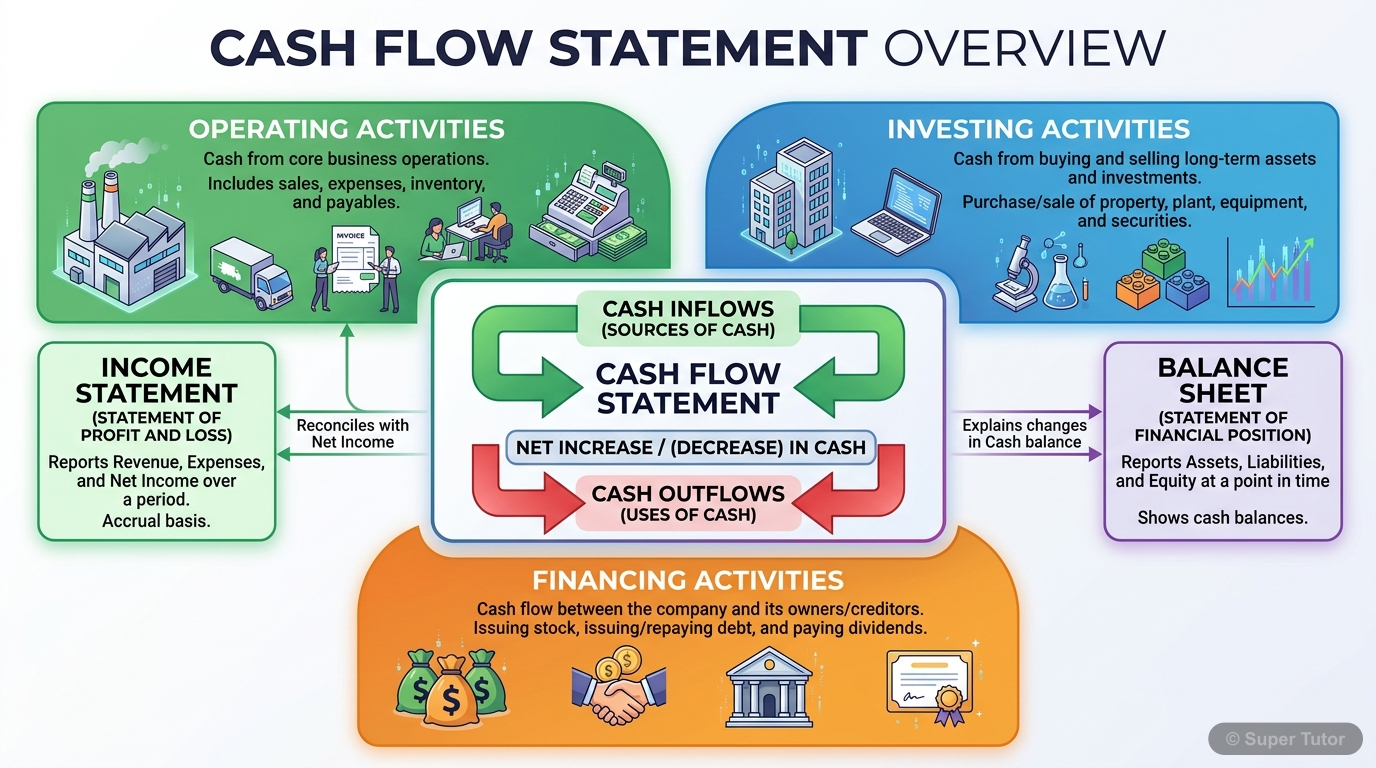
This is just one of 6+ visuals inside Super Tutor's Cash Flow Statement chapter
Explore the full setTopics in Cash Flow Statement
1. Meaning, Need, and Legal Basis
- Cash Flow Statement shows cash inflows and cash outflows for a specific period.
- It is different from Position Statement and Income Statement.
- It is one of the financial statements of a company.
2. Cash, Cash Equivalents, and Cash Flows
- Cash comprises cash in hand and demand deposits with banks.
- Cash equivalents are short-term highly liquid investments readily convertible into known amounts of cash with insignificant risk of value change.
- An investment normally qualifies as cash equivalent only if its maturity is three months or less from the date of acquisition.
3. Classification of Cash Flows
- Cash flows are classified into operating, investing, and financing activities.
- Operating activities are the principal revenue generating activities of the enterprise and are not investing or financing activities.
- Investing activities are acquisition and disposal of long-term assets and other investments not included in cash equivalents.
4. Special Items and Their Treatment
- In a financial enterprise, interest paid, interest received, and dividend received are operating activities, while dividend paid is financing.
- In a non-financial enterprise, payment of interest and dividends are financing activities, while receipt of interest and dividends are investing activities.
- Tax on operating profit is operating.
Key Concepts
Central concept: Cash Flow Statement as the statement of inflows and outflows of cash and cash equivalents classified into operating, investing, and financing activities
Frequently Asked Questions
What are the important topics in Cash Flow Statement for CBSE Class 12 Accountancy?
How to score full marks in Cash Flow Statement — CBSE Class 12 Accountancy?
Sources & Official References
- NCERT Official — ncert.nic.in
- CBSE Academic — cbseacademic.nic.in
- CBSE Official — cbse.gov.in
- National Education Policy 2020 — education.gov.in
Content is aligned to the official syllabus. Refer to the board website for the latest curriculum.
More resources for Cash Flow Statement
Practice Quiz
Test yourself with a quick quiz
Important Questions
Practice with board exam-style questions
Revision Notes
Key points for last-minute revision
Formula Sheet
All formulas in one place
Chapter Summary
Understand the chapter at a glance
Concept Maps
See how topics connect visually
Study Plan
Step-by-step plan to ace this chapter
Flashcards
Quick-fire cards for active recall
NCERT Solutions
Every textbook question solved step by step
For serious students
Get the full Cash Flow Statement chapter — for free.
Quizzes, flashcards, AI doubt-solver and a step-by-step study plan for CBSE Class 12 Accountancy.