Cash Flow Statement
CBSE · Class 12 · Accountancy
NCERT Solutions for Cash Flow Statement — CBSE Class 12 Accountancy.
Interactive on Super Tutor
Studying Cash Flow Statement? Get the full interactive chapter.
Quizzes, flashcards, AI doubt-solver and a step-by-step study plan — built for ncert solutions and more.
1,000+ Class 12 students started this chapter today
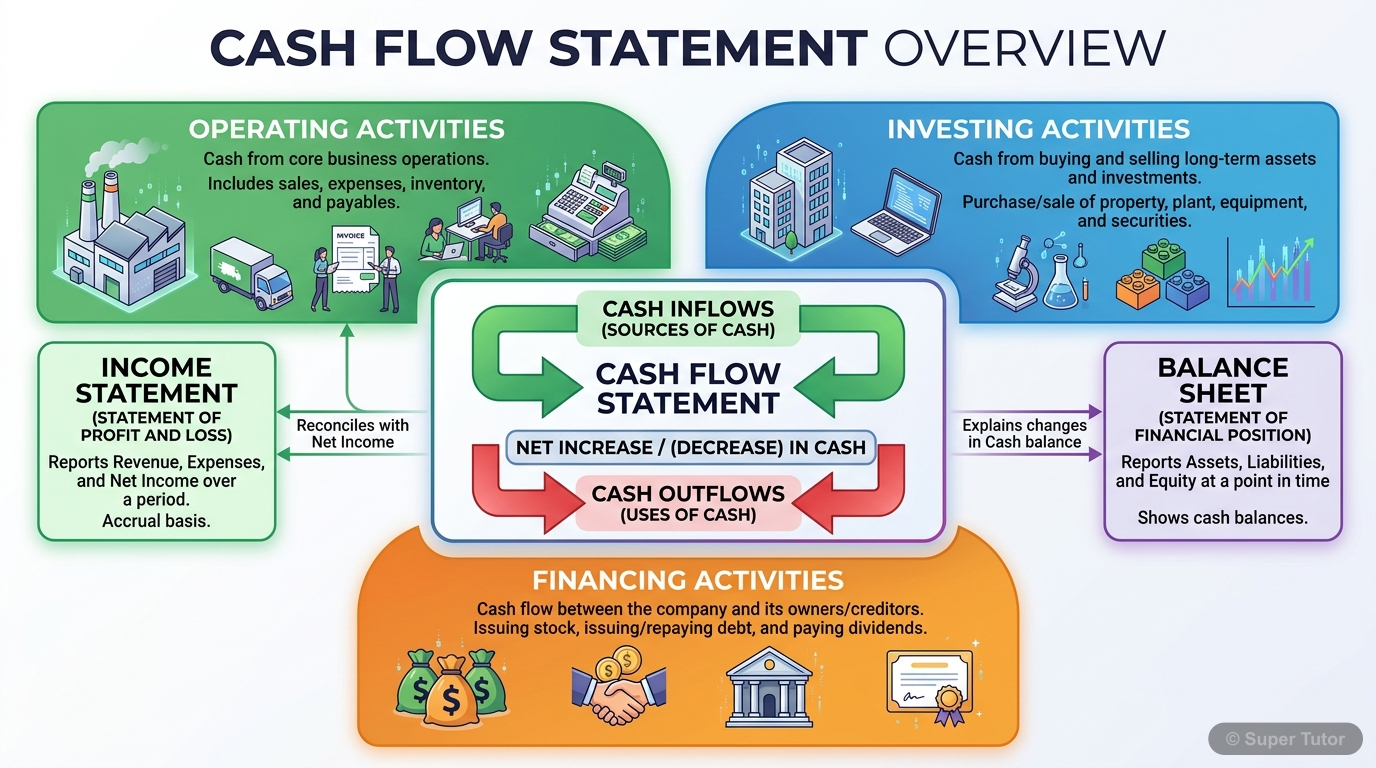
This is just one of 6+ visuals inside Super Tutor's Cash Flow Statement chapter
Explore the full set14 worked solutions below. Unlock all 27 free in Super Tutor
Questions for Practice
1What is a Cash flow statement?Show solution
Not sure why a step works? check your working in Super Tutor
2How are the various activities classified (as per AS-3 revised) while preparing cash flow statement?Show solution
1. Operating activities
2. Investing activities
3. Financing activities
This classification is used to show separately the cash flows generated or used by each type of activity.
Not sure why a step works? check your working in Super Tutor
3State the objectives of cash flow statement.Show solution
Not sure why a step works? check your working in Super Tutor
4What are the objectives of preparing cash flow statement?Show solution
- to show the changes in cash and cash equivalents during a period;
- to help users assess the enterprise’s ability to generate cash;
- to show the timing and certainty of cash generation;
- to help in evaluating the enterprise’s liquidity and solvency.
Not sure why a step works? check your working in Super Tutor
5State the meaning of the terms: (i) Cash Equivalents, (ii) Cash flows.Show solution
- Cash equivalents are short-term highly liquid investments that are readily convertible into known amounts of cash and are subject to an insignificant risk of changes in value.
- Cash flows mean the movement of cash in and out due to some non-cash items; receipt of cash is a cash inflow and payment of cash is a cash outflow.
Not sure why a step works? check your working in Super Tutor
6Prepare a format of cash flow from operating activities.Show solution
| Cash Flows from Operating Activities (Indirect Method) | |
|---|---:|
| Net Profit/Loss before Tax and Extraordinary Items | xxx |
| Add: Deductions already made in Statement of Profit and Loss on account of non-cash items such as depreciation, goodwill written-off | xxx |
| Add: Deductions already made on account of non-operating items such as interest | xxx |
| Less: Additions (incomes) made on account of non-operating items such as dividend received, profit on sale of fixed assets | xxx |
| Operating Profit before Working Capital Changes | xxx |
| Add: Increase in current liabilities / decrease in current assets | xxx |
| Less: Increase in current assets / decrease in current liabilities | xxx |
| Cash Flows from Operating Activities before Tax and Extraordinary Items | xxx |
| Less: Income tax paid | xxx |
| +/−: Effects of extraordinary items | xxx |
| Net Cash from Operating Activities | xxx |
Not sure why a step works? check your working in Super Tutor
7State clearly what would constitute the operating activities for each of the following enterprises:Show solution
- Hotel: lodging, food and related services
- Film production house: producing and distributing films
- Financial enterprise: lending and borrowing activities
- Media enterprise: publishing/broadcasting/advertising related activities
- Steel manufacturing unit: procurement of raw material, manufacturing steel, sale of steel
- Software development business unit: development and sale of software, maintenance/support services
The main idea is that operating activities are the principal revenue-generating activities of each enterprise.
Not sure why a step works? check your working in Super Tutor
8"The nature/type of enterprise can change altogether the category into which a particular activity may be classified." Do you agree? Illustrate your answer.Show solution
For example, purchase of shares is an investing activity for most enterprises, but for a share brokerage firm it is an operating activity because buying and selling shares is part of its main business. Similarly, cash advances and loans given by a financial enterprise are treated as operating activities because lending is its main activity.
Not sure why a step works? check your working in Super Tutor
1Describe the procedure to prepare Cash Flow Statement.Show solution
1. Ascertain cash flows from operating activities.
2. Ascertain cash flows from investing activities.
3. Ascertain cash flows from financing activities.
4. Find the net increase/decrease in cash and cash equivalents by adding the three net cash flows.
5. Add cash and cash equivalents at the beginning of the period.
6. Arrive at cash and cash equivalents at the end of the period.
The statement shows gross inflows and outflows under the three heads and the final change in cash and cash equivalents.
Not sure why a step works? check your working in Super Tutor
2Describe "Indirect" method of ascertaining Cash Flow from operating activities.Show solution
- non-cash items like depreciation and goodwill written off, which are added back;
- items whose cash effects are under investing or financing activities, such as interest paid/received, dividend received, profit on sale of assets;
- changes in working capital, i.e. current assets and current liabilities.
After these adjustments, income tax paid and extraordinary items are considered to arrive at net cash from operating activities.
Not sure why a step works? check your working in Super Tutor
3Explain the major Cash Inflows and outflows from investing activities.Show solution
Cash outflows:
- purchase of fixed assets including intangibles and capitalised research and development;
- purchase of shares, warrants or debt instruments of other enterprises other than trading investments;
- cash advances and loans made to third parties.
Cash inflows:
- sale of fixed assets including intangibles;
- repayment of advances or loans made to third parties;
- sale of shares, warrants or debt instruments;
- interest received on loans and advances;
- dividend received from investments in other enterprises.
Not sure why a step works? check your working in Super Tutor
4Explain the major Cash Inflows and outflows from financing activities.Show solution
Cash inflows:
- issue of equity shares or preference shares;
- issue of debentures, bonds, loans and other borrowings.
Cash outflows:
- repayment of borrowings;
- interest paid on debentures and long-term loans;
- dividends paid on equity and preference capital.
These activities relate to changes in the enterprise’s capital and borrowings.
Not sure why a step works? check your working in Super Tutor
1Anand Ltd., arrived at a net income of Rs. 5,00,000 for the year ended March 31, 2017. Depreciation for the year was Rs. 2,00,000. There was a profit of Rs. 50,000 on assets sold which was transferred to Statement of Profit and Loss account. Trade Receivables increased during the year Rs. 40,000 and Trade Payables also increased by Rs. 60,000. Compute the cash flow from operating activities by the indirect approach.Show solution
- Net income = Rs. 5,00,000
- Add depreciation = Rs. 2,00,000
- Less profit on sale of assets = Rs. 50,000
- Less increase in trade receivables = Rs. 40,000
- Add increase in trade payables = Rs. 60,000
Calculation:
So, cash flow from operating activities is Rs. 6,70,000.
Not sure why a step works? check your working in Super Tutor
2From the information given below you are required to calculate the cash paid for the inventory:Show solution
Given:
- Credit purchases = Rs. 1,60,000
- Trade payables in the beginning = Rs. 14,000
- Trade payables in the end = Rs. 14,500
So,
Therefore, cash paid for inventory = Rs. 1,59,500.
Not sure why a step works? check your working in Super Tutor
(a) Acquired machinery for Rs. 2,50,000 paying 20% by cheque and executing a bond for the balance payable.
(b) Paid Rs. 2,50,000 to acquire shares in Informa Tech. and received a dividend of Rs. 50,000 after acquisition.
(c) Sold machinery of original cost Rs. 2,00,000 with an accumulated depreciation of Rs. 1,60,000 for Rs. 60,000.
Test your Understanding – I
Test your Understanding – II
13 more solved questions in Cash Flow Statement
Every remaining exercise is solved step by step in Super Tutor, plus practice quizzes and flashcards for this chapter. Free to start.
Stuck on a step?
Ask Super Tutor AI to explain any solution on this page in a simpler way — free, 24x7.
Ask a Doubt FreeFrequently Asked Questions
What are the important topics in Cash Flow Statement for CBSE Class 12 Accountancy?
How to score full marks in Cash Flow Statement — CBSE Class 12 Accountancy?
Where can I get free NCERT Solutions for Cash Flow Statement Class 12 Accountancy?
Sources & Official References
- NCERT Official — ncert.nic.in
- CBSE Academic — cbseacademic.nic.in
- CBSE Official — cbse.gov.in
- National Education Policy 2020 — education.gov.in
Content is aligned to the official syllabus. Refer to the board website for the latest curriculum.
More resources for Cash Flow Statement
Practice Quiz
Test yourself with a quick quiz
Important Questions
Practice with board exam-style questions
Revision Notes
Key points for last-minute revision
Formula Sheet
All formulas in one place
Chapter Summary
Understand the chapter at a glance
Concept Maps
See how topics connect visually
Study Plan
Step-by-step plan to ace this chapter
Flashcards
Quick-fire cards for active recall
Syllabus
What topics to cover
For serious students
Get the full Cash Flow Statement chapter — for free.
Quizzes, flashcards, AI doubt-solver and a step-by-step study plan for CBSE Class 12 Accountancy.