Chapter 1 of 40
NCERT Solutions

The Last Lesson (Alphonse Daudet)

CBSE · Class 12 · English

NCERT Solutions for The Last Lesson (Alphonse Daudet) — CBSE Class 12 English.

37 questions24 flashcards5 concepts

Interactive on Super Tutor

Studying The Last Lesson (Alphonse Daudet)? Get the full interactive chapter.

Quizzes, flashcards, AI doubt-solver and a step-by-step study plan — built for ncert solutions and more.

1,000+ Class 12 students started this chapter today
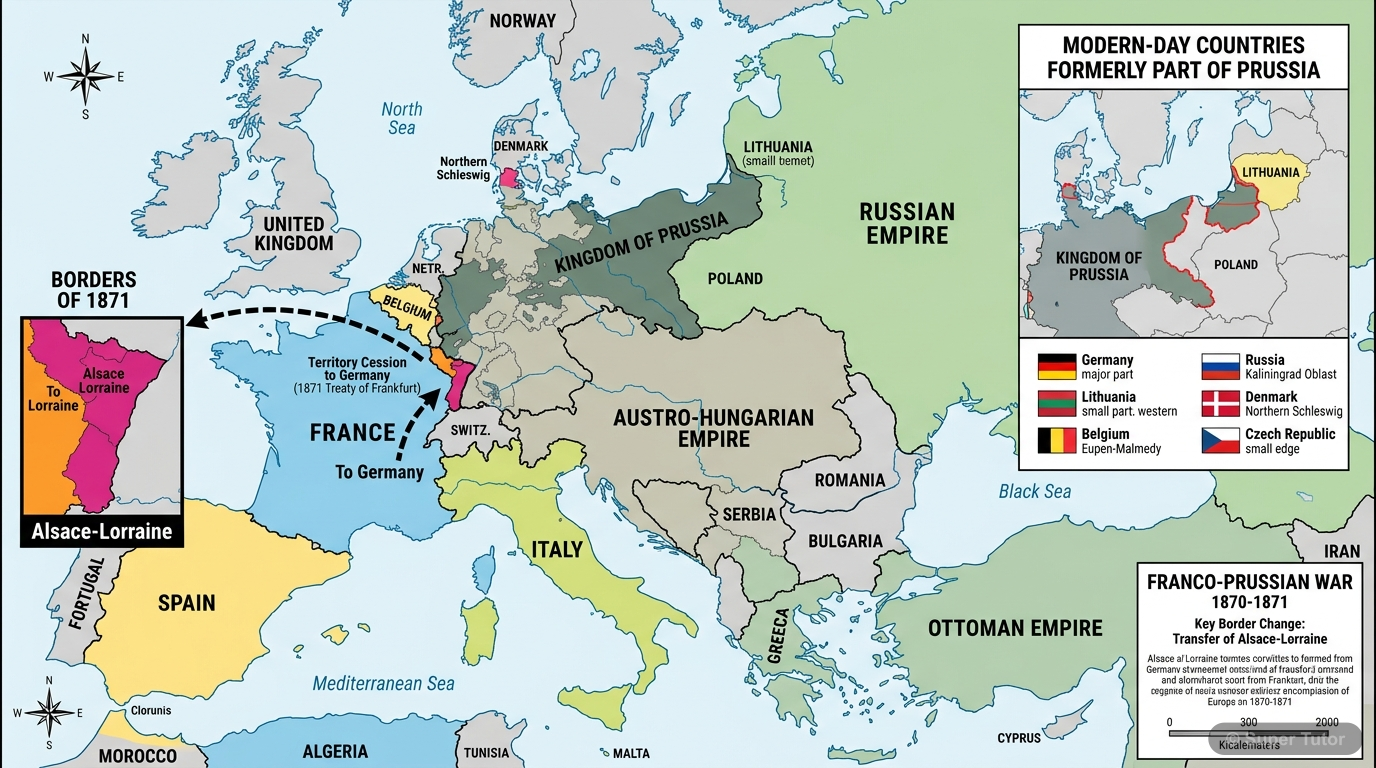
A historical map showing the territories involved in the Franco-Prussian War (1870-1871), highlighting France, Prussia (including modern-day Germany, Poland, and parts of Austria), and specifically th
Super Tutor

This is just one of 8+ visuals inside Super Tutor's The Last Lesson (Alphonse Daudet) chapter

Explore the full set
21 Questions Solved · 8 Sections

11 worked solutions below. Unlock all 21 free in Super Tutor

Think as you read

1What was Franz expected to be prepared with for school that day?Show solution
Franz was expected to be prepared with the rule for participles for school that day. He says M. Hamel had said he would question them on participles, and Franz did not know them.

Not sure why a step works? check your working in Super Tutor

2What did Franz notice that was unusual about the school that day?Show solution
Franz noticed that the school was not in its usual bustle. Instead of noise, desk-opening, and lessons repeated in unison, everything was still, quiet, and solemn. He also saw that the village people were sitting on the back benches, which was unusual.

Not sure why a step works? check your working in Super Tutor

3What had been put up on the bulletin-board?Show solution
Franz saw a crowd in front of the bulletin-board when he passed the town hall.

Not sure why a step works? check your working in Super Tutor

Think as you read

1What changes did the order from Berlin cause in school that day?Show solution
The order from Berlin brought several changes. French was stopped in Alsace and Lorraine, and German was to be taught from the next day. Because of this, the day became the last French lesson. M. Hamel wore his Sunday clothes, the village people came to the classroom, and the usual school noise disappeared. The whole room felt still, serious, and sad. Everyone realised the importance of the language and their lost country.

Not sure why a step works? check your working in Super Tutor

2How did Franz’s feelings about M. Hamel and school change?Show solution
At first Franz was in great dread of M. Hamel because he was afraid of being scolded for not knowing participles. But when he learned that it was the last lesson, his feelings changed completely. He felt sorry for not studying earlier and began to think of his books and grammar as old friends. He no longer saw M. Hamel as merely cranky; instead, he felt respect and affection for him, especially when he understood that the teacher was giving his best on his last day.

Not sure why a step works? check your working in Super Tutor

Understanding the text

1The people in this story suddenly realise how precious their language is to them. What shows you this? Why does this happen?Show solution
The story shows this through several signs. Franz regrets not learning his lessons earlier, and M. Hamel speaks भावुकly about French as the most beautiful language and the key to freedom. The village elders come to school, sit quietly, and look sad. Everyone listens carefully, even the old man Hauser, who tries to spell the words and cries. This sudden love for the language happens because they are told that French will no longer be taught. When people are about to lose something, they understand its value more deeply.

Not sure why a step works? check your working in Super Tutor

2Franz thinks, “Will they make them sing in German, even the pigeons?” What could this mean?Show solution
Franz’s words are a figurative way of showing how deeply he feels about his homeland. He imagines that the Prussians may force German on people, but he cannot imagine that they could change even the natural life of the birds. The pigeons’ cooing seems part of France itself. So the line suggests his sadness and disbelief that even the most ordinary, natural things may be affected by the occupation.

Not sure why a step works? check your working in Super Tutor

Talking about the text

1“When a people are enslaved, as long as they hold fast to their language it is as if they had the key to their prison.”

Can you think of examples in history where a conquered people had their language taken away from them or had a language imposed on them?
Show solution
Yes. History gives many examples where conquerors tried to impose their own language. For example, in many British colonies, English was made the language of administration and education. In occupied areas, local languages were sometimes discouraged or even punished. The chapter itself gives the example of Alsace and Lorraine, where German was ordered to be taught instead of French. Such policies were used to control people and weaken their identity.

Not sure why a step works? check your working in Super Tutor

2What happens to a linguistic minority in a state? How do you think they can keep their language alive?Show solution
A linguistic minority in a state may find that the majority language dominates schools, offices, and public institutions. Its language may become less visible, and younger people may slowly stop using it. To keep the language alive, people should speak it at home, use it in their community, teach children to read and write it, and preserve its books, songs, and traditions. Regular use is the best way to protect a language.

Not sure why a step works? check your working in Super Tutor

3Is it possible to carry pride in one's language too far?Show solution
Yes, it is possible to carry pride too far. Being proud of one’s language is natural and good, but linguistic chauvinism means believing that one’s own language is superior and treating other languages with disrespect. That is harmful because it creates division and unfairness. Respect for one’s language should go along with respect for other languages.

Not sure why a step works? check your working in Super Tutor

Working with words

1English is a language that contains words from many other languages. This inclusiveness is one of the reasons it is now a world language. For example:

*Find out the origins of the following words.*
Show solution
The origins are:
- tycoon — Chinese
- barbecue — Caribbean
- zero — Arabic
- tulip — Turkish
- veranda — Portuguese/Spanish
- ski — Norwegian
- logo — Greek
- robot — Czech
- trek — Afrikaans/Dutch
- bandicoot — Telugu

Not sure why a step works? check your working in Super Tutor

2(a)"What a thunderclap these words were to me!"
2(b)"When a people are enslaved, as long as they hold fast to their language it is as if they had the key to their prison"
2(c)Don't go so fast, you will get to your school in plenty of time.
2(d)I never saw him look so tall.

Noticing form

1Pick out five sentences from the story with this form of the verb and say why this form has been used.

Writing

1Write a notice for your school bulletin board. Your notice could be an announcement of a forthcoming event, or a requirement to be fulfilled, or a rule to be followed.
2Write a paragraph of about 100 words arguing for or against having to study three languages at school.
3Have you ever changed your opinion about someone or something that you had earlier liked or disliked? Narrate what led you to change your mind.

Things to do

1Find out about the following
2Given below is a survey form. Talk to at least five of your classmates and fill in the information you get in the form.

10 more solved questions in The Last Lesson (Alphonse Daudet)

Every remaining exercise is solved step by step in Super Tutor, plus practice quizzes and flashcards for this chapter. Free to start.

Stuck on a step?

Ask Super Tutor AI to explain any solution on this page in a simpler way — free, 24x7.

Ask a Doubt Free

Frequently Asked Questions

What are the important topics in The Last Lesson (Alphonse Daudet) for CBSE Class 12 English?
Key topics in The Last Lesson (Alphonse Daudet) include Correct vs Incorrect Reading of The Last Lesson Themes, The Last Lesson – Full Chapter Concept Map, The Last Lesson – Chapter Overview. These are the concepts CBSE Class 12 examiners draw on most — study them first, then practise related questions.
How to score full marks in The Last Lesson (Alphonse Daudet) — CBSE Class 12 English?
Understand the core concepts first, then work through the 37 practice questions available for this chapter. Revise formulas and definitions regularly, and use flashcards for quick recall before the exam.
Where can I get free NCERT Solutions for The Last Lesson (Alphonse Daudet) Class 12 English?
This page has free step-by-step NCERT Solutions for every exercise question in The Last Lesson (Alphonse Daudet) (CBSE Class 12 English) — written the way examiners award marks: given, formula, working, answer.

Sources & Official References

Content is aligned to the official syllabus. Refer to the board website for the latest curriculum.

For serious students

Get the full The Last Lesson (Alphonse Daudet) chapter — for free.

Quizzes, flashcards, AI doubt-solver and a step-by-step study plan for CBSE Class 12 English.