The Mughal School of Miniature Painting — Concept Maps
CBSE · Class 12 · Fine Arts
4 concept maps of The Mughal School of Miniature Painting for CBSE Class 12 Fine Arts, each also written out as a text outline.
Interactive on Super Tutor
Studying The Mughal School of Miniature Painting? Get the full interactive chapter.
Quizzes, flashcards, AI doubt-solver and a step-by-step study plan — built for concept maps and more.
Free trial, no card needed.
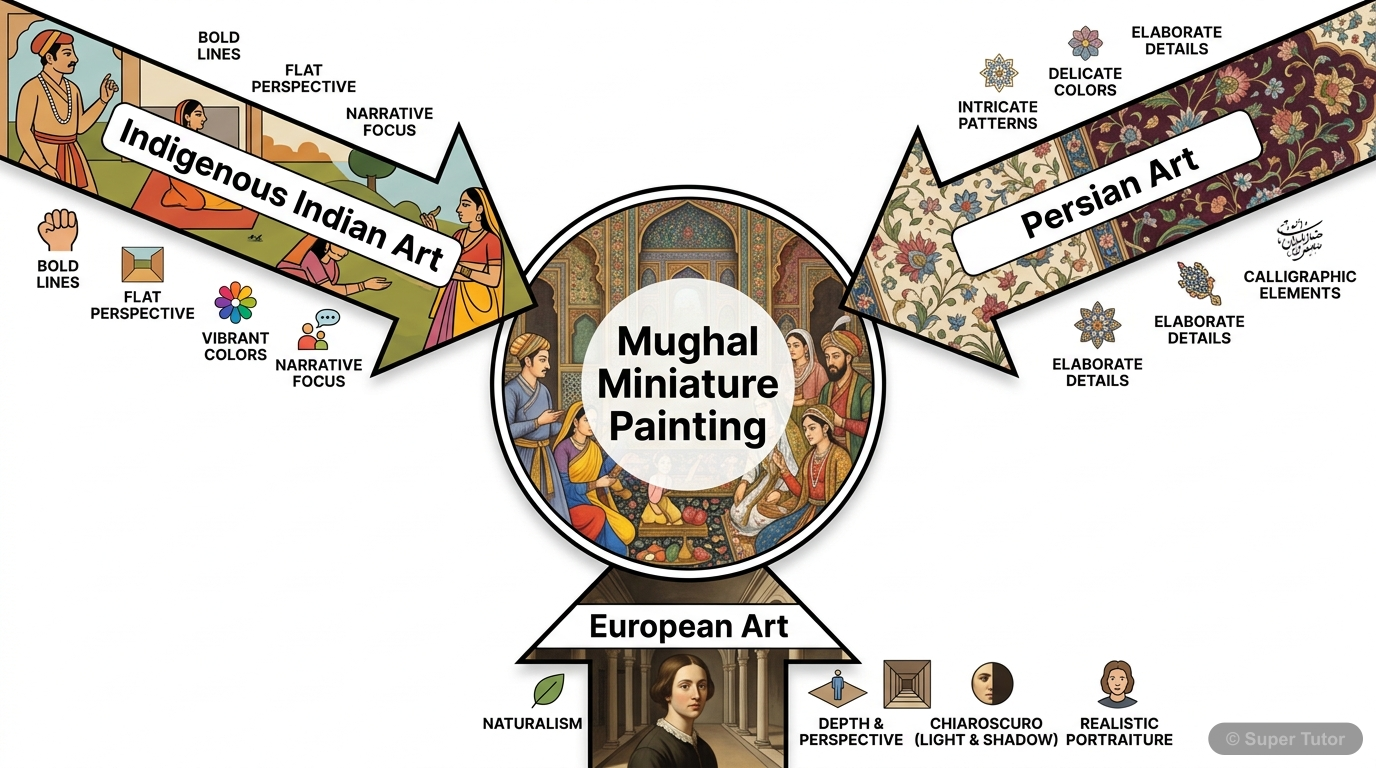
One of 6 illustrations for The Mughal School of Miniature Painting in Super Tutor — alongside flashcards, concept maps and practice questions.
See them allEvolution of Mughal Painting Through Imperial Reigns
The map in words
- 1526
- Babur brings Persian traditions
- 1530-1556
- Humayun recruits Persian masters
- 1556-1605
- Akbar creates synthesis style
- 1605-1627
- Jahangir emphasizes naturalism
- 1628-1658
- Shah Jahan achieves peak sophistication
- 1658-1707
- Aurangzeb period sees decline
- 1707-1857
- Provincial courts continue tradition
Mughal Miniature Painting Overview
The map in words
- Mughal Painting
- Origins
- Babur 1526
- Persian Influence
- Central Asian Heritage
- Key Rulers
- Humayun
- Exile Period
- Persian Artists
- Nigaar Khana
- Akbar 1556-1605
- 100 Artists
- Hamza Nama
- Cultural Integration
- Jahangir 1605-1627
- Scientific Accuracy
- Individual Masterpieces
- European Influence
- Shah Jahan 1628-1658
- Peak Period
- Idealization
- Padshahnama
- Humayun
- Techniques
- Natural Pigments
- Handmade Paper
- Three Stage Process
- Tarh
- Chiharanama
- Rangamizi
- Influences
- Indian Traditional
- Flat Perspective
- Bold Colors
- Strong Lines
- Persian
- Sophistication
- Refinement
- Court Themes
- European
- Naturalism
- Spatial Depth
- Christian Themes
- Indian Traditional
- Origins
Evolution of Mughal Painting School
The map in words
- 1526
- Babur arrives in India
- Brings Central Asian aesthetic
- 1530-1556
- Humayun period
- Persian artists arrive
- Nigar Khana established
- 1556-1605
- Akbar period
- Golden age begins
- Major manuscripts created
- 1605-1627
- Jahangir period
- Naturalism and portraiture
- Scientific accuracy achieved
- 1628-1658
- Shah Jahan period
- Classical refinement
- Idealized beauty emphasized
- 1658-1707
- Aurangzeb period
- Reduced patronage begins
- 1707-1857
- Later Mughals
- Gradual decline
- Final masterpieces created
Mughal miniature painting as a royal art form that developed through Indo-Persian-European synthesis, changing patronage, and changing techniques from Babur to the later Mughals
The map in words
- Mughal miniature painting as a royal art form that developed through Indo-Persian-European synthesis, changing patronage, and changing techniques from Babur to the later Mughals
- Early Mughal beginnings
- Humayun and artistic transition
- Akbar’s atelier
- Jahangir’s naturalism
- Shah Jahan’s idealised style
- Dara Shikoh and succession
- Aurangzeb and decline
- Later Mughal painting
Explore these maps interactively
Explore DiagramsFrequently Asked Questions
What are the important topics in The Mughal School of Miniature Painting for CBSE Class 12 Fine Arts?
What do the concept maps for The Mughal School of Miniature Painting show?
How should I revise The Mughal School of Miniature Painting for the CBSE Class 12 board exam?
Sources & Official References
- NCERT Official — ncert.nic.in
- CBSE Academic — cbseacademic.nic.in
- CBSE Official — cbse.gov.in
- National Education Policy 2020 — education.gov.in
Content is aligned to the official syllabus. Refer to the board website for the latest curriculum.
More resources for The Mughal School of Miniature Painting
Practice Quiz
Test yourself with a quick quiz
Important Questions
Exam-style questions with answers
Revision Notes
Key points for last-minute revision
Chapter Summary
Understand the chapter at a glance
Study Plan
Step-by-step plan for this chapter
Flashcards
Quick-fire cards for active recall
Syllabus
What topics to cover
NCERT Solutions
Every textbook question solved step by step
For serious students
Get the full The Mughal School of Miniature Painting chapter — start free.
Quizzes, flashcards, an AI doubt solver and a study plan for CBSE Class 12 Fine Arts. Free to start, no card needed.