The Mughal School of Miniature Painting — Revision Notes
CBSE · Class 12 · Fine Arts
The Mughal School of Miniature Painting revision notes for CBSE Class 12 Fine Arts: 4 topics in quick points. Part of the CBSE Class 12 Fine Arts syllabus.
Interactive on Super Tutor
Studying The Mughal School of Miniature Painting? Get the full interactive chapter.
Quizzes, flashcards, AI doubt-solver and a step-by-step study plan — built for revision notes and more.
Free trial, no card needed.
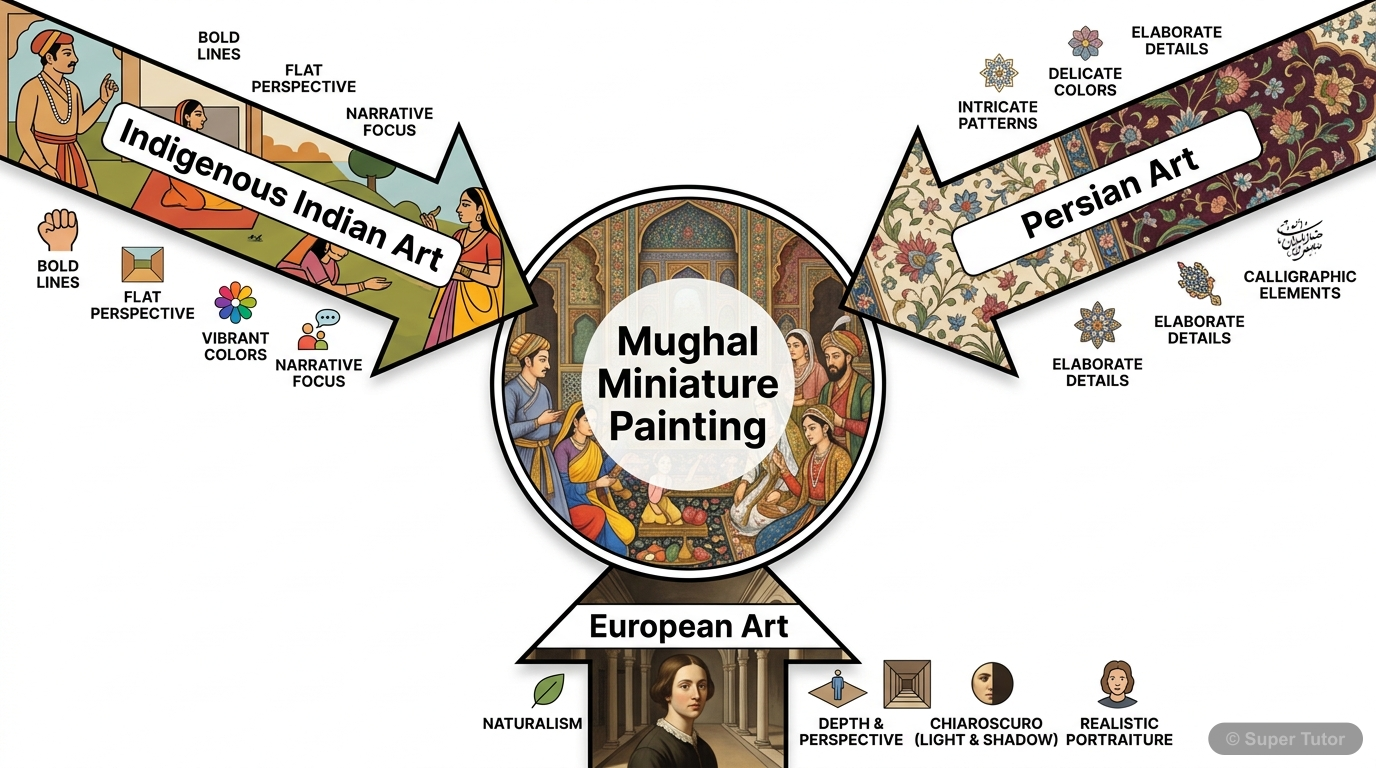
One of 6 illustrations for The Mughal School of Miniature Painting in Super Tutor — alongside flashcards, concept maps and practice questions.
See them allKey Topics to Revise
Origin and Character of Mughal Painting
- Mughal painting developed in the sixteenth century in the northern Indian subcontinent and continued till the mid-nineteenth century.
- It was not created in isolation; it developed through interaction with pre-Mughal Indian schools, Persian art, and later European art.
- The style is known for subtlety, finesse, optical realism, and three-dimensional looking figures.
Babur and Humayun: Early Mughal Phase
- Babur came to India in 1526 and was the first Mughal emperor.
- Babur was a descendant of Timur and Chaghtai Turk, and he brought Persian aesthetic sensibility to India.
- Babur wrote Baburnama and had a keen eye for portraiture.
Akbar: Expansion of Mughal Painting
- Akbar reigned from 1556 to 1605.
- Akbar is believed to have suffered from dyslexia, which made him give special importance to manuscript illustration.
- Akbar employed more than a hundred artists in his royal atelier.
Jahangir: Naturalism and Fine Detail
- Jahangir reigned from 1605 to 1627.
- Prince Salim became Jahangir after returning from Allahabad.
- Jahangir employed Aqa Riza and his son Abul Hasan.
Get complete notes with diagrams and examples
Full NotesKey Concepts
Frequently Asked Questions
What are the important topics in The Mughal School of Miniature Painting for CBSE Class 12 Fine Arts?
How should I revise The Mughal School of Miniature Painting for the CBSE Class 12 board exam?
Sources & Official References
- NCERT Official — ncert.nic.in
- CBSE Academic — cbseacademic.nic.in
- CBSE Official — cbse.gov.in
- National Education Policy 2020 — education.gov.in
Content is aligned to the official syllabus. Refer to the board website for the latest curriculum.
More resources for The Mughal School of Miniature Painting
Practice Quiz
Test yourself with a quick quiz
Important Questions
Exam-style questions with answers
Chapter Summary
Understand the chapter at a glance
Concept Maps
See how topics connect
Study Plan
Step-by-step plan for this chapter
Flashcards
Quick-fire cards for active recall
Syllabus
What topics to cover
NCERT Solutions
Every textbook question solved step by step
For serious students
Get the full The Mughal School of Miniature Painting chapter — start free.
Quizzes, flashcards, an AI doubt solver and a study plan for CBSE Class 12 Fine Arts. Free to start, no card needed.