Chapter 3 of 8
NCERT Solutions

The Mughal School of Miniature Painting

CBSE · Class 12 · Fine Arts

NCERT Solutions for The Mughal School of Miniature Painting — CBSE Class 12 Fine Arts.

5 concepts

Interactive on Super Tutor

Studying The Mughal School of Miniature Painting? Get the full interactive chapter.

Quizzes, flashcards, AI doubt-solver and a step-by-step study plan — built for ncert solutions and more.

1,000+ Class 12 students started this chapter today
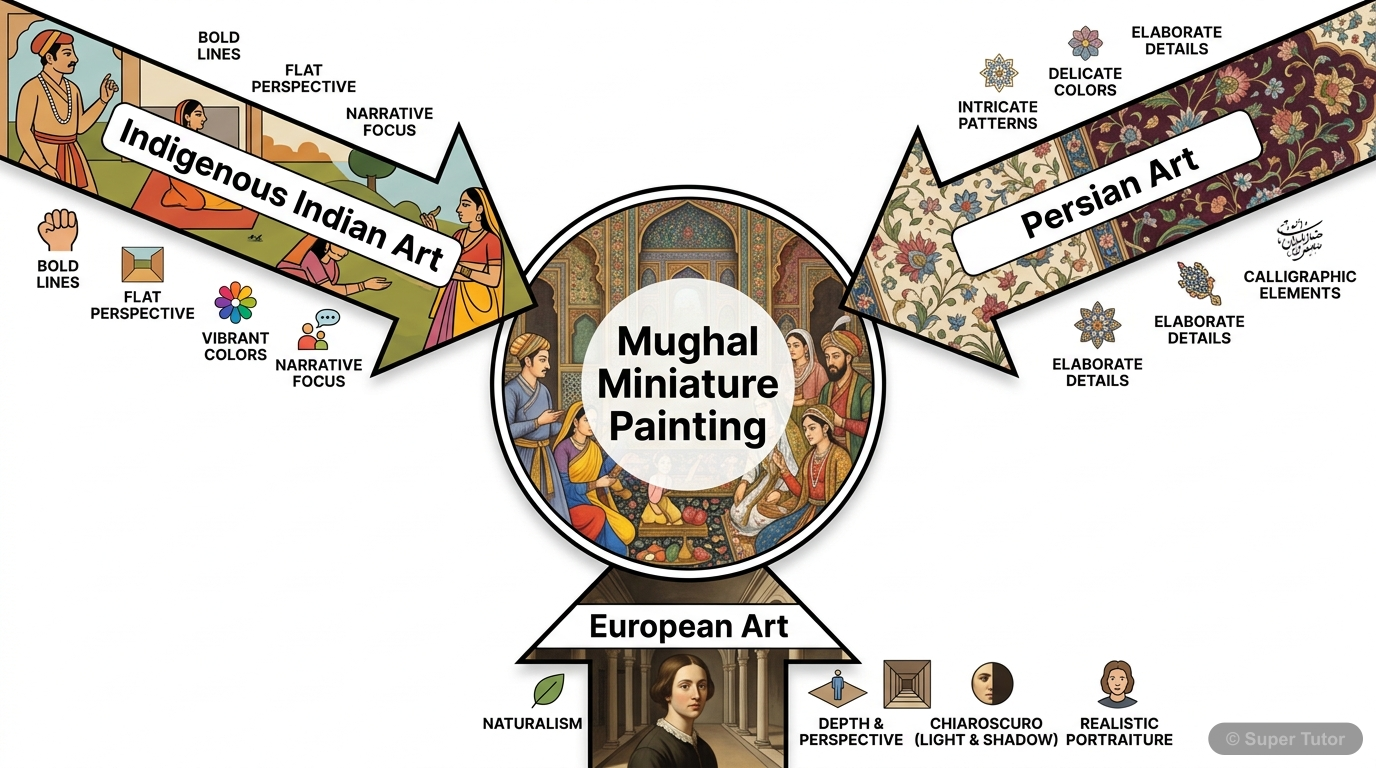
An infographic illustrating the synthesis of indigenous Indian, Persian, and European styles and themes that shaped Mughal miniature painting.
Super Tutor

This is just one of 6+ visuals inside Super Tutor's The Mughal School of Miniature Painting chapter

Explore the full set
4 Questions Solved · 1 Section

EXERCISE — The Mughal School of Miniature Painting

1Name two master artists, who were invited to India by Humayun, and discuss their masterpieces in detail.Show solution
Given / Context: Emperor Humayun, during his exile in Persia (Safavid court), came into contact with Persian master painters. On his return to India, he brought two of them to establish a royal atelier.

The Two Master Artists:

1. Mir Sayyid Ali

- Mir Sayyid Ali was the son of the renowned Persian painter Mir Musavvir. He was already a celebrated artist at the Safavid court before Humayun persuaded him to come to India.
- He is credited as one of the chief supervisors of the monumental *Hamzanama* (also called *Dastan-e-Amir Hamza*) project, initiated under Humayun and continued under Akbar.
- Masterpiece — Hamzanama: This was an extraordinarily ambitious project consisting of approximately 1,400 large-format paintings (each roughly 69 × 54 cm) painted on cloth/cotton fabric, illustrating the legendary adventures of Amir Hamza, the uncle of Prophet Muhammad. The paintings are large in scale compared to conventional miniatures, display bold Persian compositional conventions, yet show early signs of Indian influence in facial types, flora, and colour. The figures are dynamic, the colours vivid, and the narrative energy is intense. Surviving folios are now housed in museums such as the Victoria & Albert Museum, London, and the Museum of Applied Arts, Vienna.
- He also painted a celebrated miniature known as 'A Princes' Encampment' (or *Princes of the House of Timur*), which shows a royal gathering in a garden setting with fine Persian detailing.

2. Abd al-Samad (Abdus Samad)

- Abd al-Samad, also known by his title *Shirin Qalam* (Sweet Pen), was another Persian master who accompanied Humayun to India. He became one of the most influential figures in the Mughal atelier and continued to serve under Akbar.
- He is said to have personally taught the young Prince Akbar the art of painting.
- Masterpiece — 'Princes of the House of Timur': This is one of the most celebrated early Mughal paintings, attributed largely to Abd al-Samad. It depicts Timurid and Mughal rulers — including Timur, Babur, Humayun, and Akbar — seated together in a garden, symbolising dynastic continuity and legitimacy. The painting is executed with fine Persian brushwork, rich colours, and careful attention to portraiture. It is currently housed in the British Museum, London.
- He also contributed significantly to the *Hamzanama* project and later supervised the illustration of manuscripts such as the *Tutinama* (Tales of a Parrot).
- Under Akbar, Abd al-Samad rose to administrative positions as well, serving as the Master of the Mint (*Diwan*) at Fatehpur Sikri.

Conclusion: Both Mir Sayyid Ali and Abd al-Samad laid the foundational grammar of Mughal painting by blending Persian sophistication with Indian sensibilities, training local artists and establishing the collaborative atelier system that defined Mughal art for generations.
2Out of the several art projects that Akbar undertook, discuss your favourite work, explaining what you like about it.Show solution
Note: This is a personal/opinion-based question. The following is a model answer based on the *Hamzanama* project (students may choose any other Akbari project such as the *Akbarnama*, *Razmnama*, *Tutinama*, etc., and write accordingly).

Given / Context: Emperor Akbar was a great patron of the arts. Under his reign, the Mughal atelier produced illustrated manuscripts of epics, histories, and literary works. Major projects included the *Hamzanama*, *Tutinama*, *Akbarnama*, *Razmnama* (Persian translation of the Mahabharata), *Ramayana*, *Baburnama*, and *Khamsa of Nizami*.

**My Favourite Work: The *Akbarnama***

The *Akbarnama* (Book of Akbar), written by Akbar's court historian Abu'l Fazl, is the official chronicle of Akbar's reign. Its illustrated manuscript, produced in the late 16th century, is my favourite Akbari art project for the following reasons:

1. Historical Significance: The paintings document real events — battles, court scenes, hunts, architectural constructions — making them invaluable historical records as well as works of art.

2. Dynamic Composition: The paintings are full of movement and energy. For example, the folio depicting the *'Akbar Supervising the Construction of Fatehpur Sikri'* shows hundreds of workers, elephants, and architects in a single frame, conveying the scale and ambition of Akbar's vision.

3. Synthesis of Styles: The *Akbarnama* paintings beautifully blend Persian compositional elegance with Indian naturalism — Indian faces, local flora, indigenous architectural details — and early European influences in spatial depth and foreshortening.

4. Portraiture: Individual faces are rendered with psychological depth and realism, a departure from the flat, idealised Persian convention.

5. Collaborative Mastery: The project involved master artists like Basawan, Miskina, Dharm Das, and La'l, each contributing their specialisation, resulting in a work of extraordinary variety and quality. Most folios are now in the Victoria & Albert Museum, London.

Conclusion: The *Akbarnama* represents the peak of Akbari painting — a perfect marriage of history, literature, and visual art — which is why it remains my favourite among Akbar's many artistic undertakings.
3Make a comprehensive list of artists in the Mughal court, briefly explaining one painting of each in 100 words.Show solution
Given / Context: The Mughal court was home to numerous gifted artists across different reigns. Below is a comprehensive list with a brief description of one notable painting by each.

---

1. Mir Sayyid Ali *(Reign of Humayun and Akbar)*

Painting: Hamzanama folio
Mir Sayyid Ali was one of the chief supervisors of the *Hamzanama* project. A surviving folio shows a dramatic battle or adventure scene from the life of Amir Hamza. Painted on cloth in large format (approx. 69 × 54 cm), the composition is bold and energetic. Persian spatial conventions — high horizon, flat ground plane, decorative rocks and foliage — are evident. Figures are expressive and dynamic. The vivid reds, blues, and greens reflect the Persian palette. This folio exemplifies the early Mughal style where Persian training meets the beginnings of Indian naturalism.

---

2. Abd al-Samad (Abdus Samad / Shirin Qalam) *(Reign of Humayun and Akbar)*

Painting: Princes of the House of Timur
This celebrated painting depicts Timurid and Mughal rulers — Timur, Babur, Humayun, and Akbar — seated in a garden, asserting dynastic legitimacy. The composition is formal yet graceful, with figures arranged in a garden setting adorned with flowering trees. Persian brushwork is refined and precise. Faces show early attempts at individual portraiture. Rich colours — gold, lapis blue, and deep green — dominate. The painting is a political statement as much as an artistic achievement, linking the Mughals to the great Timurid heritage. It is now housed in the British Museum, London.

---

3. Basawan *(Reign of Akbar)*

Painting: Akbar's Adventures with the Elephant Hawa'i (from Akbarnama)
Basawan was considered one of Akbar's most gifted artists, praised by Abu'l Fazl for his mastery of portraiture and composition. This folio from the *Akbarnama* depicts the young Akbar riding the fierce elephant Hawa'i across a bridge of boats over the Yamuna, while another elephant falls into the river. The composition is dramatic and diagonal, conveying speed and danger. Basawan's use of foreshortening and spatial depth shows European influence. Individual faces are psychologically vivid. The painting is a masterclass in narrative dynamism and remains one of the finest examples of Akbari painting.

---

4. Daswanth *(Reign of Akbar)*

Painting: Illustrations for the Razmnama
Daswanth, said to have risen from humble origins to become one of Akbar's finest painters, contributed to the *Razmnama* (Persian translation of the Mahabharata). His paintings are characterised by bold, expressive figures, dramatic colour contrasts, and a raw emotional energy. A folio depicting a battle scene from the Mahabharata shows warriors in fierce combat, with dynamic postures and vivid reds and oranges. His style is more vigorous and less refined than Basawan's, yet deeply powerful. Tragically, Daswanth died young, reportedly by his own hand, leaving behind a small but remarkable body of work.

---

5. Miskina *(Reign of Akbar)*

Painting: Babur's Memoirs (Baburnama) illustrations
Miskina was a senior artist in Akbar's atelier known for his fine draughtsmanship and ability to depict nature. His contributions to the *Baburnama* illustrations include detailed landscapes, animals, and court scenes. One notable folio shows Babur supervising the laying out of a garden, with carefully observed trees, flowers, and water channels. Miskina's strength lay in his naturalistic rendering of flora and fauna, reflecting the growing Mughal interest in the natural world. His work bridges the Persian decorative tradition and the more observational approach that would fully mature under Jahangir.

---

6. Farrukh Beg *(Reign of Akbar and Jahangir)*

Painting: Portrait of a Sufi Saint
Farrukh Beg was a Central Asian artist who worked in the Mughal court and was known for his portraiture. A celebrated painting attributed to him depicts a Sufi saint or dervish in a contemplative pose, rendered with great sensitivity. The face is individualised and spiritually expressive. The use of a plain or simple background focuses attention entirely on the subject — a technique that would become standard in Mughal portraiture under Jahangir. The fine line work and subtle modelling of the face show both Persian training and an emerging Mughal naturalism.

---

7. Ustad Mansur *(Reign of Jahangir)*

Painting: The Siberian Crane (Saras)
Ustad Mansur, given the title *Nadir-ul-Asr* (Wonder of the Age) by Jahangir, was the foremost natural history painter of the Mughal court. His painting of the Siberian Crane is a landmark in Indian art. The bird is depicted with scientific precision — every feather, the texture of the skin, the posture — against a plain background, allowing the viewer to study it as a specimen. Yet it is also a work of great beauty. This approach reflects Jahangir's passionate interest in nature and the influence of European botanical and zoological illustration on Mughal painting.

---

8. Bichitr *(Reign of Jahangir and Shah Jahan)*

Painting: Jahangir Preferring a Sufi Sheikh to Kings
Bichitr was one of the most accomplished painters of the Jahangiri and early Shah Jahani period. This allegorical painting shows Emperor Jahangir seated on an hourglass throne, preferring the company of a Sufi saint over kings (including King James I of England and the Ottoman Sultan). European-style cherubs, a globe, and an hourglass with skulls — all borrowed from Western iconography — are seamlessly integrated. The painting is a sophisticated political and spiritual statement, demonstrating Jahangir's self-image as a divinely guided ruler. It exemplifies the cosmopolitan, syncretic character of Mughal court culture.

---

9. Abu'l Hasan *(Reign of Jahangir)*

Painting: Squirrels in a Plane Tree
Abu'l Hasan, given the title *Nadir-uz-Zaman* (Wonder of the Time) by Jahangir, was among the emperor's most favoured painters. His painting *Squirrels in a Plane Tree* (now in the India Office Library, London) depicts grey squirrels playing among the branches of a chinar tree with extraordinary naturalism. The rendering of fur, the texture of bark, and the delicate leaves show meticulous observation. The composition is balanced yet lively. This work exemplifies the Jahangiri ideal of art as a window onto the natural world, combining scientific observation with aesthetic refinement.

---

10. Muhammad Faqirullah Khan (and other Shah Jahani artists) *(Reign of Shah Jahan)*

Painting: Shah Jahan on the Globe
During Shah Jahan's reign, portraiture became more formal and idealised. A painting showing Shah Jahan standing on a globe, surrounded by a halo of light, exemplifies the imperial imagery of this period. The emperor is depicted in profile — a convention that became standard — with a jewelled halo, fine garments, and a flower in hand. The background is plain gold, focusing attention on the imperial figure. The style is more rigid and decorative compared to the naturalism of Jahangir's era, reflecting the shift toward formal court protocol and the glorification of imperial power.

---

Conclusion: The Mughal atelier brought together artists from Persia, Central Asia, and India, each contributing unique skills. Together they created one of the world's great traditions of manuscript painting and portraiture.
4With examples of three paintings of your choice, discuss the indigenous Indian, Persian and European visual elements prevalent during the medieval period.Show solution
Given / Context: Mughal painting is celebrated as a great synthesis — it absorbed Persian compositional and technical traditions, indigenous Indian artistic sensibilities, and European pictorial conventions introduced through Jesuit missionaries and traders. The following three paintings illustrate how these three streams were woven together.

---

Painting 1: Hamzanama Folio *(c. 1562–77, Akbar's reign)*

This large-format painting on cloth, illustrating the adventures of Amir Hamza, is one of the earliest examples of the Mughal synthesis.

- Persian Elements: The high horizon line, flat ground plane, decorative rocks (Chinese-influenced through Persia), stylised clouds, and the overall compositional structure are directly derived from the Safavid Persian tradition. The use of lapis lazuli blue and the decorative treatment of trees and foliage are also Persian in origin.
- Indigenous Indian Elements: The facial types of many figures — broad faces, large eyes, dark complexions — reflect Indian physiognomy rather than the Persian ideal. The use of warm earthy reds and ochres, and certain architectural details (such as jharokha windows), are Indian in character. The large scale of the paintings (unusual in Persian miniature tradition) may also reflect the influence of Indian mural painting.
- European Elements: At this early stage, European influence is minimal, though some scholars detect a slightly greater interest in three-dimensional form compared to pure Persian flatness.

---

**Painting 2: Akbar's Adventures with the Elephant Hawa'i — from the *Akbarnama*** *(c. 1590s, attributed to Basawan)*

This dramatic folio from the *Akbarnama* depicts Akbar riding the fierce elephant Hawa'i across a bridge of boats.

- Persian Elements: The overall manuscript format, the use of rich colours (lapis blue, vermilion), the decorative treatment of the sky and landscape, and the convention of multiple simultaneous events within a single frame are Persian in origin.
- Indigenous Indian Elements: The Indian landscape — the Yamuna river, the tropical vegetation, the Indian architectural elements in the background — grounds the painting in a specifically Indian setting. The faces of courtiers, soldiers, and servants reflect Indian physiognomy. The elephants themselves are rendered with the kind of intimate knowledge that only Indian artists, familiar with these animals from childhood, could bring.
- European Elements: Basawan's use of foreshortening (the elephant's body receding into the picture plane), atmospheric perspective (distant elements rendered in lighter tones), and a more convincing sense of three-dimensional space and depth all reflect the influence of European prints and paintings that had entered the Mughal court. These techniques were entirely absent from the Persian tradition and represent a conscious borrowing from Western pictorial conventions.

---

Painting 3: Jahangir Preferring a Sufi Sheikh to Kings *(c. 1615–18, attributed to Bichitr)*

This allegorical painting is perhaps the most explicit example of the three-way synthesis in Mughal art.

- Persian Elements: The overall format of the imperial portrait, the use of a richly decorated border with floral motifs, the convention of the emperor holding a flower, and the formal hierarchical arrangement of figures reflect the Persian courtly portrait tradition.
- Indigenous Indian Elements: The concept of the emperor as a divinely radiant figure — shown through the large halo of light behind Jahangir — draws on Indian (Hindu and Buddhist) iconographic traditions of the *prabhamandala* (halo/aureole). The Sufi saint represents the Indian spiritual tradition that Jahangir deeply respected. The warm palette and certain decorative motifs also reflect Indian sensibility.
- European Elements: This painting is the most striking in its absorption of European visual language. The cherubs (putti) holding a cloth behind Jahangir are directly borrowed from European Renaissance and Baroque painting. The hourglass with skulls at the base is a European *memento mori* symbol. The globe on which the throne rests is a European cartographic symbol of world dominion. The figure of King James I of England (shown as one of the kings Jahangir ignores) is rendered in a style clearly influenced by European portraiture. The spatial illusionism — the sense that the throne floats in a real space — also reflects European influence.

---

Conclusion:

The three paintings together demonstrate the remarkable openness and eclecticism of Mughal artistic culture. Persian training provided the technical foundation and compositional grammar; Indian artists brought local knowledge, naturalism, and indigenous iconographic traditions; and European prints and paintings, introduced from the late 16th century onward, contributed new tools of spatial representation — foreshortening, atmospheric perspective, chiaroscuro, and allegorical symbolism. The result was a uniquely syncretic visual language that is one of the great achievements of world art history.

| Element | Persian | Indigenous Indian | European |
|---|---|---|---|
| Composition | High horizon, flat ground | Indian landscape, faces | Spatial depth, foreshortening |
| Colour | Lapis blue, gold | Warm ochres, earthy reds | Chiaroscuro, tonal modelling |
| Iconography | Courtly portrait conventions | Halo (prabhamandala) | Cherubs, globe, memento mori |
| Technique | Fine line, decorative | Naturalistic animal/plant rendering | Atmospheric perspective |

Stuck on a step?

Ask Super Tutor AI to explain any solution on this page in a simpler way — free, 24x7.

Ask a Doubt Free

Frequently Asked Questions

What are the important topics in The Mughal School of Miniature Painting for CBSE Class 12 Fine Arts?
Key topics in The Mughal School of Miniature Painting include Evolution of Mughal Painting Through Imperial Reigns, Mughal Miniature Painting Overview, Evolution of Mughal Painting School. These are the concepts CBSE Class 12 examiners draw on most — study them first, then practise related questions.
How to score full marks in The Mughal School of Miniature Painting — CBSE Class 12 Fine Arts?
Start by understanding all key concepts. Practise previous year questions from this chapter. Revise formulas and definitions regularly. Use flashcards for quick revision before the exam.
Where can I get free NCERT Solutions for The Mughal School of Miniature Painting Class 12 Fine Arts?
This page has free step-by-step NCERT Solutions for every exercise question in The Mughal School of Miniature Painting (CBSE Class 12 Fine Arts) — written the way examiners award marks: given, formula, working, answer.

Sources & Official References

Content is aligned to the official syllabus. Refer to the board website for the latest curriculum.

For serious students

Get the full The Mughal School of Miniature Painting chapter — for free.

Quizzes, flashcards, AI doubt-solver and a step-by-step study plan for CBSE Class 12 Fine Arts.