The Mughal School of Miniature Painting — Study Plan
CBSE · Class 12 · Fine Arts
A step-by-step study plan for The Mughal School of Miniature Painting, CBSE Class 12 Fine Arts: what to learn first, what to practise and when to revise.
Interactive on Super Tutor
Studying The Mughal School of Miniature Painting? Get the full interactive chapter.
Quizzes, flashcards, AI doubt-solver and a step-by-step study plan — built for study plan and more.
Free trial, no card needed.
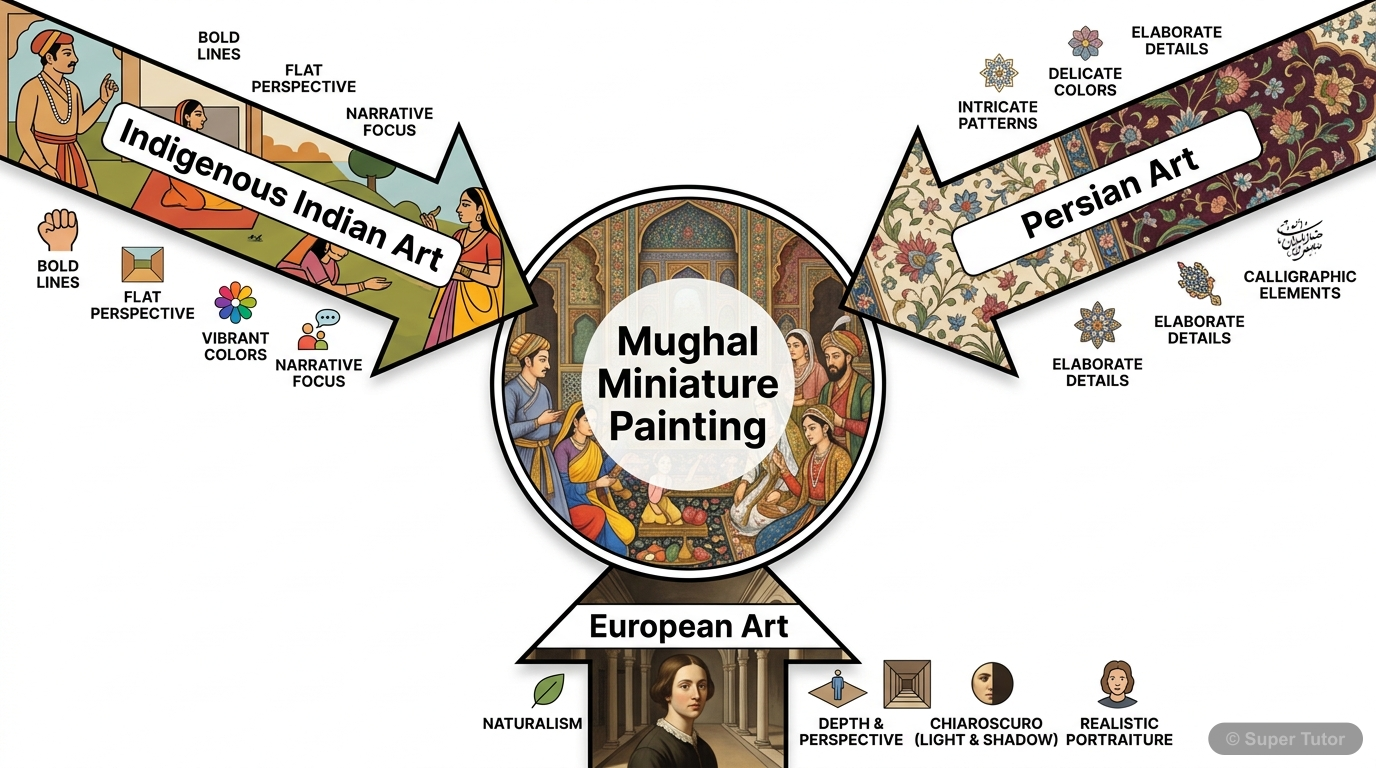
One of 6 illustrations for The Mughal School of Miniature Painting in Super Tutor — alongside flashcards, concept maps and practice questions.
See them allStudy Plan
Learn the Theory
Read the textbook chapter carefully. Note down definitions, formulas and key ideas. Focus on: Origin and Character of Mughal Painting, Babur and Humayun: Early Mughal Phase, Akbar: Expansion of Mughal Painting.
Practise
Solve the textbook exercises and extra practice questions. There are 63 questions available for this chapter.
Revise & Test
Revise key points without looking at your notes. Take a practice quiz and mark weak areas for another pass.
Spaced Revision
Come back to The Mughal School of Miniature Painting after a week. Use flashcards for quick recall and try past exam questions on this chapter.
What to Focus On
- Mughal painting developed in the sixteenth century and continued till the mid-nineteenth century.
- It is a miniature painting style mainly used in manuscripts and albums.
- It combined Indian, Persian, and European influences.
- Babur arrived in India in 1526.
- Babur was the first Mughal emperor and author of Baburnama.
- Bihzad was known for composition and colour tints but not strong face drawing.
- Akbar ruled from 1556 to 1605.
- He is believed to have suffered from dyslexia.
- More than a hundred artists worked in his royal atelier.
Common Mistakes to Avoid
Mughal painting was a pure Persian import with no Indian influence.
Babur was only a conqueror and had no role in art or painting.
Humayun did not contribute to Mughal painting because he spent much of his time in exile.
Memory Tips
Basic definition and time span of Mughal painting
Babur as the first Mughal emperor and patron of Persian sensibility
Babur’s view of Bihzad
Humayun’s artistic contribution and the Nigaar Khana
Want a personalised study plan?
Super Tutor builds a day-by-day plan for CBSE Class 12 Fine Arts that fits your exam date and pace.
Create My Study PlanFrequently Asked Questions
What are the important topics in The Mughal School of Miniature Painting for CBSE Class 12 Fine Arts?
How should I revise The Mughal School of Miniature Painting for the CBSE Class 12 board exam?
Sources & Official References
- NCERT Official — ncert.nic.in
- CBSE Academic — cbseacademic.nic.in
- CBSE Official — cbse.gov.in
- National Education Policy 2020 — education.gov.in
Content is aligned to the official syllabus. Refer to the board website for the latest curriculum.
More resources for The Mughal School of Miniature Painting
Practice Quiz
Test yourself with a quick quiz
Important Questions
Exam-style questions with answers
Revision Notes
Key points for last-minute revision
Chapter Summary
Understand the chapter at a glance
Concept Maps
See how topics connect
Flashcards
Quick-fire cards for active recall
Syllabus
What topics to cover
NCERT Solutions
Every textbook question solved step by step
For serious students
Get the full The Mughal School of Miniature Painting chapter — start free.
Quizzes, flashcards, an AI doubt solver and a study plan for CBSE Class 12 Fine Arts. Free to start, no card needed.