The Pahari Schools of Painting — Revision Notes
CBSE · Class 12 · Fine Arts
The Pahari Schools of Painting revision notes for CBSE Class 12 Fine Arts: 4 topics in quick points. Part of the CBSE Class 12 Fine Arts syllabus.
Interactive on Super Tutor
Studying The Pahari Schools of Painting? Get the full interactive chapter.
Quizzes, flashcards, AI doubt-solver and a step-by-step study plan — built for revision notes and more.
Free trial, no card needed.
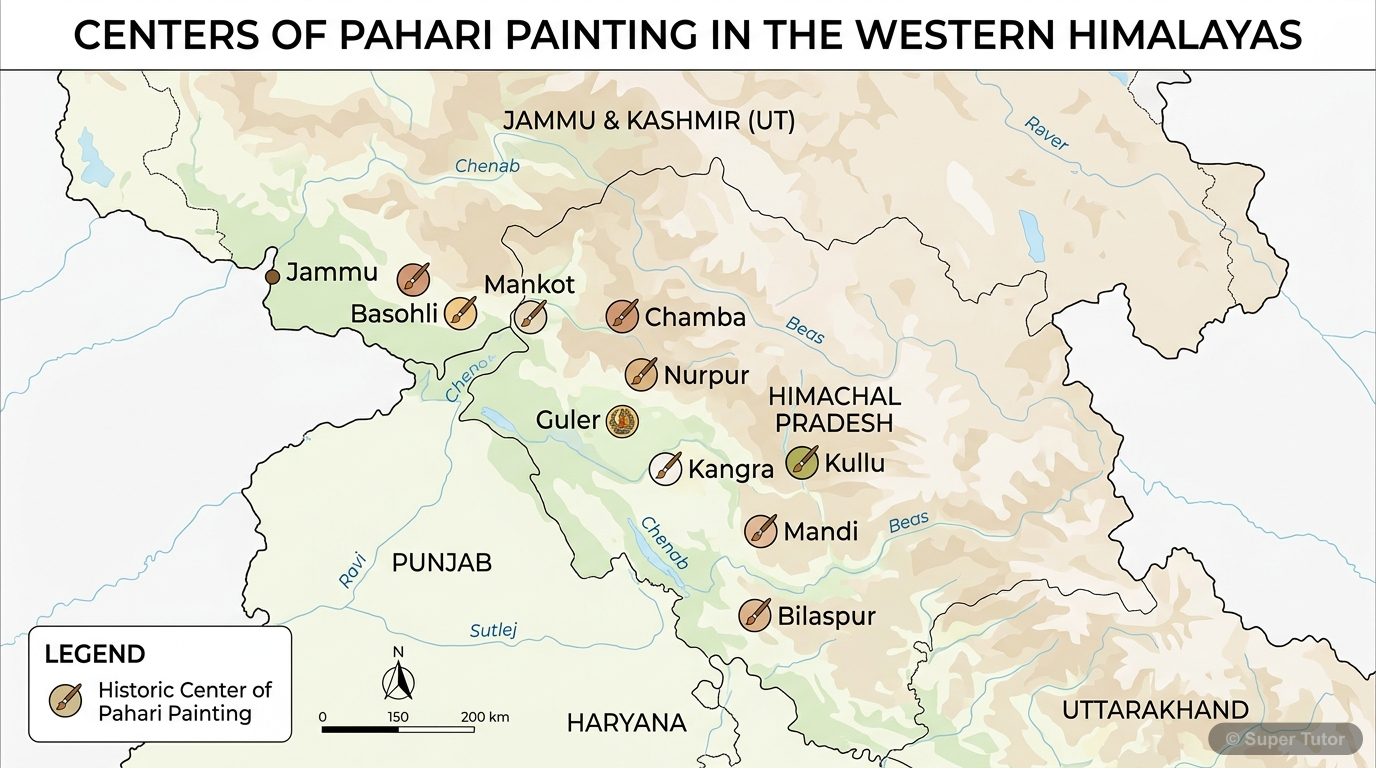
Learn better with visuals Super Tutor pairs illustrations like this with notes and quizzes for The Pahari Schools of Painting.
Get startedKey Topics to Revise
Origin and Broad Features
- Pahari painting centres emerged in the western Himalayan hill states from the seventeenth to nineteenth century.
- Basohli, Guler, Kangra, Kullu, Chamba, Mankot, Nurpur, Mandi, Bilaspur and Jammu are important centres associated with Pahari painting.
- These centres show individual features, but they do not develop as independent schools with distinctive styles.
Basohli School
- Basohli developed a distinctive and magnificent style under Kirpal Pal, who ruled from 1678 to 1695.
- The style is marked by strong primary colours, warm yellows in the background and horizon, stylised vegetation, and raised white paint for pearls in ornaments.
- Its most significant characteristic is the use of small shiny green beetle wings to delineate jewellery and simulate the effect of emeralds.
Guler or Pre-Kangra Phase
- The first quarter of the eighteenth century saw a complete transformation in the Basohli style, initiating the Guler-Kangra phase.
- This phase first appeared in Guler under the patronage of Raja Govardhan Chand, who ruled from 1744 to 1773.
- Pandit Seu, with his sons Manak and Nainsukh, changed the course of painting around 1730–40.
Kangra School
- Painting in the Kangra region blossomed under Raja Sansar Chand, who ruled from 1775 to 1823.
- Sansar Chand ascended the throne at age 10.
- His grandfather Ghamand Chand restored the kingdom to its earlier glory, founded the capital town of Tira Sujanpur on the banks of the river Beas, and maintained an atelier of artists.
Get complete notes with diagrams and examples
Full NotesKey Concepts
Frequently Asked Questions
What are the important topics in The Pahari Schools of Painting for CBSE Class 12 Fine Arts?
How should I revise The Pahari Schools of Painting for the CBSE Class 12 board exam?
Sources & Official References
- NCERT Official — ncert.nic.in
- CBSE Academic — cbseacademic.nic.in
- CBSE Official — cbse.gov.in
- National Education Policy 2020 — education.gov.in
Content is aligned to the official syllabus. Refer to the board website for the latest curriculum.
More resources for The Pahari Schools of Painting
Practice Quiz
Test yourself with a quick quiz
Important Questions
Exam-style questions with answers
Chapter Summary
Understand the chapter at a glance
Concept Maps
See how topics connect
Study Plan
Step-by-step plan for this chapter
Flashcards
Quick-fire cards for active recall
Syllabus
What topics to cover
NCERT Solutions
Every textbook question solved step by step
For serious students
Get the full The Pahari Schools of Painting chapter — start free.
Quizzes, flashcards, an AI doubt solver and a study plan for CBSE Class 12 Fine Arts. Free to start, no card needed.