The Pahari Schools of Painting — Chapter Summary
CBSE · Class 12 · Fine Arts
Summary of The Pahari Schools of Painting for CBSE Class 12 Fine Arts. Part of the CBSE Class 12 Fine Arts syllabus.
Interactive on Super Tutor
Studying The Pahari Schools of Painting? Get the full interactive chapter.
Quizzes, flashcards, AI doubt-solver and a step-by-step study plan — built for chapter summary and more.
Free trial, no card needed.
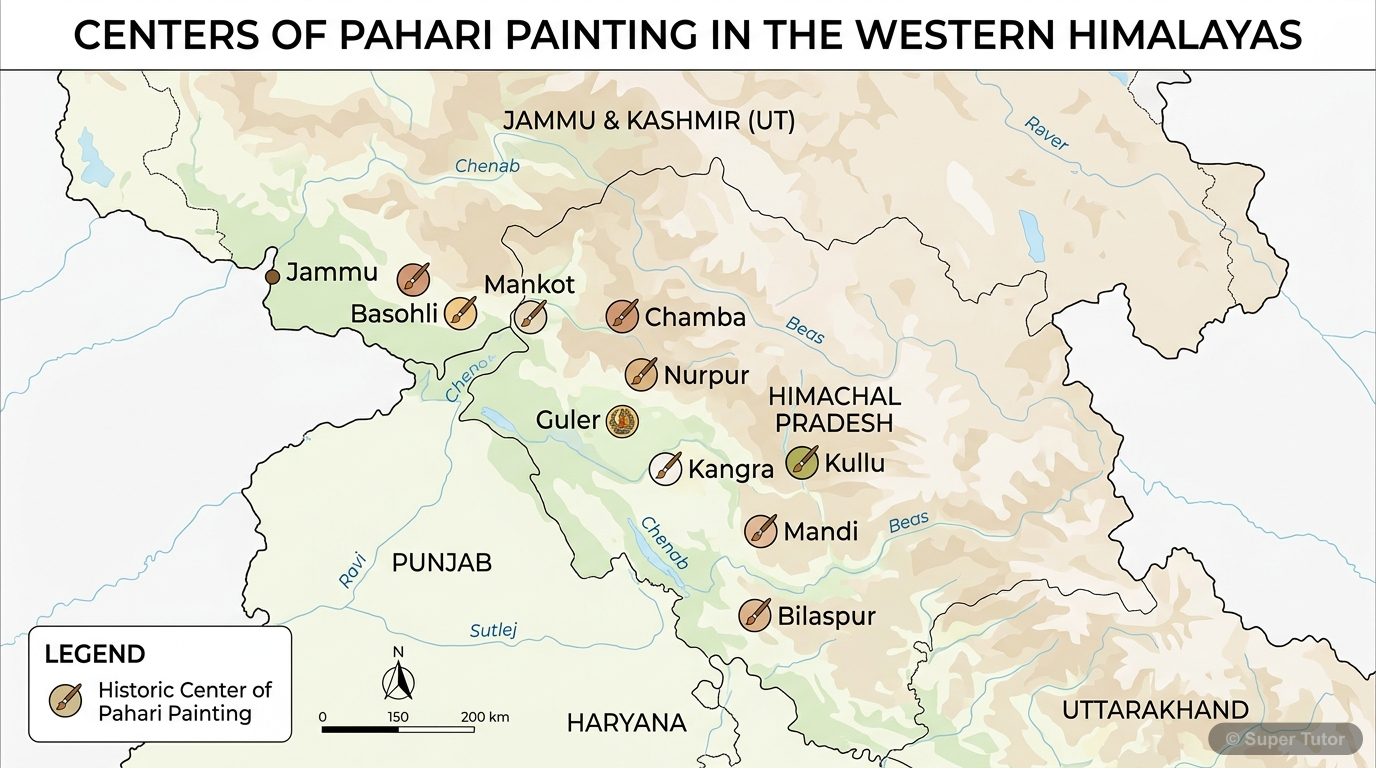
Learn better with visuals Super Tutor pairs illustrations like this with notes and quizzes for The Pahari Schools of Painting.
Get startedOverview
Pahari painting refers to the painting traditions that grew in the hilly regions of the western Himalayas from the seventeenth to the nineteenth century. The broad development moved from the bold Basohli manner to the refined Guler or pre-Kangra phase and then to the poetic Kangra style. These paint
Key Concepts
Pahari means hilly or mountainous
Pahari means hilly or mountainous in origin. The painting centres grew in hill areas such as Basohli, Guler, Kangra, Kullu, Chamba, Mankot, Nurpur, Ma
Pahari painting is broadly grouped into
Pahari painting is broadly grouped into three styles: Basohli, Guler, and Kangra. These are best understood as major phases or centres of artistic gro
Basohli is the earliest Pahari pictorial
Basohli is the earliest Pahari pictorial style and is flamboyantly bold. It developed magnificently under Kirpal Pal, who ruled Basohli from 1678 to 1
The most popular theme of Basohli
The most popular theme of Basohli painters was Rasamanjari by Bhanu Datta. Other themes included Bhagvata Purana and Ragamala. Devida, a tarkhan or ca
A new style called the Guler
A new style called the Guler-Kangra phase came into vogue during the 1690s to 1730s. It emerged as Basohli style gradually transformed into a softer,
Learning Objectives
- Understand the meaning and historical spread of Pahari painting
- Identify the three broad styles: Basohli, Guler, and Kangra
- Recognise the role of important patrons and artist families
- Explain the distinctive features of Basohli, Guler-Kangra, and Kangra styles
- Recall major themes such as Rasamanjari, Gita Govinda, Bhagvata Purana, Ramayana, Ashta Nayikas, and Baramasa
Frequently Asked Questions
What are the important topics in The Pahari Schools of Painting for CBSE Class 12 Fine Arts?
How should I revise The Pahari Schools of Painting for the CBSE Class 12 board exam?
Sources & Official References
- NCERT Official — ncert.nic.in
- CBSE Academic — cbseacademic.nic.in
- CBSE Official — cbse.gov.in
- National Education Policy 2020 — education.gov.in
Content is aligned to the official syllabus. Refer to the board website for the latest curriculum.
More resources for The Pahari Schools of Painting
Practice Quiz
Test yourself with a quick quiz
Important Questions
Exam-style questions with answers
Revision Notes
Key points for last-minute revision
Concept Maps
See how topics connect
Study Plan
Step-by-step plan for this chapter
Flashcards
Quick-fire cards for active recall
Syllabus
What topics to cover
NCERT Solutions
Every textbook question solved step by step
For serious students
Get the full The Pahari Schools of Painting chapter — start free.
Quizzes, flashcards, an AI doubt solver and a study plan for CBSE Class 12 Fine Arts. Free to start, no card needed.