The Deccani Schools of Painting — Revision Notes
CBSE · Class 12 · Fine Arts
The Deccani Schools of Painting revision notes for CBSE Class 12 Fine Arts: 4 topics in quick points. Part of the CBSE Class 12 Fine Arts syllabus.
Interactive on Super Tutor
Studying The Deccani Schools of Painting? Get the full interactive chapter.
Quizzes, flashcards, AI doubt-solver and a step-by-step study plan — built for revision notes and more.
Free trial, no card needed.
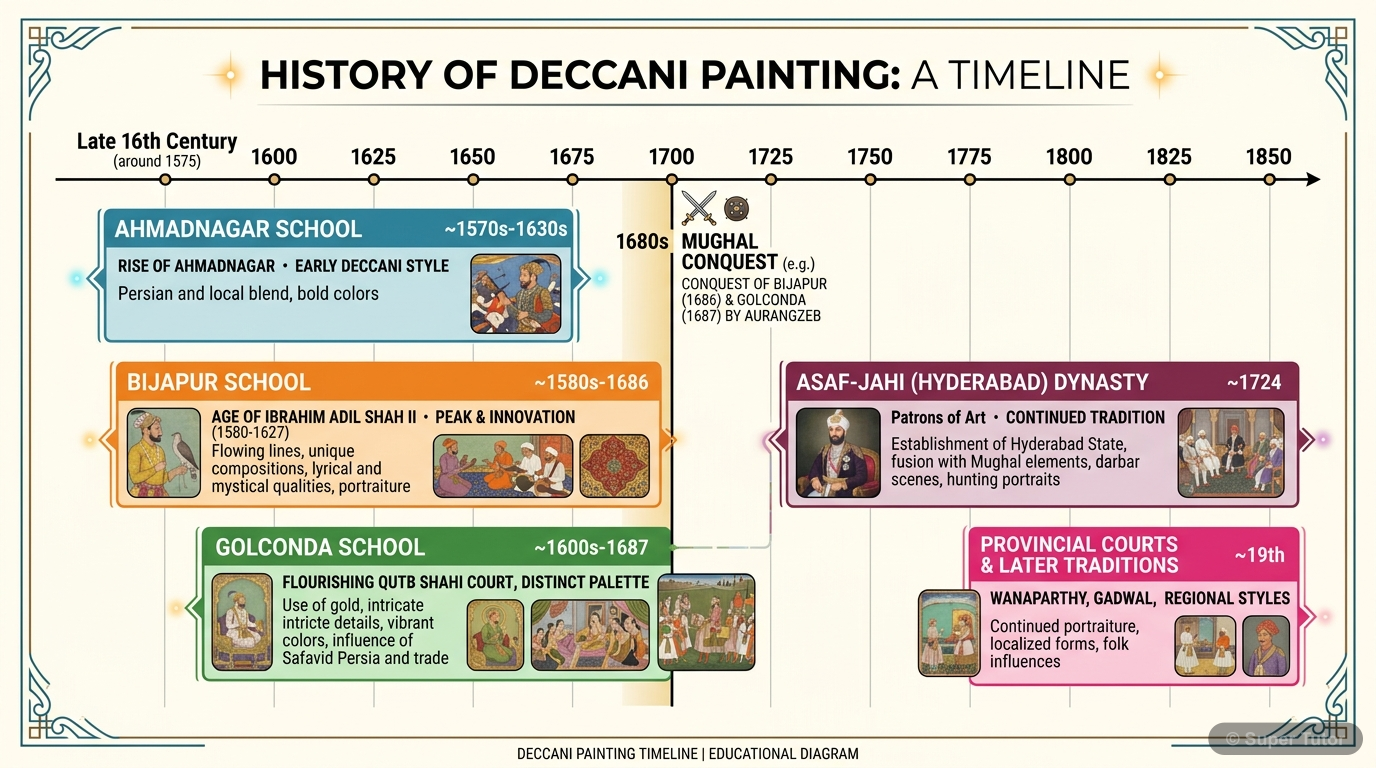
One of 11 illustrations for The Deccani Schools of Painting in Super Tutor — alongside flashcards, concept maps and practice questions.
See them allKey Topics to Revise
1. Historical background and identity
- Deccani painting was long placed under Indo-Persian art and was wrongly seen as Middle Eastern, Safavid, Persian, Turkish, or Mughal in origin.
- It is now understood as a full-fledged school of painting with its own character and royal support.
- The kingdoms of Bijapur, Golconda, and Ahmadnagar developed highly sophisticated and distinct court painting traditions.
2. Ahmadnagar School
- The earliest examples of Deccani painting are found in a volume of poems celebrating the reign of Hussain Nizam Shah I of Ahmadnagar (1553–1565).
- Most of the 12 miniatures showing battle scenes are of little artistic interest.
- The miniatures showing the queen and her marriage are rich in colour and sensuous in line.
3. Bijapur School
- The Bijapur school was patronised by Ali Adil Shah I (1558–1580) and his successor Ibrahim II (1580–1627).
- Ibrahim II was a patron of art and literature, an expert in Indian music, and the author of Nauras-nama.
- He owned the Nujum al-Ulum manuscript and may have commissioned the Ragamala series in the 1590s.
4. Golconda School
- Golconda became an independent state in 1512.
- By the end of the sixteenth century, it was the wealthiest of the Deccan kingdoms.
- Its wealth came from trade in iron and cotton goods, trade with Persia, and later diamonds discovered early in the seventeenth century.
Get complete notes with diagrams and examples
Full NotesKey Concepts
Frequently Asked Questions
What are the important topics in The Deccani Schools of Painting for CBSE Class 12 Fine Arts?
How should I revise The Deccani Schools of Painting for the CBSE Class 12 board exam?
Sources & Official References
- NCERT Official — ncert.nic.in
- CBSE Academic — cbseacademic.nic.in
- CBSE Official — cbse.gov.in
- National Education Policy 2020 — education.gov.in
Content is aligned to the official syllabus. Refer to the board website for the latest curriculum.
More resources for The Deccani Schools of Painting
Practice Quiz
Test yourself with a quick quiz
Important Questions
Exam-style questions with answers
Chapter Summary
Understand the chapter at a glance
Concept Maps
See how topics connect
Study Plan
Step-by-step plan for this chapter
Flashcards
Quick-fire cards for active recall
Syllabus
What topics to cover
NCERT Solutions
Every textbook question solved step by step
For serious students
Get the full The Deccani Schools of Painting chapter — start free.
Quizzes, flashcards, an AI doubt solver and a study plan for CBSE Class 12 Fine Arts. Free to start, no card needed.