The Modern Indian Art — Study Plan
CBSE · Class 12 · Fine Arts
A step-by-step study plan for The Modern Indian Art, CBSE Class 12 Fine Arts: what to learn first, what to practise and when to revise.
Interactive on Super Tutor
Studying The Modern Indian Art? Get the full interactive chapter.
Quizzes, flashcards, AI doubt-solver and a step-by-step study plan — built for study plan and more.
Free trial, no card needed.
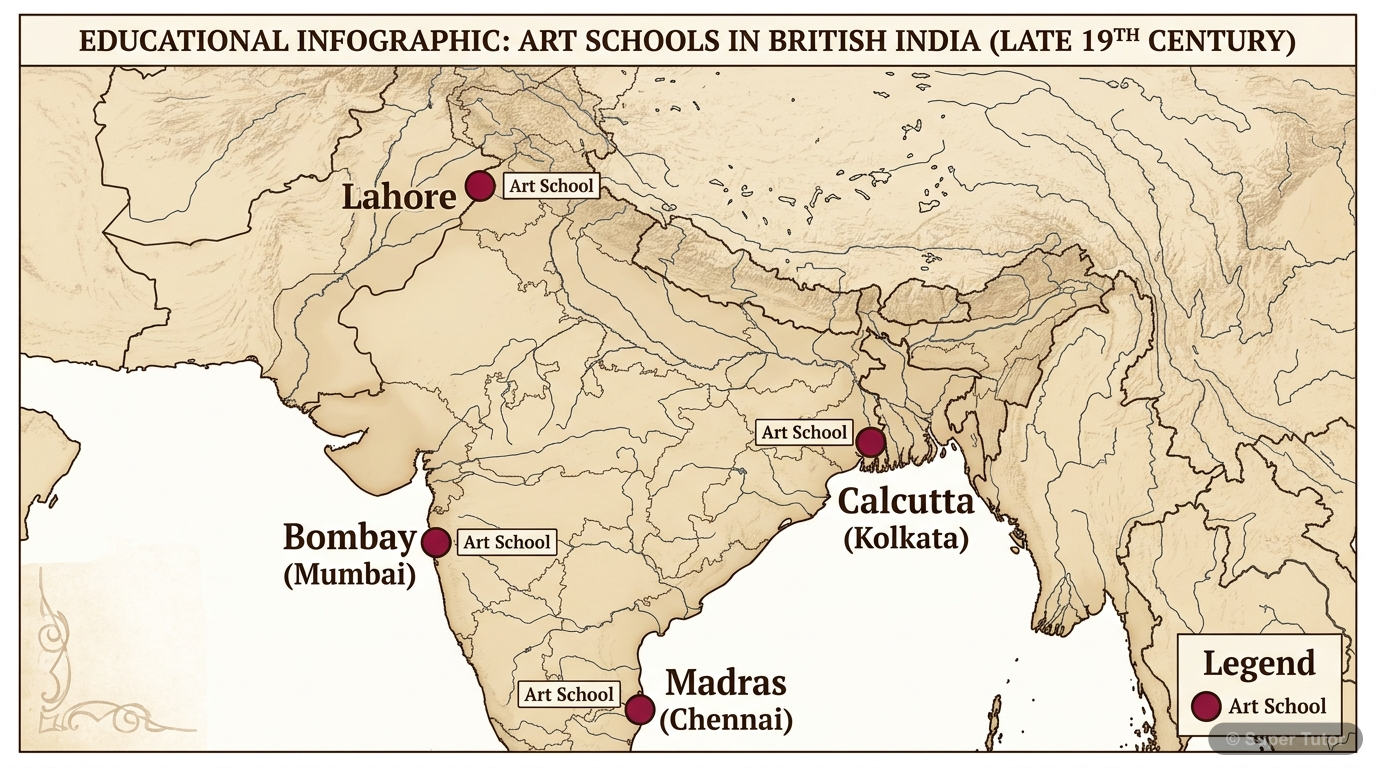
One of 14 illustrations for The Modern Indian Art in Super Tutor — alongside flashcards, concept maps and practice questions.
See them allStudy Plan
Learn the Theory
Read the textbook chapter carefully. Note down definitions, formulas and key ideas. Focus on: 1. Beginning of Modern Indian Art, 2. Bengal School, Tagore Family, and Kala Bhavana, 3. Rural Life, Human Labour, and Sculpture.
Practise
Solve the textbook exercises and extra practice questions. There are 94 questions available for this chapter.
Revise & Test
Revise key points without looking at your notes. Take a practice quiz and mark weak areas for another pass.
Spaced Revision
Come back to The Modern Indian Art after a week. Use flashcards for quick recall and try past exam questions on this chapter.
What to Focus On
- British art education promoted academic realism and Victorian taste.
- Nationalist art emerged as a response to colonial bias.
- Bengal School of Art was nurtured by Abanindranath Tagore and E. B. Havell.
- Abstraction focuses on forms, lines, and colour patches.
- Gaganendranath Tagore created a personal style using Cubism language.
- Gaganendranath’s style was different from Picasso’s Cubism.
- Nandalal Bose joined Kala Bhavana in 1921–1922.
- Benode Behari Mukherjee and Ramkinker Baij were Bose’s most creative students.
- Medieval Saints was painted on the walls of Hindi Bhavana, Shantiniketan.
Common Mistakes to Avoid
Kala Bhavana was just another art department and not a major turning point in modern Indian art.
The Bengal School of Art and modern Indian art are the same thing.
Gaganendranath Tagore copied Pablo Picasso's Cubism directly.
Memory Tips
Kala Bhavana as India's first nationalist art school, set up in 1919 as part of Visva-Bharati University, conceptualised by Rabindranath Tagore
Bengal School nurtured by Abanindranath Tagore and E. B. Havell
Gaganendranath Tagore's Cubist-style paintings used vertical, horizontal, and diagonal lines, different from Picasso's geometrical-facet Cubism
Rabindranath Tagore's calligraphic doodle style grew from crossed-out words in poems
Want a personalised study plan?
Super Tutor builds a day-by-day plan for CBSE Class 12 Fine Arts that fits your exam date and pace.
Create My Study PlanFrequently Asked Questions
What are the important topics in The Modern Indian Art for CBSE Class 12 Fine Arts?
How should I revise The Modern Indian Art for the CBSE Class 12 board exam?
Sources & Official References
- NCERT Official — ncert.nic.in
- CBSE Academic — cbseacademic.nic.in
- CBSE Official — cbse.gov.in
- National Education Policy 2020 — education.gov.in
Content is aligned to the official syllabus. Refer to the board website for the latest curriculum.
More resources for The Modern Indian Art
Practice Quiz
Test yourself with a quick quiz
Important Questions
Exam-style questions with answers
Revision Notes
Key points for last-minute revision
Chapter Summary
Understand the chapter at a glance
Concept Maps
See how topics connect
Flashcards
Quick-fire cards for active recall
Syllabus
What topics to cover
NCERT Solutions
Every textbook question solved step by step
For serious students
Get the full The Modern Indian Art chapter — start free.
Quizzes, flashcards, an AI doubt solver and a study plan for CBSE Class 12 Fine Arts. Free to start, no card needed.