The Modern Indian Art
CBSE · Class 12 · Fine Arts
NCERT Solutions for The Modern Indian Art — CBSE Class 12 Fine Arts.
Interactive on Super Tutor
Studying The Modern Indian Art? Get the full interactive chapter.
Quizzes, flashcards, AI doubt-solver and a step-by-step study plan — built for ncert solutions and more.
1,000+ Class 12 students started this chapter today
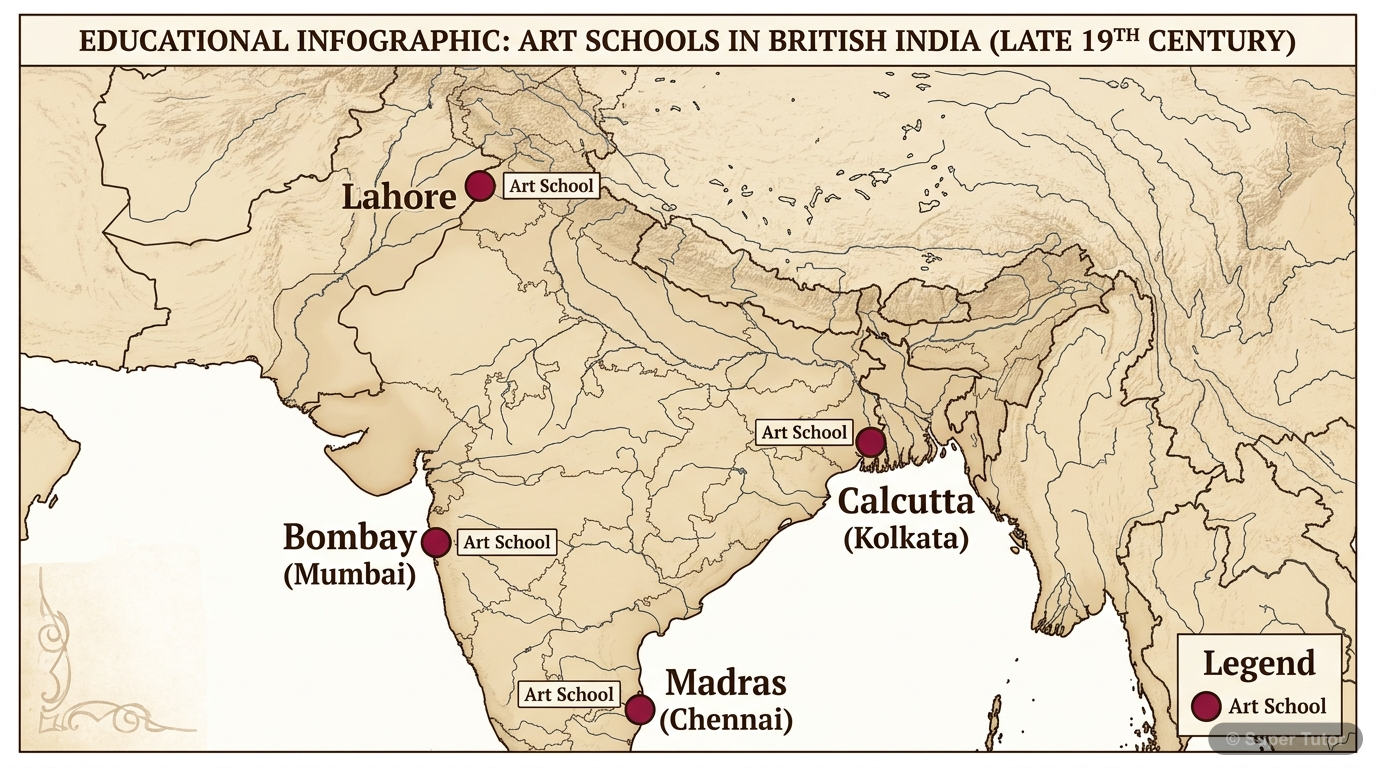
This is just one of 14+ visuals inside Super Tutor's The Modern Indian Art chapter
Explore the full setExercise — The Modern Indian Art (An Introduction to Indian Art — Part II)
1Pata Chitra is a form of audio-visual storytelling still practised in some parts of India. Compare this traditional form of storytelling with modern storytelling or narratives adopted by some Baroda artists since 1980s.Show solution
Pata Chitra is a centuries-old scroll-painting tradition (practised notably in West Bengal and Odisha) in which the *patua* (scroll painter) unrolls a painted scroll panel by panel while singing a narrative song. It is simultaneously visual and oral — a true audio-visual art form rooted in community life, mythology, and social commentary.
Concept Used:
Comparison of traditional narrative art with contemporary narrative painting/installation, with reference to the Baroda School's narrative turn in the 1980s.
---
Pata Chitra — Traditional Storytelling:
1. Medium & Form: Long painted scrolls (*patas*) made on cloth or paper using natural pigments. Each panel depicts one episode of a story.
2. Audio-Visual Nature: The *patua* sings a composed song (*pater gaan*) while unrolling the scroll, making it simultaneously visual and musical.
3. Themes: Mythological stories (Ramayana, Mahabharata), folk tales, social events (floods, epidemics), and more recently, current affairs.
4. Community Function: Performed in villages and public spaces; the audience participates emotionally. Art is inseparable from its social context.
5. Transmission: Knowledge passes orally and practically from generation to generation within the *patua* community.
6. Purpose: Religious, educational, and entertainment — art serves a direct social function.
---
Baroda Artists' Narrative Art (since 1980s):
1. Medium & Form: Oil on canvas, mixed media, installation, and printmaking. Artists such as Gulammohammed Sheikh, Bhupen Khakhar, Vivan Sundaram, and Nalini Malani used narrative strategies in their work.
2. Visual-Only (primarily): Unlike Pata Chitra, the narrative is embedded within a single canvas or installation; the viewer 'reads' the image rather than listening to an accompanying song.
3. Themes: Personal identity, political history, partition, gender, caste, globalisation, and the collision of tradition with modernity. Gulammohammed Sheikh's *Kaavad: Travelling Shrine* (1995) directly borrowed the portable-shrine format of folk storytelling.
4. Intertextuality: Baroda artists consciously quoted from miniature painting, Pata Chitra, Kalighat painting, and Western art history simultaneously — creating layered, multi-referential narratives.
5. Gallery/Museum Context: Work is displayed in galleries and museums, addressing an educated, often urban audience — unlike the village-square performance of the *patua*.
6. Individual Authorship: The artist is a named individual whose personal vision drives the work, whereas Pata Chitra is a community/family tradition.
---
Comparative Summary Table:
| Aspect | Pata Chitra | Baroda Narrative Art (1980s+) |
|---|---|---|
| Medium | Painted scroll + song | Canvas, installation, mixed media |
| Mode | Audio-visual performance | Primarily visual |
| Audience | Village community | Gallery-going / urban audience |
| Themes | Mythology, folk tales, social events | History, identity, politics, modernity |
| Authorship | Community / family tradition | Individual artist |
| Context | Public / open-air | Gallery / museum |
| Transmission | Oral, generational | Art education, critical writing |
---
Conclusion:
Both traditions use sequential or layered visual narratives to communicate complex stories. However, while Pata Chitra is a living, participatory, community-based performance art, the Baroda artists appropriated the *spirit* of such storytelling — its episodic structure, its mixing of text and image, its social commentary — and translated it into a contemporary fine-art language. This dialogue between the traditional and the modern is one of the defining features of post-1980s Indian art.
2How does new technology like video and digital media inspire contemporary artists to experiment with new themes? Comment on different genres of such art forms like video, installation and digital art.Show solution
From the late 20th century onwards, artists in India and globally began using video cameras, computers, the internet, and digital tools as primary artistic media, opening entirely new possibilities for theme, form, and audience engagement.
Concept Used:
Relationship between technological tools and artistic experimentation; characteristics of video art, installation art, and digital art.
---
How New Technology Inspires New Themes:
1. Democratisation of Image-Making: Video and digital cameras made image production accessible, allowing artists to document everyday life, marginalised communities, and personal experiences that were previously outside the scope of 'high art.'
2. Time as a Medium: Video introduced *duration* and *movement* into art. Artists could explore memory, trauma, and political events as they unfold over time — impossible in a static painting.
3. Interactivity: Digital media allows the viewer to become a participant, blurring the boundary between creator and audience.
4. Global Connectivity: The internet enabled artists to engage with global themes — migration, surveillance, climate change, digital identity — and reach international audiences instantly.
5. Manipulation & Simulation: Digital tools allow artists to construct alternate realities, question the 'truth' of images, and comment on media culture and propaganda.
---
Genres of New Media Art:
### (A) Video Art
- Definition: Art that uses video technology as its primary medium, displayed on monitors, projected on walls, or incorporated into larger environments.
- Characteristics: Explores time, narrative, performance, and the moving image outside the commercial film context.
- Indian Example: Nalini Malani is one of India's foremost video artists. Her multi-channel video installations (e.g., *In Search of Vanished Blood*, 2012) use fragmented narratives drawn from mythology, literature, and political history, projected simultaneously on multiple screens to create an immersive, disorienting experience.
- Themes Explored: Gender violence, partition, war, memory, and the female body.
### (B) Installation Art
- Definition: Three-dimensional works designed to transform a specific space. The viewer physically enters and moves through the work, making the experience bodily and spatial.
- Characteristics: Uses diverse materials — found objects, light, sound, video, text, natural materials. The space itself becomes part of the meaning.
- Indian Example: Vivan Sundaram's *Memorial* (1993) and *Trash* (2005–08) used found industrial and domestic waste to comment on history, consumption, and environmental degradation.
- Themes Explored: History, ecology, consumerism, identity, and the politics of space.
### (C) Digital Art
- Definition: Art created using digital technology — computers, software, algorithms, the internet, or AI — as the primary tool.
- Characteristics: Can be static (digital painting/photography), dynamic (generative art), or interactive (net art, apps). Easily reproducible and distributable.
- Themes Explored: Virtual identity, surveillance, data, artificial intelligence, and the nature of reality in a screen-mediated world.
- Significance: Challenges traditional notions of the 'original' artwork and the gallery as the only site of art.
---
Conclusion:
New technology does not merely provide new tools — it fundamentally changes *what* artists can say and *how* audiences experience art. Video art restores time and performance to the gallery; installation art makes the viewer's body central to meaning; digital art questions the very nature of image, authorship, and reality. Together, these genres have vastly expanded the vocabulary of contemporary Indian and global art.
3What do you understand by 'public art'? Find out about different communities that live around your residence or school and their understanding of art. If you have to prepare a public monument, how will you design it in a way that people can relate with it?Show solution
Public art refers to artworks created for and placed in public spaces — accessible to all citizens, not confined to galleries or private collections. This question also involves a practical/reflective component about community engagement and monument design.
Concept Used:
Definition and purpose of public art; principles of community-responsive monument design.
---
Part 1: Understanding Public Art
Definition:
Public art is any work of art that is deliberately placed in a publicly accessible space — streets, parks, government buildings, transport hubs, or open plazas — with the intention of engaging the general public rather than a select audience.
Key Characteristics:
1. Accessibility: It belongs to everyone; no ticket or gallery visit is required.
2. Site-Specificity: Good public art responds to the history, culture, and physical character of its location.
3. Community Engagement: It often involves the local community in its conception, design, or execution.
4. Multiple Functions: It can commemorate, beautify, provoke thought, celebrate identity, or stimulate dialogue.
5. Durability: Public art is usually made from weather-resistant materials (stone, bronze, steel, mosaic, mural paint).
Examples in India:
- Murals on urban walls (e.g., the St+art India Foundation's murals in Delhi's Lodhi Colony, transforming a residential colony into an open-air gallery).
- Statues and memorials (e.g., the Statue of Unity, Gujarat; Ambedkar statues in public squares).
- Folk art on public buildings (e.g., Warli paintings on Mumbai's suburban railway stations).
---
Part 2: Communities Around My Residence/School and Their Understanding of Art
*(This section requires personal observation; a model answer is provided below.)*
In a typical Indian urban or semi-urban neighbourhood, one might find:
- Working-class communities who relate to art through festival decorations (Rangoli, Alpana, Kolam), religious imagery (calendar art, idol-making), and cinema posters.
- Middle-class communities who engage with art through school craft activities, television, and occasional museum visits.
- Migrant communities who carry folk art traditions (Madhubani, Pata Chitra, Warli) from their home regions.
- Younger generations who engage with street art, graffiti, and digital art through social media.
Key Insight: Art for most communities is not a separate, elevated activity — it is woven into daily life through ritual, decoration, and celebration. A successful public artwork must speak to this lived experience.
---
Part 3: Designing a Public Monument — My Approach
Step 1 — Research the Community:
Before designing, I would conduct community meetings, surveys, and conversations to understand:
- The history and shared memories of the locality.
- The cultural and religious diversity of residents.
- What symbols, stories, or figures the community identifies with.
Step 2 — Choose an Inclusive Theme:
Rather than a single heroic figure (which may represent only one group), I would choose a theme that reflects the *shared life* of the community — for example, the river that flows through the town, the market that everyone uses, or a local festival celebrated by all.
Step 3 — Design Principles:
- Interactive: Include elements people can touch, sit on, or walk through — not just observe from a distance.
- Multi-layered: Incorporate local motifs, materials, and craft traditions so that different community members see their own heritage reflected.
- Bilingual/Multi-lingual Text: Any inscriptions should be in the languages spoken locally.
- Human Scale: The monument should feel approachable, not intimidating.
- Participatory Creation: Involve local artisans, schoolchildren, and community members in making parts of the monument (e.g., mosaic tiles, carved panels).
Step 4 — Material Choice:
Use locally sourced, durable materials — stone from the region, traditional tile-work, or recycled materials — to connect the monument to its place.
Step 5 — Maintenance Plan:
Design the monument so that the community feels ownership and responsibility for its upkeep.
---
Conclusion:
Public art is most powerful when it emerges *from* the community rather than being imposed *upon* it. A monument designed with genuine community participation becomes a living symbol of shared identity, not merely a decorative object in a public space.
4How do you understand the 'art world'? What are the different components of the art world and how does it relate with the art market?Show solution
The term 'art world' refers to the entire social, institutional, and economic network that surrounds the creation, presentation, interpretation, and sale of art. Understanding it requires examining both its cultural/intellectual dimensions and its commercial dimensions.
Concept Used:
Sociological and economic analysis of the art world; relationship between cultural institutions and the art market.
---
Part 1: Understanding the 'Art World'
The philosopher Arthur Danto and sociologist Howard Becker popularised the concept of the 'art world' — the idea that an object becomes 'art' not simply because of its intrinsic qualities, but because it is recognised, validated, and circulated within a specific social network of institutions and individuals.
In simple terms: the art world is the entire ecosystem that gives art its meaning, value, and visibility.
---
Part 2: Components of the Art World
### 1. Artists
- The primary creators. Their training, background, and choices of medium and theme are shaped by the institutions around them.
- In India: graduates of art schools like M.S. University Baroda, Sir J.J. School of Art (Mumbai), Santiniketan, and Delhi College of Art form important networks.
### 2. Art Schools and Universities
- Institutions that train artists, transmit art history, and foster critical thinking.
- They shape aesthetic movements and ideological tendencies (e.g., the Baroda School's emphasis on narrative and figuration).
### 3. Museums and Public Galleries
- Institutions that collect, preserve, display, and interpret art for the public.
- Examples in India: National Gallery of Modern Art (NGMA) in Delhi, Mumbai, and Bengaluru; Chhatrapati Shivaji Maharaj Vastu Sangrahalaya.
- Museums confer prestige and historical significance on artworks.
### 4. Commercial Galleries
- Private spaces that represent artists, exhibit their work, and sell it to collectors.
- Examples: Chemould Prescott Road (Mumbai), Vadehra Art Gallery (Delhi), Gallery Espace.
- They act as intermediaries between artists and buyers.
### 5. Curators
- Professionals who select, organise, and interpret artworks for exhibitions.
- A curator's choice of which artists to include in a major show can significantly affect an artist's reputation and market value.
### 6. Critics and Art Historians
- Writers who analyse, contextualise, and evaluate art in journals, newspapers, catalogues, and books.
- Critical writing shapes how art is understood and remembered.
### 7. Collectors
- Individuals or institutions that purchase and hold artworks.
- Private collectors (e.g., the Tata, Birla, and Poddar collections in India) have historically supported Indian modernism.
### 8. Auction Houses
- Organisations that sell art through public bidding.
- Examples: Sotheby's, Christie's (international); Saffronart, Pundole's (India).
- Auction results are widely reported and directly influence market prices.
### 9. Art Fairs
- Large commercial events where galleries from around the world exhibit and sell work.
- Examples: India Art Fair (New Delhi), Art Basel, Frieze.
- They are major sites of networking, buying, and trend-setting.
### 10. Biennales and International Exhibitions
- Large-scale, non-commercial (or semi-commercial) exhibitions that bring together artists from many countries.
- Examples: Kochi-Muziris Biennale (India's largest contemporary art event), Venice Biennale.
- They build international reputations for artists and cities.
### 11. Government and Cultural Bodies
- Institutions like the Lalit Kala Akademi, Sangeet Natak Akademi, and the Ministry of Culture that fund, award, and promote art.
---
Part 3: The Art World and the Art Market — Their Relationship
The art market is the commercial sub-system within the art world — the buying, selling, and pricing of artworks. The two are deeply intertwined:
| Art World Function | Impact on Art Market |
|---|---|
| Museum retrospective of an artist | Increases demand and prices for that artist's work |
| Positive critical review | Attracts collector interest |
| Inclusion in a major Biennale | Raises international profile; opens global market |
| Art school training | Creates networks that galleries and collectors tap into |
| Auction record price | Sets a benchmark; encourages speculation |
Key Tensions:
- The art world claims to value art for its cultural, intellectual, and aesthetic significance.
- The art market values art as a financial asset and commodity.
- These two logics sometimes conflict: an artist celebrated critically may not sell well, while a commercially successful artist may be dismissed by critics.
- In contemporary India, the rapid growth of the art market since the 2000s (driven by economic liberalisation and a new collector class) has raised questions about whether market forces are distorting artistic production — pushing artists toward 'sellable' work rather than experimental or socially critical art.
---
Conclusion:
The art world is a complex, multi-layered ecosystem of people, institutions, and ideas that collectively determine what counts as art, who counts as an artist, and what art means in society. The art market is one powerful component of this world, but it functions alongside — and sometimes in tension with — the cultural, educational, and critical institutions that give art its deeper significance. Understanding both dimensions is essential for any serious engagement with contemporary art.
Stuck on a step?
Ask Super Tutor AI to explain any solution on this page in a simpler way — free, 24x7.
Ask a Doubt FreeFrequently Asked Questions
What are the important topics in The Modern Indian Art for CBSE Class 12 Fine Arts?
How to score full marks in The Modern Indian Art — CBSE Class 12 Fine Arts?
Where can I get free NCERT Solutions for The Modern Indian Art Class 12 Fine Arts?
Sources & Official References
- NCERT Official — ncert.nic.in
- CBSE Academic — cbseacademic.nic.in
- CBSE Official — cbse.gov.in
- National Education Policy 2020 — education.gov.in
Content is aligned to the official syllabus. Refer to the board website for the latest curriculum.
More resources for The Modern Indian Art
Important Questions
Practice with board exam-style questions
Syllabus
What topics to cover
Revision Notes
Key points for last-minute revision
Study Plan
Step-by-step plan to ace this chapter
Flashcards
Quick-fire cards for active recall
Formula Sheet
All formulas in one place
Chapter Summary
Understand the chapter at a glance
Practice Quiz
Test yourself with a quick quiz
Concept Maps
See how topics connect visually
For serious students
Get the full The Modern Indian Art chapter — for free.
Quizzes, flashcards, AI doubt-solver and a step-by-step study plan for CBSE Class 12 Fine Arts.