Care and Maintenance of Fabrics in Institutions — Study Plan
CBSE · Class 12 · Home Science
A step-by-step study plan for Care and Maintenance of Fabrics in Institutions, CBSE Class 12 Home Science: what to learn first, what to practise and when.
Interactive on Super Tutor
Studying Care and Maintenance of Fabrics in Institutions? Get the full interactive chapter.
Quizzes, flashcards, AI doubt-solver and a step-by-step study plan — built for study plan and more.
Free trial, no card needed.
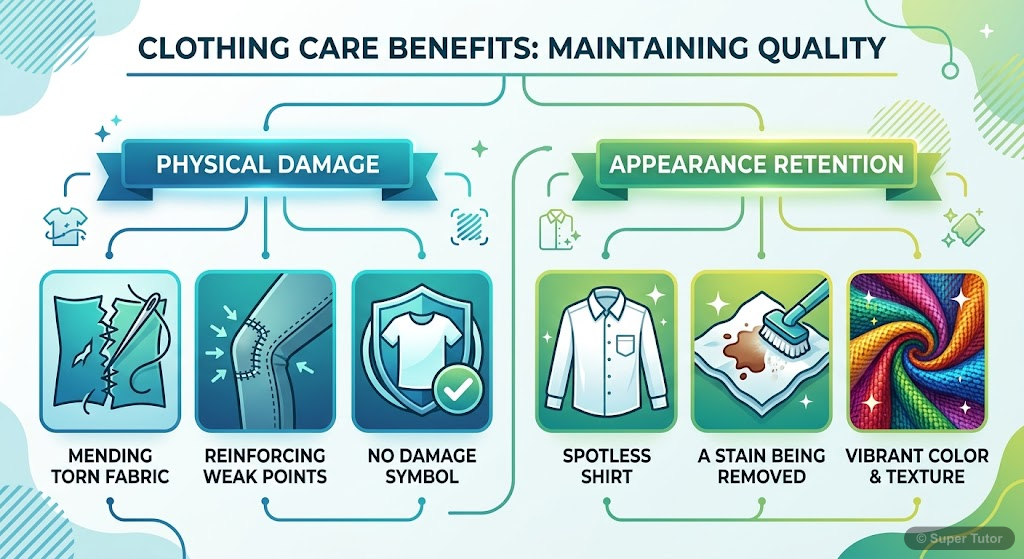
One of 9 illustrations for Care and Maintenance of Fabrics in Institutions in Super Tutor — alongside flashcards, concept maps and practice questions.
See them allStudy Plan
Learn the Theory
Read the textbook chapter carefully. Note down definitions, formulas and key ideas. Focus on: 1. Core Idea of Fabric Care, 2. Washing Equipment and Machine Types, 3. Methods of Washing.
Practise
Solve the textbook exercises and extra practice questions. There are 63 questions available for this chapter.
Revise & Test
Revise key points without looking at your notes. Take a practice quiz and mark weak areas for another pass.
Spaced Revision
Come back to Care and Maintenance of Fabrics in Institutions after a week. Use flashcards for quick recall and try past exam questions on this chapter.
What to Focus On
- Fabric care preserves both function and appearance.
- Physical damage and appearance loss are the two main aspects of care and maintenance.
- Institutional fabrics must remain serviceable for a long time.
- Laundry uses scientific principles and practical skill.
- Important laundry processes include washing, rinsing, drying, pressing, and folding.
- Good laundering gives hygienic and neat results.
- Three equipment groups are washing, drying, and ironing/pressing.
- Top loading and front loading are the two main washing machine models.
- Fully automatic machines need least manual work.
Common Mistakes to Avoid
All washing machines work in the same way, so top loading and front loading machines are only different in shape.
A semi-automatic washing machine is fully automatic because it has more than one tub.
Agitation, pulsation, and tumbling are just three names for the same washing action.
Memory Tips
Care and maintenance of fabrics has two aspects
Laundry is both a science and an art
Three main types of laundry equipment
Top loading and front loading washing machines
Want a personalised study plan?
Super Tutor builds a day-by-day plan for CBSE Class 12 Home Science that fits your exam date and pace.
Create My Study PlanFrequently Asked Questions
What are the important topics in Care and Maintenance of Fabrics in Institutions for CBSE Class 12 Home Science?
How should I revise Care and Maintenance of Fabrics in Institutions for the CBSE Class 12 board exam?
Sources & Official References
- NCERT Official — ncert.nic.in
- CBSE Academic — cbseacademic.nic.in
- CBSE Official — cbse.gov.in
- National Education Policy 2020 — education.gov.in
Content is aligned to the official syllabus. Refer to the board website for the latest curriculum.
More resources for Care and Maintenance of Fabrics in Institutions
Practice Quiz
Test yourself with a quick quiz
Important Questions
Exam-style questions with answers
Revision Notes
Key points for last-minute revision
Chapter Summary
Understand the chapter at a glance
Concept Maps
See how topics connect
Flashcards
Quick-fire cards for active recall
Syllabus
What topics to cover
NCERT Solutions
Every textbook question solved step by step
For serious students
Get the full Care and Maintenance of Fabrics in Institutions chapter — start free.
Quizzes, flashcards, an AI doubt solver and a study plan for CBSE Class 12 Home Science. Free to start, no card needed.