Chapter 6 of 14
NCERT Solutions

Care and Maintenance of Fabrics in Institutions

CBSE · Class 12 · Home Science

NCERT Solutions for Care and Maintenance of Fabrics in Institutions — CBSE Class 12 Home Science.

5 concepts

Interactive on Super Tutor

Studying Care and Maintenance of Fabrics in Institutions? Get the full interactive chapter.

Quizzes, flashcards, AI doubt-solver and a step-by-step study plan — built for ncert solutions and more.

1,000+ Class 12 students started this chapter today

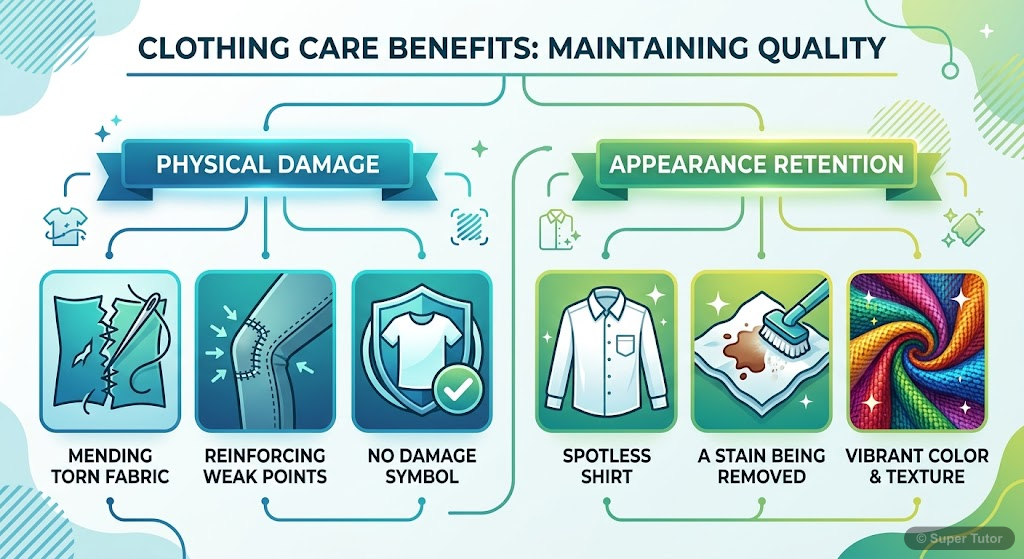
An infographic illustrating the two main aspects of fabric care and maintenance: preventing and rectifying physical damage, and retaining/refreshing appearance (stain/dirt removal, textural/visual cha
Super Tutor

Super Tutor has 9+ illustrations like this for Care and Maintenance of Fabrics in Institutions alone — flashcards, concept maps, and step-by-step visuals.

See them all
5 Questions Solved · 2 Sections

REVIEW QUESTIONS — Care and Maintenance of Fabrics in Institutions

1What are the two aspects of care and maintenance of fabrics?Show solution
Given: The chapter deals with care and maintenance of fabrics in institutions.

Answer:
The two aspects of care and maintenance of fabrics are:

1. Cleaning – This involves the removal of dirt, stains, and other foreign matter from fabrics through processes such as washing (laundering), dry-cleaning, and stain removal. The aim is to restore the fabric to its original clean condition.

2. Finishing/Restoration – This involves processes carried out after cleaning to restore the appearance and feel of the fabric. It includes ironing, pressing, calendaring, and other finishing treatments that give the fabric a neat, fresh, and presentable look.

Together, these two aspects ensure that fabrics remain hygienic, presentable, and long-lasting.
2What are the factors which affect the process of cleaning of fabrics?Show solution
Given: Cleaning of fabrics is influenced by several interrelated factors.

Answer:
The following factors affect the process of cleaning of fabrics:

1. Water – The quality (hard or soft), temperature (hot, warm, or cold), and quantity of water used greatly influence the cleaning process. Soft water lathers better and cleans more effectively than hard water.

2. Detergent/Soap – The type, quality, and concentration of the cleaning agent (soap or synthetic detergent) used determines how effectively dirt and stains are removed.

3. Temperature – Higher temperatures generally improve the cleaning action by loosening dirt and dissolving grease. However, the temperature must be appropriate for the type of fabric to avoid damage.

4. Mechanical Action – Agitation (hand rubbing, machine washing, scrubbing) helps to dislodge dirt particles from the fabric surface. The degree of mechanical action must suit the fabric's delicacy.

5. Time – The duration of soaking and washing affects the thoroughness of cleaning. Longer soaking helps loosen stubborn stains.

6. Nature of the Fabric – The fibre content (cotton, silk, wool, synthetic), weave, and finish of the fabric determine the method and intensity of cleaning that can be safely applied.

7. Nature of the Stain/Soil – Whether the stain is fresh or old, greasy or non-greasy, protein-based or pigment-based affects the choice of cleaning agent and method.

8. pH of the Cleaning Solution – Alkaline solutions suit cotton and linen, while neutral or mildly acidic solutions are safer for silk and wool.
3How are the different sections organised in a commercial or institutional laundry?Show solution
Given: Commercial and institutional laundries handle large volumes of fabric articles and are organised into distinct functional sections.

Answer:
A commercial or institutional laundry is typically organised into the following sections:

1. Receiving/Sorting Section – Soiled linen and garments are received, counted, and sorted according to the type of fabric, degree of soiling, and the washing process required. Articles are tagged or marked for identification.

2. Stain Removal Section – Articles with specific stains are pre-treated before the main wash to ensure effective stain removal.

3. Washing Section – Sorted articles are washed using large washing machines (e.g., tunnel washing systems) with appropriate detergents, water temperature, and wash cycles suited to each fabric type.

4. Hydro-extraction Section – After washing, excess water is removed from the articles using hydro-extractors (high-speed centrifugal machines), reducing drying time.

5. Drying Section – Articles are dried using large tumble dryers or drying cabinets, or in some cases by open-air drying.

6. Ironing/Finishing Section – Dried articles are ironed, pressed, or calendared (for flat articles like bed sheets and tablecloths) to give them a smooth, finished appearance. Calendaring machines are used for flat work.

7. Folding and Packing Section – Finished articles are folded neatly, counted, and packed or bundled for return to the owner or for storage.

8. Dispatch/Delivery Section – Packed articles are dispatched to the respective departments or customers.

This systematic organisation ensures efficiency, hygiene, and proper handling of large quantities of laundry.
4What are the differences in processing laundry work in commercial laundries and hospital laundries?Show solution
Given: Both commercial and hospital laundries handle large volumes of linen, but their requirements and processing methods differ significantly.

Answer:
The key differences in processing laundry work in commercial laundries and hospital laundries are as follows:

| Aspect | Commercial Laundry | Hospital Laundry |
|---|---|---|
| Purpose | Cleaning and finishing of garments and household linen for general clients | Cleaning, disinfection, and sterilisation of hospital linen and uniforms |
| Type of Soiling | General dirt, food stains, grease, etc. | Blood, body fluids, infectious matter, and other bio-hazardous soiling |
| Disinfection | Not always required; focus is mainly on cleanliness and appearance | Mandatory; all linen must be disinfected or sterilised to prevent spread of infection |
| Washing Temperature | Varies according to fabric type | High temperatures (above 65°C–71°C) are used to destroy pathogens |
| Chemical Treatment | Standard detergents and finishing agents | Disinfectants and bactericidal agents are used in addition to detergents |
| Handling Procedures | Standard handling; no special precautions needed | Strict protocols — infected linen is handled separately, workers use protective gear |
| Sorting | Sorted by fabric type and colour | Sorted by degree of infection risk (infected vs. non-infected linen) in addition to fabric type |
| Equipment | Standard commercial washing machines, hydro-extractors, calendars | Specialised machines capable of high-temperature washing; barrier washers may be used to prevent cross-contamination |
| Quality Check | Focus on cleanliness and appearance | Focus on microbiological safety in addition to cleanliness |

In summary, hospital laundries follow much stricter hygiene and safety protocols compared to commercial laundries because the primary goal is infection control and patient safety, not just cleanliness and appearance.

PRACTICAL 1 — Stain Removal

P1Task: To remove different types of stains like ball pen, blood, coffee, tea, lipstick, curry, grease, ink from fabric samples. Write the procedure for removing each stain from cotton/linen, silk/wool, and synthetic fabrics.Show solution
Purpose: A stain is an unwanted mark or colouration on a fabric caused by contact and absorption of foreign matter. It requires special treatment before the actual washing process. The correct stain removal method depends on: (i) the type of stain, (ii) whether it is fresh or old, and (iii) the type of fabric.

---

Materials Required:
- White cotton cloth pieces of 4″ × 4″ (two samples for each stain — one treated, one control)
- Staining agents: ball pen, blood, coffee, tea, lipstick, curry, grease, ink
- Stain removal agents as listed below

---

Procedure and Stain Removal Methods:

---

1. Blood Stain

| Condition | Cotton and Linen | Silk and Wool | Synthetics |
|---|---|---|---|
| Fresh | Soak in cold water; then wash in dilute ammonia. | Sponge with cold water. | Wash in cold water. |
| Old | Steep in cold water and salt (1 oz to 2 pints) until stain is removed. | (1) Same as cotton. (2) Apply starch paste, leave to dry, and brush off. | — |

*Key principle: Always use cold water for blood — hot water sets the protein stain permanently.*

---

2. Ball Pen Ink Stain

| Condition | Cotton and Linen | Silk and Wool | Synthetics |
|---|---|---|---|
| Any | (1) Steep in methylated spirit. (2) Wash with soap and water. | Same as cotton. | Same as cotton. |

---

3. Curry Stain

| Condition | Cotton and Linen | Silk and Wool | Synthetics |
|---|---|---|---|
| Fresh | (1) Wash with soap and water. (2) Bleach in sunlight and air. | Same as cotton. | Same as cotton. |
| Old | (1) Same as for fresh. (2) Bleach with Javelle water. | Treat with potassium permanganate and ammonia; dip the stained portion alternately in the two solutions. | Bleach with sodium perborate. |

---

4. Grease Stain

| Condition | Cotton and Linen | Silk and Wool | Synthetics |
|---|---|---|---|
| Fresh | Wash with hot water and soap. | (1) If washable: same as cotton. (2) If unwashable: spread French chalk on stain; brush off after an hour. | Same as silk and wool. |
| Old | (1) Treat with grease solvent (petrol or methylated spirit). (2) Wash with hot water and soap. | Same as cotton. | Same as cotton. |

---

5. Ink Stain

| Condition | Cotton and Linen | Silk and Wool | Synthetics |
|---|---|---|---|
| Fresh | (1) Rub with a cut tomato and salt wash. (2) Soak in sour milk or curd for half an hour, then wash. (3) Apply salt and lime juice; leave for half an hour, then wash. | Treat with sour milk or curd as for cotton. | Same as silk and wool. |
| Old | (1) Try methods 2 and 3 above with prolonged treatment. (2) Steep in dilute oxalic acid. (3) Rinse thoroughly with dilute borax solution. | (1) Same as cotton. (2) Rinse in dilute ammonia solution. | Same as silk and wool. |

---

6. Lipstick Stain

| Condition | Cotton and Linen | Silk and Wool | Synthetics |
|---|---|---|---|
| Fresh | Steep in methylated spirit and wash with soap and water. | Same as cotton. | Same as cotton. |
| Old | Moisten and soften by working glycerine into the stain; leave for a short while; rinse, then wash with soap and water. | Same as cotton. | Steep in kerosene or turpentine; wash with soap and warm water. |

---

7. Tea and Coffee Stain

| Condition | Cotton and Linen | Silk and Wool | Synthetics |
|---|---|---|---|
| Fresh | Pour boiling water through the stain. | (1) Steep in warm water. (2) Steep in dilute borax solution (½ tsp to 2 cups of water). | Steep in warm sodium perborate solution (1 tsp to 1 pint). |
| Old | (1) Spread borax over the stain and pour boiling water through. (2) Steep in glycerine until stain is removed. | (1) Steep in borax solution. (2) Treat with dilute hydrogen peroxide. | — |

---

Observation and Recording:
- After treating one sample, compare it with the untreated control sample.
- Note the effectiveness of the stain removal treatment.
- Stick both the control and treated samples in your practical file with proper labelling.

Conclusion: Different stains require different removal agents and methods depending on the nature of the stain (protein, oil, dye, etc.) and the type of fabric. Fresh stains are always easier to remove than old stains. Correct identification of the stain and prompt treatment gives the best results.

Stuck on a step?

Ask Super Tutor AI to explain any solution on this page in a simpler way — free, 24x7.

Ask a Doubt Free

Frequently Asked Questions

What are the important topics in Care and Maintenance of Fabrics in Institutions for CBSE Class 12 Home Science?
Key topics in Care and Maintenance of Fabrics in Institutions include Institutional Fabric Care System Overview, Care and Maintenance of Fabrics in Institutions - Complete Overview, Fabric Care and Maintenance Concepts Overview. These are the concepts CBSE Class 12 examiners draw on most — study them first, then practise related questions.
How to score full marks in Care and Maintenance of Fabrics in Institutions — CBSE Class 12 Home Science?
Start by understanding all key concepts. Practise previous year questions from this chapter. Revise formulas and definitions regularly. Use flashcards for quick revision before the exam.
Where can I get free NCERT Solutions for Care and Maintenance of Fabrics in Institutions Class 12 Home Science?
This page has free step-by-step NCERT Solutions for every exercise question in Care and Maintenance of Fabrics in Institutions (CBSE Class 12 Home Science) — written the way examiners award marks: given, formula, working, answer.

Sources & Official References

Content is aligned to the official syllabus. Refer to the board website for the latest curriculum.

For serious students

Get the full Care and Maintenance of Fabrics in Institutions chapter — for free.

Quizzes, flashcards, AI doubt-solver and a step-by-step study plan for CBSE Class 12 Home Science.