Management of Support Services, Institutions and Programmes for Children, Youth and Elderly — Study Plan
CBSE · Class 12 · Home Science
A step-by-step study plan for Management of Support Services, Institutions and Programmes for Children, Youth and Elderly, CBSE Class 12 Home Science.
Interactive on Super Tutor
Studying Management of Support Services, Institutions and Programmes for Children, Youth and Elderly? Get the full interactive chapter.
Quizzes, flashcards, AI doubt-solver and a step-by-step study plan — built for study plan and more.
Free trial, no card needed.
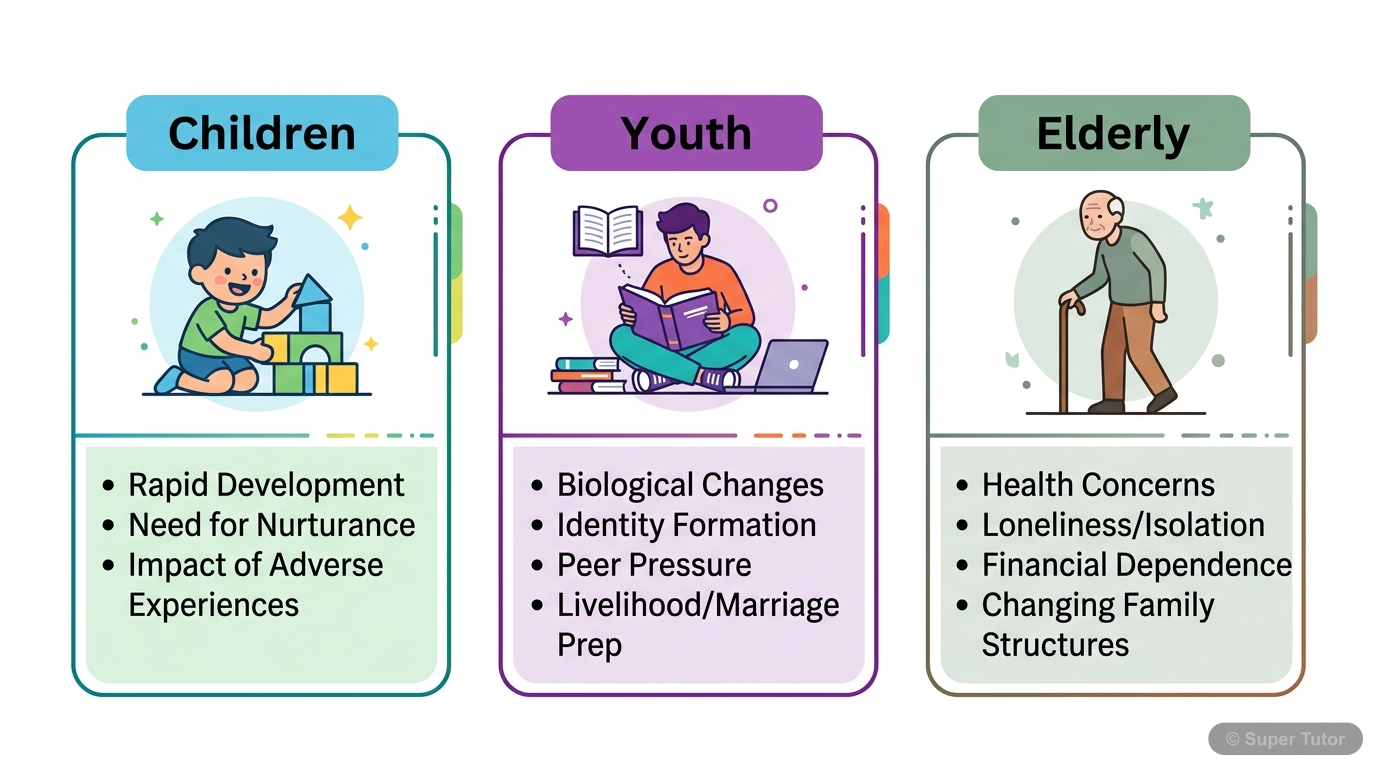
One of 10 illustrations for Management of Support Services, Institutions and Programmes for Children, Youth and Elderly in Super Tutor — alongside flashcards, concept maps and practice questions.
See them allStudy Plan
Learn the Theory
Read the textbook chapter carefully. Note down definitions, formulas and key ideas. Focus on: Why Support Services Are Needed, Children: Vulnerability and Support, Institutions and Programmes for Children.
Practise
Solve the textbook exercises and extra practice questions. There are 65 questions available for this chapter.
Revise & Test
Revise key points without looking at your notes. Take a practice quiz and mark weak areas for another pass.
Spaced Revision
Come back to Management of Support Services, Institutions and Programmes for Children, Youth and Elderly after a week. Use flashcards for quick recall and try past exam questions on this chapter.
What to Focus On
- Family is the first support system, but it cannot meet all specialised needs.
- Vulnerable groups are more likely to suffer harmful effects from difficult circumstances.
- Integrated services are important because growth, health, education and care are connected.
- Childhood is a stage of rapid and connected development.
- Nutrition, shelter, care, stimulation and schooling are essential for healthy development.
- Child vulnerability increases when basic needs are not met.
- ICDS provides integrated care for children below six years.
- Anganwadi centres deliver ICDS services.
- SOS Children’s Villages provide family-based long-term care.
Common Mistakes to Avoid
Children in need of care and protection and children in conflict with law are the same group.
Observation Homes, Special Homes, and Juvenile/Children's Homes are interchangeable names for child shelters.
ICDS is only a nutrition programme for small children.
Memory Tips
Meaning of vulnerable groups
Why children need support
ICDS programme
ICDS coverage and importance
Want a personalised study plan?
Super Tutor builds a day-by-day plan for CBSE Class 12 Home Science that fits your exam date and pace.
Create My Study PlanFrequently Asked Questions
What are the important topics in Management of Support Services, Institutions and Programmes for Children, Youth and Elderly for CBSE Class 12 Home Science?
How should I revise Management of Support Services, Institutions and Programmes for Children, Youth and Elderly for the CBSE Class 12 board exam?
Sources & Official References
- NCERT Official — ncert.nic.in
- CBSE Academic — cbseacademic.nic.in
- CBSE Official — cbse.gov.in
- National Education Policy 2020 — education.gov.in
Content is aligned to the official syllabus. Refer to the board website for the latest curriculum.
More resources for Management of Support Services, Institutions and Programmes for Children, Youth and Elderly
Practice Quiz
Test yourself with a quick quiz
Important Questions
Exam-style questions with answers
Revision Notes
Key points for last-minute revision
Chapter Summary
Understand the chapter at a glance
Concept Maps
See how topics connect
Flashcards
Quick-fire cards for active recall
Syllabus
What topics to cover
NCERT Solutions
Every textbook question solved step by step
For serious students
Get the full Management of Support Services, Institutions and Programmes for Children, Youth and Elderly chapter — start free.
Quizzes, flashcards, an AI doubt solver and a study plan for CBSE Class 12 Home Science. Free to start, no card needed.