Continuity and Differentiability
CBSE · Class 12 · Mathematics
NCERT Solutions for Continuity and Differentiability — CBSE Class 12 Mathematics.
Interactive on Super Tutor
Studying Continuity and Differentiability? Get the full interactive chapter.
Quizzes, flashcards, AI doubt-solver and a step-by-step study plan — built for ncert solutions and more.
1,000+ Class 12 students started this chapter today
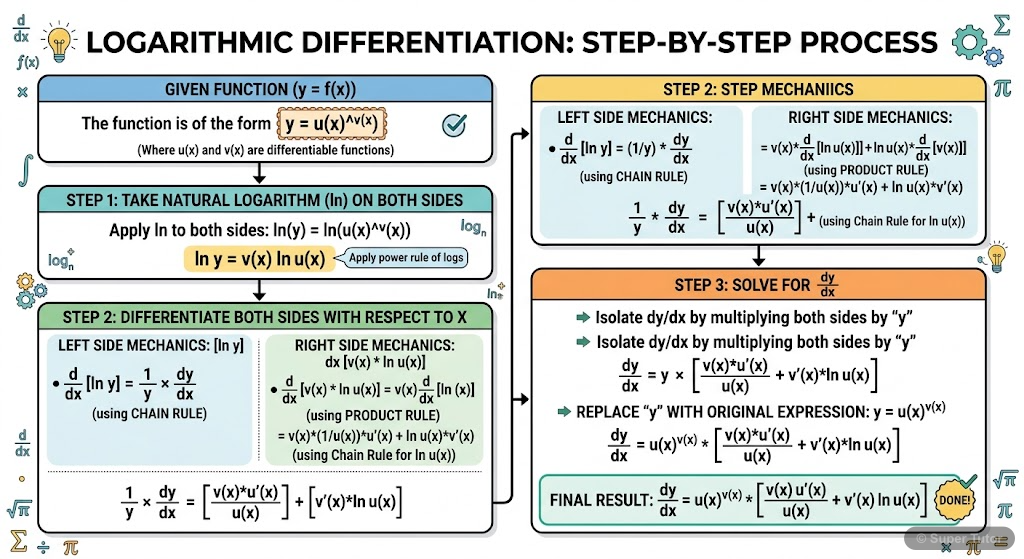
Super Tutor has 5+ illustrations like this for Continuity and Differentiability alone — flashcards, concept maps, and step-by-step visuals.
See them all20 worked solutions below. Unlock all 39 free in Super Tutor
EXERCISE 5.1
1Prove that the function is continuous at , at and at .Show solution
So is continuous at every real number. Hence it is continuous at , and .
Not sure why a step works? check your working in Super Tutor
2Examine the continuity of the function at .Show solution
Also,
Since , the function is continuous at .
Not sure why a step works? check your working in Super Tutor
3(a)Show solution
Every polynomial function is continuous at every real number. So is continuous everywhere.
Not sure why a step works? check your working in Super Tutor
3(b)Show solution
This is a rational function, so it is continuous wherever it is defined. Since it is not defined at , it is continuous for all .
Not sure why a step works? check your working in Super Tutor
3(c)Show solution
So the function agrees with the polynomial wherever it is defined. Hence it is continuous for all .
Not sure why a step works? check your working in Super Tutor
3(d)Show solution
and the modulus function is continuous everywhere. Since is a polynomial and continuous everywhere, is also continuous everywhere.
Not sure why a step works? check your working in Super Tutor
4Prove that the function is continuous at , where is a positive integer.Show solution
Not sure why a step works? check your working in Super Tutor
5Is the function defined byShow solution
- At , the first branch applies, so , which is continuous. Hence it is continuous at .
- At , from the first branch. The left hand limit is also , but the right hand limit is . Since they do not match, the function is not continuous at .
- At , the second branch applies and , so it is continuous at .
So the function is continuous at and , but not at .
Not sure why a step works? check your working in Super Tutor
6Show solution
For , is linear, so continuous. For , it is also linear, so continuous.
Check :
- Left value:
- Right hand limit:
Since these are not equal, the function is discontinuous at .
So the only point of discontinuity is .
Not sure why a step works? check your working in Super Tutor
7Show solution
Each branch is continuous on its interval. So only the boundary points need checking.
At :
-
- Right hand limit from is
So it is continuous at .
At :
- Left hand limit from is
-
These do not match, so it is discontinuous at .
Hence the only point of discontinuity is .
Not sure why a step works? check your working in Super Tutor
8Show solution
At , the function value is defined as .
The left hand limit at is and the right hand limit at is , so the limits are not equal. Therefore the function is discontinuous at .
Not sure why a step works? check your working in Super Tutor
9Show solution
For , the function is also .
So the function is constant equal to on its whole domain, hence continuous wherever it is defined. Since it is defined for all real numbers, it is continuous everywhere.
Not sure why a step works? check your working in Super Tutor
10Show solution
Each branch is continuous on its interval. Check the joining point :
- Left hand limit:
- Right hand limit:
- Value:
Since all three are equal, the function is continuous at and hence everywhere.
Not sure why a step works? check your working in Super Tutor
11Show solution
Each branch is continuous on its interval. Check :
- Left value:
- Right hand limit:
They are equal, so the function is continuous at .
Therefore the function is continuous everywhere.
Not sure why a step works? check your working in Super Tutor
12Show solution
Each piece is continuous on its interval. Check at :
- Left value:
- Right hand limit:
Since these are not equal, the function is not continuous at .
So it is continuous at all points except .
Not sure why a step works? check your working in Super Tutor
13Is the function defined byShow solution
Each piece is constant, so continuous on its interval. Check the junctions:
- At , left value is and right hand limit is , so discontinuous.
- At , left hand limit is and value is , so discontinuous.
Thus the points of discontinuity are and .
Not sure why a step works? check your working in Super Tutor
14Show solution
Each part is continuous on its own interval.
- At , left hand limit is and , so continuous.
- At , left hand limit is , but right hand limit is , so not continuous.
Hence the only point of discontinuity is .
Not sure why a step works? check your working in Super Tutor
15Show solution
Check the boundary points:
- At , left value is and right hand limit from is , so continuous.
- At , left value is and right hand limit is , so continuous.
Therefore the function is continuous everywhere; there are no points of discontinuity.
Not sure why a step works? check your working in Super Tutor
16Show solution
Left side at :
Right side at :
So we need
which simplifies to
Hence the required relation is .
Not sure why a step works? check your working in Super Tutor
17Find the relationship between and so that the function defined byShow solution
Left branch at :
Right hand limit at :
Since , the function cannot be continuous at for any value of .
At , the second branch applies, and the function is continuous there because it is linear on that side and the left branch is also continuous. The question’s continuity condition at has no solution.
Not sure why a step works? check your working in Super Tutor
19 more solved questions in Continuity and Differentiability
Every remaining exercise is solved step by step in Super Tutor, plus practice quizzes and flashcards for this chapter. Free to start.
Stuck on a step?
Ask Super Tutor AI to explain any solution on this page in a simpler way — free, 24x7.
Ask a Doubt FreeFrequently Asked Questions
What are the important topics in Continuity and Differentiability for CBSE Class 12 Mathematics?
How to score full marks in Continuity and Differentiability — CBSE Class 12 Mathematics?
Where can I get free NCERT Solutions for Continuity and Differentiability Class 12 Mathematics?
Sources & Official References
- NCERT Official — ncert.nic.in
- CBSE Academic — cbseacademic.nic.in
- CBSE Official — cbse.gov.in
- National Education Policy 2020 — education.gov.in
Content is aligned to the official syllabus. Refer to the board website for the latest curriculum.
More resources for Continuity and Differentiability
Practice Quiz
Test yourself with a quick quiz
Important Questions
Practice with board exam-style questions
Revision Notes
Key points for last-minute revision
Formula Sheet
All formulas in one place
Chapter Summary
Understand the chapter at a glance
Concept Maps
See how topics connect visually
Study Plan
Step-by-step plan to ace this chapter
Flashcards
Quick-fire cards for active recall
Syllabus
What topics to cover
For serious students
Get the full Continuity and Differentiability chapter — for free.
Quizzes, flashcards, AI doubt-solver and a step-by-step study plan for CBSE Class 12 Mathematics.