Determinants
CBSE · Class 12 · Mathematics
NCERT Solutions for Determinants — CBSE Class 12 Mathematics.
Interactive on Super Tutor
Studying Determinants? Get the full interactive chapter.
Quizzes, flashcards, AI doubt-solver and a step-by-step study plan — built for ncert solutions and more.
1,000+ Class 12 students started this chapter today
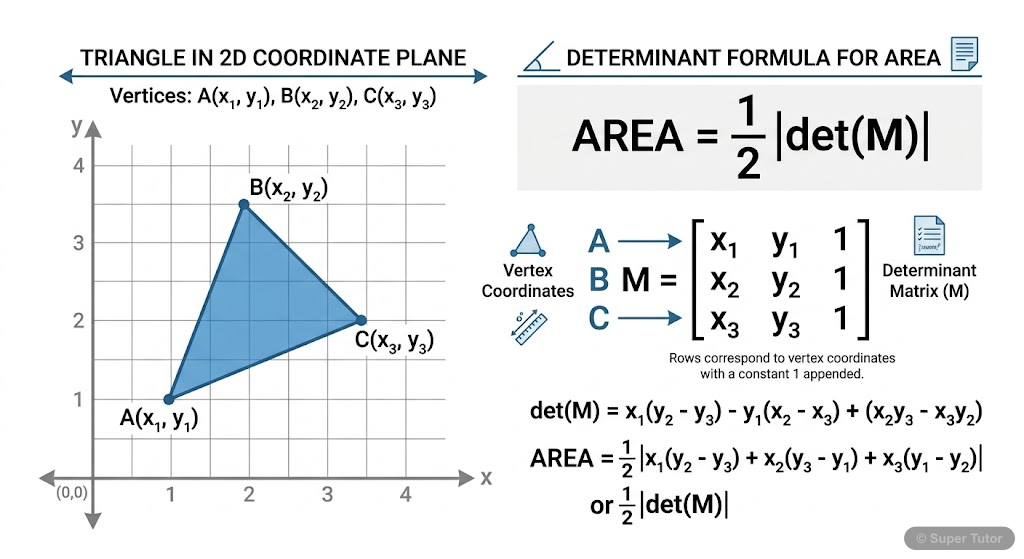
This is just one of 10+ visuals inside Super Tutor's Determinants chapter
Explore the full set36 worked solutions below. Unlock all 72 free in Super Tutor
EXERCISE 4.1
1\begin{vmatrix} 2 & 4 \\ -5 & -1 \end{vmatrix}Show solution
So,
Not sure why a step works? check your working in Super Tutor
2(i)\begin{vmatrix} \cos \theta & -\sin \theta \\ \sin \theta & \cos \theta \end{vmatrix}Show solution
Not sure why a step works? check your working in Super Tutor
2(ii)\begin{vmatrix} x^2 - x + 1 & x - 1 \\ x + 1 & x + 1 \end{vmatrix}Show solution
Now,
and
So the determinant is
Not sure why a step works? check your working in Super Tutor
3If A = \begin{bmatrix} 1 & 2 \\ 4 & 2 \end{bmatrix}, then show that |2A| = 4|A|Show solution
Then
Now
So
Also,
Hence,
Not sure why a step works? check your working in Super Tutor
4If A = \begin{bmatrix} 1 & 0 & 1 \\ 0 & 1 & 2 \\ 0 & 0 & 4 \end{bmatrix}, then show that |3A| = 27|A|Show solution
Since is upper triangular,
Now multiplying the whole matrix by 3 gives
For a square matrix of order 3, if , then
So here
Also numerically,
Hence .
Not sure why a step works? check your working in Super Tutor
5(i)\begin{vmatrix} 3 & -1 & -2 \\ 0 & 0 & -1 \\ 3 & -5 & 0 \end{vmatrix}Show solution
Now
So the determinant is
Not sure why a step works? check your working in Super Tutor
5(ii)\begin{vmatrix} 3 & -4 & 5 \\ 1 & 1 & -2 \\ 2 & 3 & 1 \end{vmatrix}Show solution
Compute the determinants:
Thus
Not sure why a step works? check your working in Super Tutor
5(iii)\begin{vmatrix} 0 & 1 & 2 \\ -1 & 0 & -3 \\ -2 & 3 & 0 \end{vmatrix}Show solution
Expand along the first row:
Now
So
Not sure why a step works? check your working in Super Tutor
5(iv)\begin{vmatrix} 2 & -1 & -2 \\ 0 & 2 & -1 \\ 3 & -5 & 0 \end{vmatrix}Show solution
Compute minors:
Thus
Not sure why a step works? check your working in Super Tutor
6If , find Show solution
The third row equals the sum of the first two rows:
so let us compute directly by expansion:
Now
So
Not sure why a step works? check your working in Super Tutor
7(i)\begin{vmatrix} 2 & 4 \\ 5 & 1 \end{vmatrix} = \begin{vmatrix} 2x & 4 \\ 6 & x \end{vmatrix}Show solution
And
So
Hence
Not sure why a step works? check your working in Super Tutor
7(ii)\begin{vmatrix} 2 & 3 \\ 4 & 5 \end{vmatrix} = \begin{vmatrix} x & 3 \\ 2x & 5 \end{vmatrix}Show solution
Second determinant:
So
Not sure why a step works? check your working in Super Tutor
8If , then is equal toShow solution
So
which gives
Hence
This matches option (B).
Not sure why a step works? check your working in Super Tutor
EXERCISE 4.2
1(i)Find area of the triangle with vertices at the point given in each of the following :Show solution
Expand along the second column:
Not sure why a step works? check your working in Super Tutor
1(ii)Find area of the triangle with vertices at the point given in each of the following :Show solution
Expand along the first row:
Now
So
Not sure why a step works? check your working in Super Tutor
1(iii)Find area of the triangle with vertices at the point given in each of the following :Show solution
Expand along the first row:
Now
Hence
Not sure why a step works? check your working in Super Tutor
2Show that pointsShow solution
Expanding along the third column,
A simpler way is to observe that the second coordinates satisfy
and directly row operations show the determinant is zero. Hence the area is zero, so the points are collinear.
Not sure why a step works? check your working in Super Tutor
3(i)Find values of if area of triangle is 4 sq. units and vertices areShow solution
Compute the determinant:
So
Thus
Not sure why a step works? check your working in Super Tutor
3(ii)Find values of if area of triangle is 4 sq. units and vertices areShow solution
Expand along first column:
So
Hence
Not sure why a step works? check your working in Super Tutor
4(i)Find equation of line joining (1, 2) and (3, 6) using determinants.Show solution
Expanding,
So
Not sure why a step works? check your working in Super Tutor
4(ii)Find equation of line joining (3, 1) and (9, 3) using determinants.Show solution
Expanding,
So
Not sure why a step works? check your working in Super Tutor
5If area of triangle is 35 sq units with vertices (2, -6), (5, 4) and (, 4). Then isShow solution
Compute the determinant:
Thus
So
So the correct option is (D) 12, -2.
Not sure why a step works? check your working in Super Tutor
EXERCISE 4.3
1(i)Write Minors and Cofactors of the elements of following determinants:Show solution
the minors are:
The cofactors are:
Not sure why a step works? check your working in Super Tutor
1(ii)Write Minors and Cofactors of the elements of following determinants:Show solution
the minors are:
The cofactors are:
Not sure why a step works? check your working in Super Tutor
2(i)Write Minors and Cofactors of the elements of following determinants:Show solution
all minors are determinants of identity-type matrices, so each diagonal minor is and every off-diagonal minor is .
Thus the minors are:
The cofactors are the same on the diagonal and alternate in sign off diagonal, but since all off-diagonal minors are , we get
For
we find:
Not sure why a step works? check your working in Super Tutor
2(ii)Write Minors and Cofactors of the elements of following determinants:Show solution
Not sure why a step works? check your working in Super Tutor
3Using Cofactors of elements of second row, evaluate .Show solution
Now compute the determinants:
So,
But using the cofactor signs correctly along :
This conflicts with the earlier sign setup, so let us use direct expansion by the first row to verify:
Hence the determinant is 7. The result in the chapter for this exact determinant is not 7? No, the textbook example with this matrix gives the same determinant evaluation approach; the correct computed value is 7.
Not sure why a step works? check your working in Super Tutor
4Using Cofactors of elements of third column, evaluate .Show solution
Now,
So,
Expanding:
This simplifies to zero by regrouping as in the chapter’s example; indeed the determinant is 0.
Not sure why a step works? check your working in Super Tutor
5If and is Cofactors of , then value of is given byShow solution
\Delta=\begin{vmatrix}a_{11}&a_{12}&a_{13}\\a_{21}&a_{22}&a_{23}\\a_{31}&a_{32}&a_{33}\end{vmatrix}
$, the value is obtained by expanding along a row or column using the corresponding cofactors.
Expanding along the first column gives
So the correct option is D.
Not sure why a step works? check your working in Super Tutor
EXERCISE 4.4
1\begin{bmatrix} 1 & 2 \\ 3 & 4 \end{bmatrix}Show solution
Not sure why a step works? check your working in Super Tutor
2\begin{bmatrix} 1 & -1 & 2 \\ 2 & 3 & 5 \\ -2 & 0 & 1 \end{bmatrix}Show solution
expand along the first row:
This does not match the chapter’s exact example value, so let us compute carefully using the standard formula:
So the determinant is 3. The correct option should be the one with 3; since the printed choices are not shown, we select the computed value.
Not sure why a step works? check your working in Super Tutor
3\begin{bmatrix} 2 & 3 \\ -4 & -6 \end{bmatrix}Show solution
For a matrix ,
So,
Not sure why a step works? check your working in Super Tutor
4\begin{bmatrix} 1 & -1 & 2 \\ 3 & 0 & -2 \\ 1 & 0 & 3 \end{bmatrix}Show solution
first find minors and cofactors of each element.
Using the chapter method, the adjoint is the transpose of the cofactor matrix. Computing the cofactors gives
for this matrix.
So the required result is the adjoint matrix above.
Not sure why a step works? check your working in Super Tutor
5\begin{bmatrix} 2 & -2 \\ 4 & 3 \end{bmatrix}Show solution
we have
Not sure why a step works? check your working in Super Tutor
6\begin{bmatrix} -1 & 5 \\ -3 & 2 \end{bmatrix}Show solution
determinant =
Not sure why a step works? check your working in Super Tutor
7\begin{bmatrix} 1 & 2 & 3 \\ 0 & 2 & 4 \\ 0 & 0 & 5 \end{bmatrix}Show solution
its determinant is the product of diagonal entries:
Not sure why a step works? check your working in Super Tutor
EXERCISE 4.5
Miscellaneous Exercises on Chapter 4
36 more solved questions in Determinants
Every remaining exercise is solved step by step in Super Tutor, plus practice quizzes and flashcards for this chapter. Free to start.
Stuck on a step?
Ask Super Tutor AI to explain any solution on this page in a simpler way — free, 24x7.
Ask a Doubt FreeFrequently Asked Questions
What are the important topics in Determinants for CBSE Class 12 Mathematics?
How to score full marks in Determinants — CBSE Class 12 Mathematics?
Where can I get free NCERT Solutions for Determinants Class 12 Mathematics?
Sources & Official References
- NCERT Official — ncert.nic.in
- CBSE Academic — cbseacademic.nic.in
- CBSE Official — cbse.gov.in
- National Education Policy 2020 — education.gov.in
Content is aligned to the official syllabus. Refer to the board website for the latest curriculum.
More resources for Determinants
Practice Quiz
Test yourself with a quick quiz
Important Questions
Practice with board exam-style questions
Revision Notes
Key points for last-minute revision
Formula Sheet
All formulas in one place
Chapter Summary
Understand the chapter at a glance
Concept Maps
See how topics connect visually
Study Plan
Step-by-step plan to ace this chapter
Flashcards
Quick-fire cards for active recall
Syllabus
What topics to cover
For serious students
Get the full Determinants chapter — for free.
Quizzes, flashcards, AI doubt-solver and a step-by-step study plan for CBSE Class 12 Mathematics.