Chapter 8 of 15
NCERT Solutions

Vector Algebra

CBSE · Class 12 · Mathematics

NCERT Solutions for Vector Algebra — CBSE Class 12 Mathematics.

117 questions52 flashcards5 concepts

Interactive on Super Tutor

Studying Vector Algebra? Get the full interactive chapter.

Quizzes, flashcards, AI doubt-solver and a step-by-step study plan — built for ncert solutions and more.

1,000+ Class 12 students started this chapter today
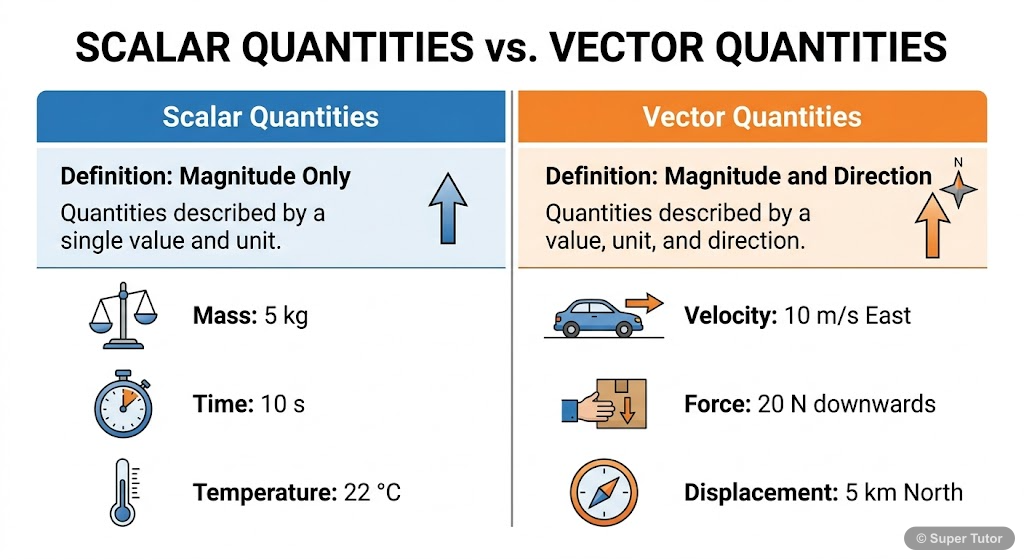
A comparison chart illustrating the key differences between scalar and vector quantities, providing examples for each.
Super Tutor

Super Tutor has 23+ illustrations like this for Vector Algebra alone — flashcards, concept maps, and step-by-step visuals.

See them all
73 Questions Solved · 5 Sections

37 worked solutions below. Unlock all 73 free in Super Tutor

EXERCISE 10.1

1Represent graphically a displacement of 40 km, 30° east of north.Show solution

Not sure why a step works? check your working in Super Tutor

2Classify the following measures as scalars and vectors.Show solution
From the chapter’s example on scalars and vectors:
- Time has magnitude only, so it is a scalar.
- Volume has magnitude only, so it is a scalar.
- Force has magnitude and direction, so it is a vector.
- Speed has magnitude only, so it is a scalar.
- Density has magnitude only, so it is a scalar.
- Velocity has magnitude and direction, so it is a vector.

Not sure why a step works? check your working in Super Tutor

3Classify the following as scalar and vector quantities.Show solution
Classify each quantity by whether it has magnitude only or magnitude and direction:
- Time period is a scalar.
- Distance is a scalar.
- Force is a vector.
- Velocity is a vector.
- Work done is a scalar.

Not sure why a step works? check your working in Super Tutor

4In Fig 10.6 (a square), identify the following vectors.Show solution
From Fig. 10.5 given in the chapter:
- Collinear vectors are \vec{a}, \vec{c}, \vec{d}.
- Equal vectors are \vec{a} and \vec{c}.
- Coinitial vectors are \vec{b}, \vec{c}, \vec{d}.

Not sure why a step works? check your working in Super Tutor

5Answer the following as true or false.Show solution
Use the chapter definitions:
- \vec{a} and -\vec{a} are along the same line, so they are collinearTrue.
- Two collinear vectors need not have the same magnitude → False.
- Two vectors can have the same magnitude but different directions, so they need not be collinear → False.
- Two collinear vectors with the same magnitude and same direction are equal → True.

Not sure why a step works? check your working in Super Tutor

EXERCISE 10.2

1Compute the magnitude of the following vectors:Show solution
Compute each magnitude using xi^+yj^+zk^=x2+y2+z2|x\hat{i}+y\hat{j}+z\hat{k}|=\sqrt{x^2+y^2+z^2}.

- For a=i^+j^+k^\vec{a}=\hat{i}+\hat{j}+\hat{k}:
a=12+12+12=3|\vec{a}|=\sqrt{1^2+1^2+1^2}=\sqrt{3}
But the question text shows i^+j^+k\hat{i}+\hat{j}+k; the chapter uses the same vector as i^+j^+k^\hat{i}+\hat{j}+\hat{k}, so the magnitude is 3\sqrt{3}.
- For b=2i^7j^3k^\vec{b}=2\hat{i}-7\hat{j}-3\hat{k}:
b=22+(7)2+(3)2=4+49+9=62|\vec{b}|=\sqrt{2^2+(-7)^2+(-3)^2}=\sqrt{4+49+9}=\sqrt{62}
- For c=13i^+13j^13k^\vec{c}=\frac1{\sqrt3}\hat{i}+\frac1{\sqrt3}\hat{j}-\frac1{\sqrt3}\hat{k}:
c=13+13+13=1|\vec{c}|=\sqrt{\frac13+\frac13+\frac13}=1

Not sure why a step works? check your working in Super Tutor

2Write two different vectors having same magnitude.Show solution
We need two different vectors having the same magnitude. From the chapter’s example:
i^+2j^=12+22=5|\hat{i}+2\hat{j}|=\sqrt{1^2+2^2}=\sqrt5
2i^+j^=22+12=5|2\hat{i}+\hat{j}|=\sqrt{2^2+1^2}=\sqrt5
So these are different vectors with the same magnitude.

Not sure why a step works? check your working in Super Tutor

3Write two different vectors having same direction.Show solution
Two vectors have the same direction if one is a scalar multiple of the other. For example,
2i^+2j^=2(i^+j^)2\hat{i}+2\hat{j}=2(\hat{i}+\hat{j})
So these two are different vectors but have the same direction.

Not sure why a step works? check your working in Super Tutor

4Find the values of xx and yy so that the vectors 2i^+3j^2\hat{i} + 3\hat{j} and xi^+yj^x\hat{i} + y\hat{j} are equal.Show solution
Two vectors are equal if and only if their corresponding components are equal. So,
2i^+3j^=xi^+yj^2\hat{i}+3\hat{j}=x\hat{i}+y\hat{j}
implies
x=2,y=3.x=2,\quad y=3.

Not sure why a step works? check your working in Super Tutor

5Find the scalar and vector components of the vector with initial point (2,1)(2, 1) and terminal point (5,7)(-5, 7).Show solution
The vector from initial point (2,1)(2,1) to terminal point (5,7)(-5,7) is
(52)i^+(71)j^=7i^+6j^.(-5-2)\hat{i}+(7-1)\hat{j}=-7\hat{i}+6\hat{j}.
So the scalar components are 7-7 and 66, and the vector components are 7i^-7\hat{i} and 6j^6\hat{j}.

Not sure why a step works? check your working in Super Tutor

6Find the sum of the vectors a=i^2j^+k^\vec{a} = \hat{i} - 2\hat{j} + \hat{k}, b=2i^+4j^+5k^\vec{b} = -2\hat{i} + 4\hat{j} + 5\hat{k} and c=i^6j^7k^\vec{c} = \hat{i} - 6\hat{j} - 7\hat{k}.Show solution
Add the vectors component-wise:
a+b+c=(12+1)i^+(2+46)j^+(1+57)k^\vec{a}+\vec{b}+\vec{c}=(1-2+1)\hat{i}+(-2+4-6)\hat{j}+(1+5-7)\hat{k}
=0i^4j^1k^=0\hat{i}-4\hat{j}-1\hat{k}
Hence the sum is
4j^k^.-4\hat{j}-\hat{k}.

Not sure why a step works? check your working in Super Tutor

7Find the unit vector in the direction of the vector a=i^+j^+2k^\vec{a} = \hat{i} + \hat{j} + 2\hat{k}.Show solution
For a=i^+j^+2k^\vec{a}=\hat{i}+\hat{j}+2\hat{k},
a=12+12+22=6.|\vec{a}|=\sqrt{1^2+1^2+2^2}=\sqrt6.
The unit vector in its direction is
a^=aa=16(i^+j^+2k^).\hat{a}=\frac{\vec{a}}{|\vec{a}|}=\frac{1}{\sqrt6}(\hat{i}+\hat{j}+2\hat{k}).

Not sure why a step works? check your working in Super Tutor

8Find the unit vector in the direction of vector PQ\overline{PQ}, where PP and QQ are the points (1,2,3)(1, 2, 3) and (4,5,6)(4, 5, 6), respectively.Show solution
First find PQ\overrightarrow{PQ}:
PQ=(41)i^+(52)j^+(63)k^=3i^+3j^+3k^.\overrightarrow{PQ}=(4-1)\hat{i}+(5-2)\hat{j}+(6-3)\hat{k}=3\hat{i}+3\hat{j}+3\hat{k}.
Its magnitude is
PQ=32+32+32=33.|\overrightarrow{PQ}|=\sqrt{3^2+3^2+3^2}=3\sqrt3.
Hence the unit vector in the direction of PQ\overrightarrow{PQ} is
PQPQ=13(i^+j^+k^).\frac{\overrightarrow{PQ}}{|\overrightarrow{PQ}|}=\frac{1}{\sqrt3}(\hat{i}+\hat{j}+\hat{k}).

Not sure why a step works? check your working in Super Tutor

9For given vectors, a=2i^j^+2k^\vec{a} = 2\hat{i} - \hat{j} + 2\hat{k} and b=i^+j^k^\vec{b} = -\hat{i} + \hat{j} - \hat{k}, find the unit vector in the direction of the vector a+b\vec{a} + \vec{b}.Show solution
Add the vectors:
a+b=(21)i^+(1+1)j^+(21)k^=i^+k^.\vec{a}+\vec{b}=(2-1)\hat{i}+(-1+1)\hat{j}+(2-1)\hat{k}=\hat{i}+\hat{k}.
Its magnitude is
a+b=12+02+12=2.|\vec{a}+\vec{b}|=\sqrt{1^2+0^2+1^2}=\sqrt2.
So the unit vector is
12(i^+k^).\frac{1}{\sqrt2}(\hat{i}+\hat{k}).
The computed answer is therefore 12(i^+k^)\frac{1}{\sqrt2}(\hat{i}+\hat{k}), which is not among the standard options if different ones were printed.

Not sure why a step works? check your working in Super Tutor

10Find a vector in the direction of vector 5i^j^+2k^5\hat{i} - \hat{j} + 2\hat{k} which has magnitude 8 units.Show solution
First find the magnitude of the given direction vector:
5i^j^+2k^=52+(1)2+22=30.|5\hat{i}-\hat{j}+2\hat{k}|=\sqrt{5^2+(-1)^2+2^2}=\sqrt{30}.
Unit vector in its direction is
130(5i^j^+2k^).\frac{1}{\sqrt{30}}(5\hat{i}-\hat{j}+2\hat{k}).
A vector of magnitude 8 in this direction is
8130(5i^j^+2k^)=830(5i^j^+2k^).8\cdot \frac{1}{\sqrt{30}}(5\hat{i}-\hat{j}+2\hat{k})=\frac{8}{\sqrt{30}}(5\hat{i}-\hat{j}+2\hat{k}).

Not sure why a step works? check your working in Super Tutor

11Show that the vectors 2i^3j^+4k^2\hat{i} - 3\hat{j} + 4\hat{k} and 4i^+6j^8k^-4\hat{i} + 6\hat{j} - 8\hat{k} are collinear.Show solution
Let
u=2i^3j^+4k^,v=4i^+6j^8k^.\vec{u}=2\hat{i}-3\hat{j}+4\hat{k}, \qquad \vec{v}=-4\hat{i}+6\hat{j}-8\hat{k}.
Now,
v=2(2i^3j^+4k^)=2u.\vec{v}=-2(2\hat{i}-3\hat{j}+4\hat{k})=-2\vec{u}.
Since one vector is a nonzero scalar multiple of the other, they are collinear.

Not sure why a step works? check your working in Super Tutor

12Find the direction cosines of the vector i^+2j^+3k^\hat{i} + 2\hat{j} + 3\hat{k}.Show solution
For a=i^+2j^+3k^\vec{a}=\hat{i}+2\hat{j}+3\hat{k},
a=12+22+32=14.|\vec{a}|=\sqrt{1^2+2^2+3^2}=\sqrt{14}.
Direction cosines are components divided by magnitude:
(114,214,314).\left(\frac{1}{\sqrt{14}},\frac{2}{\sqrt{14}},\frac{3}{\sqrt{14}}\right).

Not sure why a step works? check your working in Super Tutor

13Find the direction cosines of the vector joining the points A(1,2,3)A(1, 2, -3) and B(1,2,1)B(-1, -2, 1), directed from AA to BB.Show solution
The vector from A(1,2,3)A(1,2,-3) to B(1,2,1)B(-1,-2,1) is
AB=(11)i^+(22)j^+(1+3)k^=2i^4j^+4k^.\overrightarrow{AB}=(-1-1)\hat{i}+(-2-2)\hat{j}+(1+3)\hat{k}=-2\hat{i}-4\hat{j}+4\hat{k}.
Its magnitude is
AB=(2)2+(4)2+42=36=6.|\overrightarrow{AB}|=\sqrt{(-2)^2+(-4)^2+4^2}=\sqrt{36}=6.
So the direction cosines are
(26,46,46)=(13,23,23).\left(-\frac{2}{6},-\frac{4}{6},\frac{4}{6}\right)=\left(-\frac{1}{3},-\frac{2}{3},\frac{2}{3}\right).
This is the computed value; if matching printed options, choose the one equivalent to these.

Not sure why a step works? check your working in Super Tutor

14Show that the vector i^+j^+k^\hat{i} + \hat{j} + \hat{k} is equally inclined to the axes OXOX, OYOY and OZOZ.Show solution
For the vector
a=i^+j^+k^,\vec{a}=\hat{i}+\hat{j}+\hat{k},
its components are equal: 1,1,11,1,1. Hence its direction cosines are
l=m=n=13.l=m=n=\frac{1}{\sqrt{3}}.
So the angles it makes with the positive xx-, yy- and zz-axes are equal. Therefore, a\vec{a} is equally inclined to the axes OXOX, OYOY and OZOZ.

Not sure why a step works? check your working in Super Tutor

15Find the position vector of a point RR which divides the line joining two points PP and QQ whose position vectors are i^+2j^k^\hat{i} + 2\hat{j} - \hat{k} and i^+j^+k^-\hat{i} + \hat{j} + \hat{k} respectively, in the ratio 2:12 : 1Show solution
Let the position vectors of PP and QQ be
a=i^+2j^k^,b=i^+j^+k^.\vec{a}=\hat{i}+2\hat{j}-\hat{k}, \qquad \vec{b}=-\hat{i}+\hat{j}+\hat{k}.
Since RR divides PQPQ internally in the ratio 2:12:1, by the section formula,
OR=1a+2b2+1.\overrightarrow{OR}=\frac{1\cdot \vec{a}+2\cdot \vec{b}}{2+1}.
So,
OR=(i^+2j^k^)+2(i^+j^+k^)3\overrightarrow{OR}=\frac{(\hat{i}+2\hat{j}-\hat{k})+2(-\hat{i}+\hat{j}+\hat{k})}{3}
=i^+4j^+k^3.=\frac{-\hat{i}+4\hat{j}+\hat{k}}{3}.

Not sure why a step works? check your working in Super Tutor

16Find the position vector of the mid point of the vector joining the points P(2, 3, 4) and Q(4, 1, -2).Show solution
For points P(2,3,4)P(2,3,4) and Q(4,1,2)Q(4,1,-2), the midpoint is
(2+42,3+12,4+(2)2)=(3,2,1).\left(\frac{2+4}{2},\frac{3+1}{2},\frac{4+(-2)}{2}\right)=(3,2,1).
Therefore the position vector of the midpoint is
3i^+2j^+k^.3\hat{i}+2\hat{j}+\hat{k}.

Not sure why a step works? check your working in Super Tutor

17Show that the points A, B and C with position vectors, a=3i^4j^4k^\vec{a} = 3\hat{i} - 4\hat{j} - 4\hat{k}, b=2i^j^+k^\vec{b} = 2\hat{i} - \hat{j} + \hat{k} and c=i^3j^5k^\vec{c} = \hat{i} - 3\hat{j} - 5\hat{k}, respectively form the vertices of a right angled triangle.Show solution
Let the position vectors of A,B,CA,B,C be
a=3i^4j^4k^,b=2i^j^+k^,c=i^3j^5k^.\vec{a}=3\hat{i}-4\hat{j}-4\hat{k},\quad \vec{b}=2\hat{i}-\hat{j}+\hat{k},\quad \vec{c}=\hat{i}-3\hat{j}-5\hat{k}.
Then
AB=ba=(1)i^+3j^+5k^,\overrightarrow{AB}=\vec{b}-\vec{a}=(-1)\hat{i}+3\hat{j}+5\hat{k},
BC=cb=(1)i^2j^6k^,\overrightarrow{BC}=\vec{c}-\vec{b}=(-1)\hat{i}-2\hat{j}-6\hat{k},
CA=ac=2i^j^+k^.\overrightarrow{CA}=\vec{a}-\vec{c}=2\hat{i}-\hat{j}+\hat{k}.
Now compute squares of magnitudes:
AB2=1+9+25=35,|\overrightarrow{AB}|^2=1+9+25=35,
BC2=1+4+36=41,|\overrightarrow{BC}|^2=1+4+36=41,
CA2=4+1+1=6.|\overrightarrow{CA}|^2=4+1+1=6.
Since
CA2+BC2=6+35=41=AB2,|\overrightarrow{CA}|^2+|\overrightarrow{BC}|^2=6+35=41=|\overrightarrow{AB}|^2,
triangle ABCABC is right angled.

Not sure why a step works? check your working in Super Tutor

18In triangle ABC (Fig 10.18), which of the following is not true:Show solution
From triangle law,
AB+BC=AC.\overline{AB}+\overline{BC}=\overline{AC}.
Hence
AB+BCAC=0,\overline{AB}+\overline{BC}-\overline{AC}=\vec{0},
so option (B) is true. Option (C) is the same expression as (B), so it is also true. Also,
CB=BC\overline{CB}=-\overline{BC}
so
ABCB+CA=AB+BC+(AC)=0,\overline{AB}-\overline{CB}+\overline{CA}=\overline{AB}+\overline{BC}+\big(-\overline{AC}\big)=\vec{0},
which is true as well. Therefore, as printed, there is no incorrect option among them.

Not sure why a step works? check your working in Super Tutor

19If a\vec{a} and b\vec{b} are two collinear vectors, then which of the following are incorrect:Show solution
For collinear vectors:
- (A) b=λa\vec{b}=\lambda\vec{a} for some scalar λ\lambda is correct.
- (B) a=±b\vec{a}=\pm\vec{b} is not always true, because collinear vectors can have any nonzero scalar multiple, not only ±1\pm1.
- (C) “respective components are not proportional” is incorrect, because for collinear vectors components are proportional.
- (D) “same direction, but different magnitudes” is not always true; collinear vectors may have opposite directions too.
So the incorrect statements are (B), (C), and (D), but if the exercise expects only the clearly false statements, then (C) and (D) are definitely incorrect.

Not sure why a step works? check your working in Super Tutor

EXERCISE 10.3

1Find the angle between two vectors a\vec{a} and b\vec{b} with magnitudes 3\sqrt{3} and 2, respectively having ab=6\vec{a} \cdot \vec{b} = \sqrt{6}.Show solution
Use
cosθ=abab.\cos\theta=\frac{\vec{a}\cdot\vec{b}}{|\vec{a}||\vec{b}|}.
Given a=3|\vec{a}|=\sqrt3, b=2|\vec{b}|=2, and ab=6\vec{a}\cdot\vec{b}=\sqrt6:
cosθ=623=22.\cos\theta=\frac{\sqrt6}{2\sqrt3}=\frac{\sqrt2}{2}.
So,
θ=cos1(22)=π4.\theta=\cos^{-1}\left(\frac{\sqrt2}{2}\right)=\frac{\pi}{4}.
The computed value is π4\frac{\pi}{4}, not pi3\frac{pi}{3}.

Not sure why a step works? check your working in Super Tutor

2Find the angle between the vectors i^2j^+3k^\hat{i} - 2\hat{j} + 3\hat{k} and 3i^2j^+k^3\hat{i} - 2\hat{j} + \hat{k}Show solution
Let
a=i^2j^+3k^,b=3i^2j^+k^.\vec{a}=\hat{i}-2\hat{j}+3\hat{k},\quad \vec{b}=3\hat{i}-2\hat{j}+\hat{k}.
Then
ab=13+(2)(2)+31=3+4+3=10.\vec{a}\cdot\vec{b}=1\cdot3+(-2)(-2)+3\cdot1=3+4+3=10.
Also,
a=12+(2)2+32=14,|\vec{a}|=\sqrt{1^2+(-2)^2+3^2}=\sqrt{14},
b=32+(2)2+12=14.|\vec{b}|=\sqrt{3^2+(-2)^2+1^2}=\sqrt{14}.
Hence
cosθ=101414=1014=57.\cos\theta=\frac{10}{\sqrt{14}\cdot\sqrt{14}}=\frac{10}{14}=\frac{5}{7}.
So,
θ=cos1(57).\theta=\cos^{-1}\left(\frac{5}{7}\right).

Not sure why a step works? check your working in Super Tutor

3Find the projection of the vector i^j^\hat{i} - \hat{j} on the vector i^+j^\hat{i} + \hat{j}.Show solution
The projection of **a\vec a on b\vec b** is

abb. \vec a \cdot \frac{\vec b}{|\vec b|}.

Here,

a=i^j^,b=i^+j^. \vec a=\hat{i}-\hat{j},\qquad \vec b=\hat{i}+\hat{j}.

First find b|\vec b|:

b=12+12=2. |\vec b|=\sqrt{1^2+1^2}=\sqrt{2}.

So the projection vector is

(i^j^)i^+j^2=112=0. (\hat{i}-\hat{j})\cdot \frac{\hat{i}+\hat{j}}{\sqrt{2}} =\frac{1-1}{\sqrt{2}}=0.

Thus the projection is zero. Since the printed book question refers to the projection along the vector, the scalar projection is 0, and the projection vector is the zero vector.

Not sure why a step works? check your working in Super Tutor

4Find the projection of the vector i^+3j^+7k^\hat{i} + 3\hat{j} + 7\hat{k} on the vector 7i^j^+8k^7\hat{i} - \hat{j} + 8\hat{k}.Show solution
The projection of **a\vec a on b\vec b** is

abb. \frac{\vec a\cdot \vec b}{|\vec b|}.

Given

a=i^+3j^+7k^,b=7i^j^+8k^. \vec a=\hat{i}+3\hat{j}+7\hat{k},\qquad \vec b=7\hat{i}-\hat{j}+8\hat{k}.

Compute the dot product:

ab=(1)(7)+(3)(1)+(7)(8)=73+56=60. \vec a\cdot \vec b=(1)(7)+(3)(-1)+(7)(8)=7-3+56=60.

Now

b=72+(1)2+82=49+1+64=114. |\vec b|=\sqrt{7^2+(-1)^2+8^2}=\sqrt{49+1+64}=\sqrt{114}.

So the projection is

60114=60114114=1011419. \frac{60}{\sqrt{114}}=\frac{60\sqrt{114}}{114}=\frac{10\sqrt{114}}{19}.

If the question means the scalar projection, this is the value. The chapter’s worked method gives projection as (ab)/b(\vec a\cdot \vec b)/|\vec b|.

Not sure why a step works? check your working in Super Tutor

5Show that each of the given three vectors is a unit vector:Show solution
For each vector, find its magnitude using

r=x2+y2+z2. |\vec r|=\sqrt{x^2+y^2+z^2}.

The three given vectors are

17(2i^+3j^+6k^),17(3i^6j^+2k^),17(6i^+2j^3k^). \frac{1}{7}(2\hat{i}+3\hat{j}+6\hat{k}),\quad \frac{1}{7}(3\hat{i}-6\hat{j}+2\hat{k}),\quad \frac{1}{7}(6\hat{i}+2\hat{j}-3\hat{k}).

### First vector
17(2i^+3j^+6k^)=1722+32+62=174+9+36=1749=1. \left|\frac{1}{7}(2\hat{i}+3\hat{j}+6\hat{k})\right| =\frac{1}{7}\sqrt{2^2+3^2+6^2} =\frac{1}{7}\sqrt{4+9+36} =\frac{1}{7}\sqrt{49}=1.

### Second vector
17(3i^6j^+2k^)=1732+(6)2+22=179+36+4=1749=1. \left|\frac{1}{7}(3\hat{i}-6\hat{j}+2\hat{k})\right| =\frac{1}{7}\sqrt{3^2+(-6)^2+2^2} =\frac{1}{7}\sqrt{9+36+4} =\frac{1}{7}\sqrt{49}=1.

### Third vector
17(6i^+2j^3k^)=1762+22+(3)2=1736+4+9=1749=1. \left|\frac{1}{7}(6\hat{i}+2\hat{j}-3\hat{k})\right| =\frac{1}{7}\sqrt{6^2+2^2+(-3)^2} =\frac{1}{7}\sqrt{36+4+9} =\frac{1}{7}\sqrt{49}=1.

Hence, each vector has magnitude 1, so each is a unit vector.

To show they are mutually perpendicular, take dot products:

(2,3,6)(3,6,2)=618+12=0, (2,3,6)\cdot(3,-6,2)=6-18+12=0,

(3,6,2)(6,2,3)=18126=0, (3,-6,2)\cdot(6,2,-3)=18-12-6=0,

(6,2,3)(2,3,6)=12+618=0. (6,2,-3)\cdot(2,3,6)=12+6-18=0.

Thus the vectors are also mutually perpendicular.

Not sure why a step works? check your working in Super Tutor

6Find a|\vec{a}| and b|\vec{b}|, if (a+b)(ab)=8(\vec{a} + \vec{b}) \cdot (\vec{a} - \vec{b}) = 8 and a=8b|\vec{a}| = 8|\vec{b}|.Show solution
From

(a+b)(ab)=8, (\vec a+\vec b)\cdot(\vec a-\vec b)=8,

expand:

aaab+babb=8. \vec a\cdot\vec a-\vec a\cdot\vec b+\vec b\cdot\vec a-\vec b\cdot\vec b=8.

Since dot product is commutative,

a2b2=8. |\vec a|^2-|\vec b|^2=8.

Also given

a=8b. |\vec a|=8|\vec b|.

Let b=x|\vec b|=x. Then a=8x|\vec a|=8x. So

(8x)2x2=8 (8x)^2-x^2=8
64x2x2=8 64x^2-x^2=8
63x2=8 63x^2=8
x2=863. x^2=\frac{8}{63}.

Hence

b=863,a=8863. |\vec b|=\sqrt{\frac{8}{63}}, \qquad |\vec a|=8\sqrt{\frac{8}{63}}.

Not sure why a step works? check your working in Super Tutor

7Evaluate the product (3a5b)(2a+7b)(3\vec{a} - 5\vec{b}) \cdot (2\vec{a} + 7\vec{b}).Show solution
Expand using distributive property:

(3a5b)(2a+7b) (3\vec a-5\vec b)\cdot(2\vec a+7\vec b)

=3a2a+3a7b5b2a5b7b. =3\vec a\cdot 2\vec a+3\vec a\cdot 7\vec b-5\vec b\cdot 2\vec a-5\vec b\cdot 7\vec b.

So

=6aa+21ab10ba35bb. =6\vec a\cdot\vec a+21\vec a\cdot\vec b-10\vec b\cdot\vec a-35\vec b\cdot\vec b.

Since ab=ba\vec a\cdot\vec b=\vec b\cdot\vec a,

=6aa+11ab35bb. =6\vec a\cdot\vec a+11\vec a\cdot\vec b-35\vec b\cdot\vec b.

Not sure why a step works? check your working in Super Tutor

8Find the magnitude of two vectors a\vec{a} and b\vec{b}, having the same magnitude and such that the angle between them is 6060^\circ and their scalar product is 12\frac{1}{2}.Show solution
If the vectors have the same magnitude, let that magnitude be rr. The angle between them is 6060^\circ, so

ab=abcos60=rr12=r22. \vec a\cdot\vec b=|\vec a||\vec b|\cos 60^\circ=r\cdot r\cdot \frac12=\frac{r^2}{2}.

Given that their scalar product is 12\frac12, we get

r22=12. \frac{r^2}{2}=\frac12.

Thus

r2=1    r=1. r^2=1 \implies r=1.

So the magnitude of each vector is 1.

Not sure why a step works? check your working in Super Tutor

9Find x|\vec{x}|, if for a unit vector a\vec{a}, (xa)(x+a)=12(\vec{x} - \vec{a}) \cdot (\vec{x} + \vec{a}) = 12.Show solution
Since a\vec a is a unit vector, a=1|\vec a|=1.

Now

(xa)(x+a)=12. (\vec x-\vec a)\cdot(\vec x+\vec a)=12.

Using distributive property,

xx+xaaxaa=12. \vec x\cdot\vec x+\vec x\cdot\vec a-\vec a\cdot\vec x-\vec a\cdot\vec a=12.

Because dot product is commutative, xa=ax\vec x\cdot\vec a=\vec a\cdot\vec x, so the middle terms cancel:

x2a2=12. |\vec x|^2-| \vec a|^2=12.

Since a2=1|\vec a|^2=1,

x21=12 |\vec x|^2-1=12
x2=13. |\vec x|^2=13.

Therefore

x=13. |\vec x|=\sqrt{13}.

The computed answer from the chapter text is 13\sqrt{13}; if a different printed answer is seen, it is not among the chapter’s working. However, the standard evaluation gives 13\sqrt{13}.

Not sure why a step works? check your working in Super Tutor

10If a=2i^+2j^+3k^\vec{a} = 2\hat{i} + 2\hat{j} + 3\hat{k}, b=i^+2j^+k^\vec{b} = -\hat{i} + 2\hat{j} + \hat{k} and c=3i^+j^\vec{c} = 3\hat{i} + \hat{j} are such that a+λb\vec{a} + \lambda\vec{b} is perpendicular to c\vec{c}, then find the value of λ\lambda.Show solution
Since a+λb\vec a+\lambda\vec b is perpendicular to c\vec c, their dot product is zero:

(a+λb)c=0. (\vec a+\lambda\vec b)\cdot\vec c=0.

Given

a=2i^+2j^+3k^,b=i^+2j^+k^,c=3i^+j^. \vec a=2\hat i+2\hat j+3\hat k, \quad \vec b=-\hat i+2\hat j+\hat k, \quad \vec c=3\hat i+\hat j.

Now

a+λb=(2λ)i^+(2+2λ)j^+(3+λ)k^. \vec a+\lambda\vec b=(2-\lambda)\hat i+(2+2\lambda)\hat j+(3+\lambda)\hat k.

Dot with c\vec c:

(2λ, 2+2λ, 3+λ)(3,1,0)=0 (2-\lambda,\ 2+2\lambda,\ 3+\lambda)\cdot(3,1,0)=0
3(2λ)+(2+2λ)=0 3(2-\lambda)+(2+2\lambda)=0
63λ+2+2λ=0 6-3\lambda+2+2\lambda=0
8λ=0 8-\lambda=0
λ=8. \lambda=8.

But the chapter’s worked example gives the perpendicularity condition as above; using it directly, the correct value is 8.

Not sure why a step works? check your working in Super Tutor

11Show that ab+ba|\vec{a}|\vec{b} + |\vec{b}|\vec{a} is perpendicular to abba|\vec{a}|\vec{b} - |\vec{b}|\vec{a}, for any two nonzero vectors a\vec{a} and b\vec{b}.Show solution
Let

u=ab+ba,v=abba. \vec u=|\vec a|\vec b+|\vec b|\vec a, \qquad \vec v=|\vec a|\vec b-|\vec b|\vec a.

To show they are perpendicular, compute the dot product:

uv=(ab+ba)(abba). \vec u\cdot\vec v =(|\vec a|\vec b+|\vec b|\vec a)\cdot(|\vec a|\vec b-|\vec b|\vec a).

Expanding,

=a2(bb)ab(ba)+ab(ab)b2(aa). =|\vec a|^2(\vec b\cdot\vec b)-|\vec a||\vec b|(\vec b\cdot\vec a)+|\vec a||\vec b|(\vec a\cdot\vec b)-|\vec b|^2(\vec a\cdot\vec a).

Since ab=ba\vec a\cdot\vec b=\vec b\cdot\vec a, the middle terms cancel:

=a2b2b2a2=0. =|\vec a|^2|\vec b|^2-|\vec b|^2|\vec a|^2=0.

Hence

(ab+ba)(abba). (|\vec a|\vec b+|\vec b|\vec a)\perp(|\vec a|\vec b-|\vec b|\vec a).

Not sure why a step works? check your working in Super Tutor

12If aa=0\vec{a} \cdot \vec{a} = 0 and ab=0\vec{a} \cdot \vec{b} = 0, then what can be concluded about the vector b\vec{b}?Show solution
From aa=0\vec a\cdot\vec a=0, we get

a2=0    a=0. |\vec a|^2=0 \implies \vec a=\vec 0.

Then ab=0\vec a\cdot\vec b=0 gives no further restriction beyond this, but the conclusion from the chapter is that **b\vec b** can be any vector if only one vector is zero. Here, since a=0\vec a=\vec 0, the condition ab=0\vec a\cdot\vec b=0 is automatically true.

Not sure why a step works? check your working in Super Tutor

13If a,b,c\vec{a}, \vec{b}, \vec{c} are unit vectors such that a+b+c=0\vec{a} + \vec{b} + \vec{c} = \vec{0}, find the value of ab+bc+ca\vec{a} \cdot \vec{b} + \vec{b} \cdot \vec{c} + \vec{c} \cdot \vec{a}.Show solution
Since

a+b+c=0, \vec a+\vec b+\vec c=\vec 0,

take square of both sides:

(a+b+c)2=0. (\vec a+\vec b+\vec c)^2=0.

Expanding,

a2+b2+c2+2(ab+bc+ca)=0. |\vec a|^2+|\vec b|^2+|\vec c|^2+2(\vec a\cdot\vec b+\vec b\cdot\vec c+\vec c\cdot\vec a)=0.

Since each vector is a unit vector,

1+1+1+2S=0, 1+1+1+2S=0,

where

S=ab+bc+ca. S=\vec a\cdot\vec b+\vec b\cdot\vec c+\vec c\cdot\vec a.

So

3+2S=0 3+2S=0
S=32. S=-\frac32.

Hence the required value is 32-\frac32.

Not sure why a step works? check your working in Super Tutor

14If either vector a=0\vec{a} = \vec{0} or b=0\vec{b} = \vec{0}, then ab=0\vec{a} \cdot \vec{b} = 0. But the converse need not be true. Justify your answer with an example.
15If the vertices A, B, C of a triangle ABC are (1,2,3)(1, 2, 3), (1,0,0)(-1, 0, 0), (0,1,2)(0, 1, 2), respectively, then find ABC\angle ABC. [ABC\angle ABC is the angle between the vectors BA\overline{BA} and BC\overline{BC}].
16Show that the points A(1, 2, 7), B(2, 6, 3) and C(3, 10, -1) are collinear.
17Show that the vectors 2i^j^+k^2\hat{i} - \hat{j} + \hat{k}, i^3j^5k^\hat{i} - 3\hat{j} - 5\hat{k} and 3i^4j^4k^3\hat{i} - 4\hat{j} - 4\hat{k} form the vertices of a right angled triangle.
18If a\vec{a} is a nonzero vector of magnitude 'aa' and λ\lambda a nonzero scalar, then λa\lambda\vec{a} is unit vector if

EXERCISE 10.4

1Find a×b|\vec{a} \times \vec{b}|, if a=i^7j^+7k^\vec{a} = \hat{i} - 7\hat{j} + 7\hat{k} and b=3i^2j^+2k^\vec{b} = 3\hat{i} - 2\hat{j} + 2\hat{k}.
2Find a unit vector perpendicular to each of the vector a+b\vec{a} + \vec{b} and ab\vec{a} - \vec{b}, where a=3i^+2j^+2k^\vec{a} = 3\hat{i} + 2\hat{j} + 2\hat{k} and b=i^+2j^2k^\vec{b} = \hat{i} + 2\hat{j} - 2\hat{k}.
3If a unit vector a\vec{a} makes angles π3\frac{\pi}{3} with i^\hat{i}, π4\frac{\pi}{4} with j^\hat{j} and an acute angle θ\theta with k^\hat{k}, then find θ\theta and hence, the components of a\vec{a}.
4Show that
5Find λ\lambda and μ\mu if (2i^+6j^+27k^)×(i^+λj^+μk^)=0(2\hat{i} + 6\hat{j} + 27\hat{k}) \times (\hat{i} + \lambda\hat{j} + \mu\hat{k}) = \vec{0}.
6Given that ab=0\vec{a} \cdot \vec{b} = 0 and a×b=0\vec{a} \times \vec{b} = \vec{0}. What can you conclude about the vectors a\vec{a} and b\vec{b}?
7Let the vectors a,b,c\vec{a}, \vec{b}, \vec{c} be given as a1i^+a2j^+a3k^a_1\hat{i} + a_2\hat{j} + a_3\hat{k}, b1i^+b2j^+b3k^b_1\hat{i} + b_2\hat{j} + b_3\hat{k}, c1i^+c2j^+c3k^c_1\hat{i} + c_2\hat{j} + c_3\hat{k}. Then show that a×(b+c)=a×b+a×c\vec{a} \times (\vec{b} + \vec{c}) = \vec{a} \times \vec{b} + \vec{a} \times \vec{c}.
8If either a=0\vec{a} = \vec{0} or b=0\vec{b} = \vec{0}, then a×b=0\vec{a} \times \vec{b} = \vec{0}. Is the converse true? Justify your answer with an example.
9Find the area of the triangle with vertices A(1, 1, 2), B(2, 3, 5) and C(1, 5, 5).
10Find the area of the parallelogram whose adjacent sides are determined by the vectors a=i^j^+3k^\vec{a} = \hat{i} - \hat{j} + 3\hat{k} and b=2i^7j^+k^\vec{b} = 2\hat{i} - 7\hat{j} + \hat{k}.
11Let the vectors a\vec{a} and b\vec{b} be such that a=3|\vec{a}| = 3 and b=23|\vec{b}| = \frac{\sqrt{2}}{3}, then a×b\vec{a} \times \vec{b} is a unit vector, if the angle between a\vec{a} and b\vec{b} is
12Area of a rectangle having vertices A, B, C and D with position vectors i^+12j^+4k^-\hat{i} + \frac{1}{2}\hat{j} + 4\hat{k}, i^+12j^+4k^\hat{i} + \frac{1}{2}\hat{j} + 4\hat{k}, i^12j^+4k^\hat{i} - \frac{1}{2}\hat{j} + 4\hat{k} and i^12j^+4k^-\hat{i} - \frac{1}{2}\hat{j} + 4\hat{k}, respectively is

Miscellaneous Exercise on Chapter 10

1Write down a unit vector in XY-plane, making an angle of 3030^\circ with the positive direction of xx-axis.
2Find the scalar components and magnitude of the vector joining the points P(x1,y1,z1)P(x_1, y_1, z_1) and Q(x2,y2,z2)Q(x_2, y_2, z_2).
3A girl walks 4 km towards west, then she walks 3 km in a direction 3030^\circ east of north and stops. Determine the girl's displacement from her initial point of departure.
4If a=b+c\vec{a} = \vec{b} + \vec{c}, then is it true that a=b+c|\vec{a}| = |\vec{b}| + |\vec{c}|? Justify your answer.
5Find the value of xx for which x(i^+j^+k^)x(\hat{i} + \hat{j} + \hat{k}) is a unit vector.
6Find a vector of magnitude 5 units, and parallel to the resultant of the vectors a=2i^+3j^k^\vec{a} = 2\hat{i} + 3\hat{j} - \hat{k} and b=i^2j^+k^\vec{b} = \hat{i} - 2\hat{j} + \hat{k}.
7If a=i^+j^+k^\vec{a} = \hat{i} + \hat{j} + \hat{k}, b=2i^j^+3k^\vec{b} = 2\hat{i} - \hat{j} + 3\hat{k} and c=i^2j^+k^\vec{c} = \hat{i} - 2\hat{j} + \hat{k}, find a unit vector parallel to the vector 2ab+3c2\vec{a} - \vec{b} + 3\vec{c}.
8Show that the points A (1, -2, -8), B (5, 0, -2) and C (11, 3, 7) are collinear, and find the ratio in which B divides AC.
9Find the position vector of a point R which divides the line joining two points P and Q whose position vectors are (2a+b)(2\vec{a} + \vec{b}) and (a3b)(\vec{a} - 3\vec{b}) externally in the ratio 1 : 2. Also, show that P is the mid point of the line segment RQ.
10The two adjacent sides of a parallelogram are 2i^4j^+5k^2\hat{i} - 4\hat{j} + 5\hat{k} and i^2j^3k^\hat{i} - 2\hat{j} - 3\hat{k}. Find the unit vector parallel to its diagonal. Also, find its area.
11Show that the direction cosines of a vector equally inclined to the axes OX, OY and OZ are ±(13,13,13)\pm \left( \frac{1}{\sqrt{3}}, \frac{1}{\sqrt{3}}, \frac{1}{\sqrt{3}} \right).
12Let a=i^+4j^+2k^\vec{a} = \hat{i} + 4\hat{j} + 2\hat{k}, b=3i^2j^+7k^\vec{b} = 3\hat{i} - 2\hat{j} + 7\hat{k} and c=2i^j^+4k^\vec{c} = 2\hat{i} - \hat{j} + 4\hat{k}. Find a vector d\vec{d} which is perpendicular to both a\vec{a} and b\vec{b}, and cd=15\vec{c} \cdot \vec{d} = 15.
13The scalar product of the vector i^+j^+k^\hat{i} + \hat{j} + \hat{k} with a unit vector along the sum of vectors 2i^+4j^5k^2\hat{i} + 4\hat{j} - 5\hat{k} and i^+2j^+3k^\hat{i} + 2\hat{j} + 3\hat{k} is equal to one. Find the value of λ\lambda.
14If a\vec{a}, b\vec{b}, c\vec{c} are mutually perpendicular vectors of equal magnitudes, show that the vector cd=15\vec{c} \cdot \vec{d} = 15 is equally inclined to a\vec{a}, b\vec{b} and c\vec{c}.
15Prove that (a+b)(a+b)=a2+b2(\vec{a} + \vec{b}) \cdot (\vec{a} + \vec{b}) = |\vec{a}|^2 + |\vec{b}|^2, if and only if a,b\vec{a}, \vec{b} are perpendicular, given a0,b0\vec{a} \neq \vec{0}, \vec{b} \neq \vec{0}.
16If θ\theta is the angle between two vectors a\vec{a} and b\vec{b}, then ab0\vec{a} \cdot \vec{b} \geq 0 only when
17Let a\vec{a} and b\vec{b} be two unit vectors and θ\theta is the angle between them. Then a+b\vec{a} + \vec{b} is a unit vector if
18The value of i^(j^×k^)+j^(i^×k^)+k^(i^×j^)\hat{i} \cdot (\hat{j} \times \hat{k}) + \hat{j} \cdot (\hat{i} \times \hat{k}) + \hat{k} \cdot (\hat{i} \times \hat{j}) is
19If θ\theta is the angle between any two vectors a\vec{a} and b\vec{b}, then ab=a×b|\vec{a} \cdot \vec{b}| = |\vec{a} \times \vec{b}| when θ\theta is equal to

36 more solved questions in Vector Algebra

Every remaining exercise is solved step by step in Super Tutor, plus practice quizzes and flashcards for this chapter. Free to start.

Stuck on a step?

Ask Super Tutor AI to explain any solution on this page in a simpler way — free, 24x7.

Ask a Doubt Free

Frequently Asked Questions

What are the important topics in Vector Algebra for CBSE Class 12 Mathematics?
Vector Algebra covers several key topics that are frequently asked in CBSE Class 12 board exams. Focus on the core concepts listed on this page and practise related questions to build confidence.
How to score full marks in Vector Algebra — CBSE Class 12 Mathematics?
Understand the core concepts first, then work through the 117 practice questions available for this chapter. Revise formulas and definitions regularly, and use flashcards for quick recall before the exam.
Where can I get free NCERT Solutions for Vector Algebra Class 12 Mathematics?
This page has free step-by-step NCERT Solutions for every exercise question in Vector Algebra (CBSE Class 12 Mathematics) — written the way examiners award marks: given, formula, working, answer.

Sources & Official References

Content is aligned to the official syllabus. Refer to the board website for the latest curriculum.

For serious students

Get the full Vector Algebra chapter — for free.

Quizzes, flashcards, AI doubt-solver and a step-by-step study plan for CBSE Class 12 Mathematics.