Chapter 3 of 15
NCERT Solutions

Inverse Trigonometric Functions

CBSE · Class 12 · Mathematics

NCERT Solutions for Inverse Trigonometric Functions — CBSE Class 12 Mathematics.

105 questions44 flashcards5 concepts

Interactive on Super Tutor

Studying Inverse Trigonometric Functions? Get the full interactive chapter.

Quizzes, flashcards, AI doubt-solver and a step-by-step study plan — built for ncert solutions and more.

1,000+ Class 12 students started this chapter today
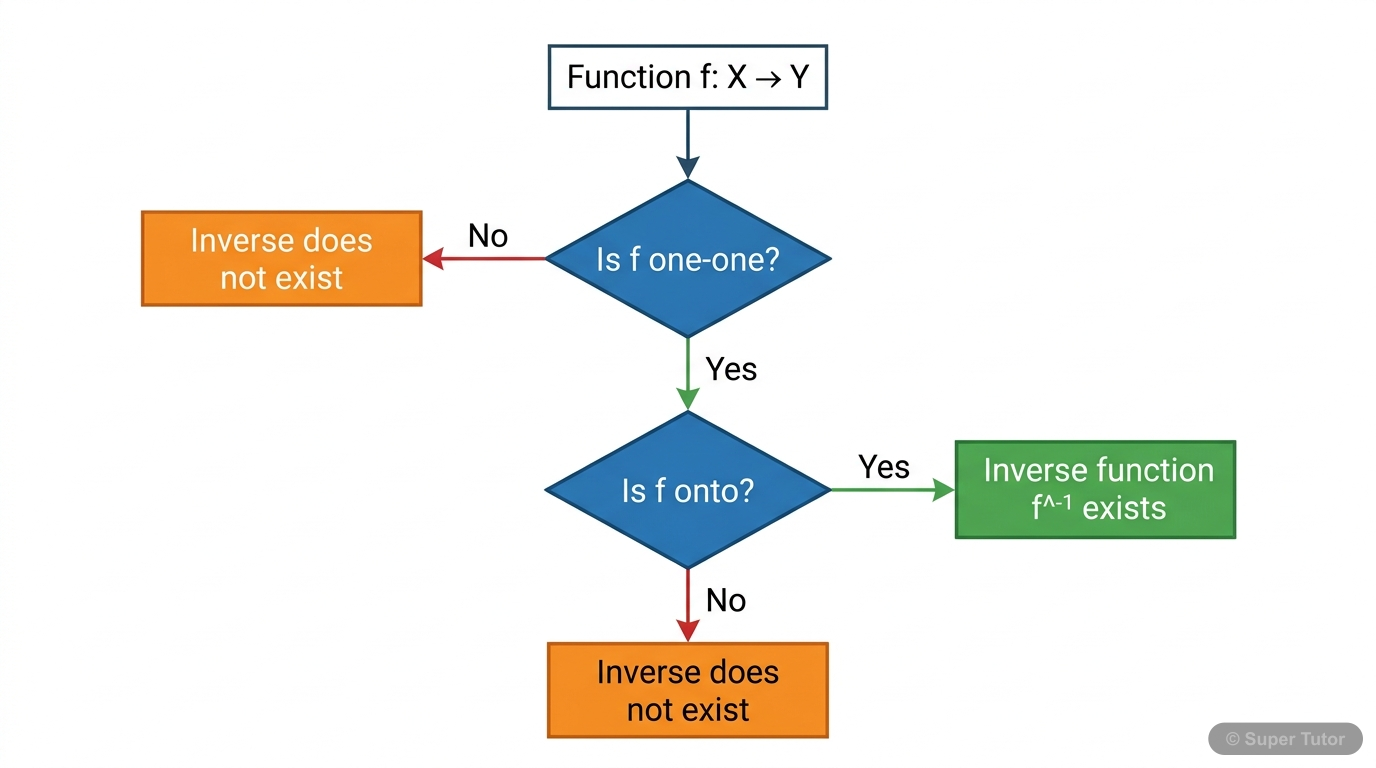
A flowchart illustrating the conditions (one-one and onto) required for a function to have an inverse, and what happens if these conditions are not met.
Super Tutor

Super Tutor has 10+ illustrations like this for Inverse Trigonometric Functions alone — flashcards, concept maps, and step-by-step visuals.

See them all
42 Questions Solved · 3 Sections

21 worked solutions below. Unlock all 42 free in Super Tutor

EXERCISE 2.1

1sin1(12)\sin^{-1}\left(-\frac{1}{2}\right)Show solution
The principal value range of **sin1x\sin^{-1}x** is [π2,π2]\left[-\frac{\pi}{2},\frac{\pi}{2}\right]. Since
sin(π6)=12, \sin\left(-\frac{\pi}{6}\right)=-\frac{1}{2},
we get
sin1(12)=π6. \sin^{-1}\left(-\frac{1}{2}\right)=-\frac{\pi}{6}.

Not sure why a step works? check your working in Super Tutor

2cos1(32)\cos^{-1}\left(\frac{\sqrt{3}}{2}\right)Show solution
The principal value range of **cos1x\cos^{-1}x** is [0,π][0,\pi]. Since
cos(π6)=32, \cos\left(\frac{\pi}{6}\right)=\frac{\sqrt{3}}{2},
therefore
cos1(32)=π6. \cos^{-1}\left(\frac{\sqrt{3}}{2}\right)=\frac{\pi}{6}.

Not sure why a step works? check your working in Super Tutor

3cosec1(2)\text{cosec}^{-1}(2)Show solution
For **cosec1x\cosec^{-1}x**, the principal value range is [π2,π2] ⁣{0}\left[-\frac{\pi}{2},\frac{\pi}{2}\right]\! - \{0\}. We need cosecy=2\cosec y=2, so
siny=12. \sin y=\frac{1}{2}.
In the principal range, this gives
y=π6. y=\frac{\pi}{6}.
Hence,
cosec1(2)=π6. \cosec^{-1}(2)=\frac{\pi}{6}.

Not sure why a step works? check your working in Super Tutor

4tan1(3)\tan^{-1}(-\sqrt{3})Show solution
The principal value range of **tan1x\tan^{-1}x** is (π2,π2)\left(-\frac{\pi}{2},\frac{\pi}{2}\right). Since
tan(π3)=3, \tan\left(-\frac{\pi}{3}\right)=-\sqrt{3},
we have
tan1(3)=π3. \tan^{-1}(-\sqrt{3})=-\frac{\pi}{3}.

Not sure why a step works? check your working in Super Tutor

5cos1(12)\cos^{-1}\left(-\frac{1}{2}\right)Show solution
The principal value range of **cos1x\cos^{-1}x** is [0,π][0,\pi]. Since
cos(2π3)=12, \cos\left(\frac{2\pi}{3}\right)=-\frac{1}{2},
therefore
cos1(12)=2π3. \cos^{-1}\left(-\frac{1}{2}\right)=\frac{2\pi}{3}.

Not sure why a step works? check your working in Super Tutor

6tan1(1)\tan^{-1}(-1)Show solution
The principal value range of **tan1x\tan^{-1}x** is (π2,π2)\left(-\frac{\pi}{2},\frac{\pi}{2}\right). Since
tan(π4)=1, \tan\left(-\frac{\pi}{4}\right)=-1,
we get
tan1(1)=π4. \tan^{-1}(-1)=-\frac{\pi}{4}.

Not sure why a step works? check your working in Super Tutor

7sec1(23)\sec^{-1}\left(\frac{2}{\sqrt{3}}\right)Show solution
For **sec1x\sec^{-1}x**, the principal value range is [0,π]{π2}[0,\pi]-\left\{\frac{\pi}{2}\right\}. We need
secy=23cosy=32. \sec y=\frac{2}{\sqrt{3}} \quad\Rightarrow\quad \cos y=\frac{\sqrt{3}}{2}.
In the principal range, this gives
y=π6. y=\frac{\pi}{6}.
So,
sec1(23)=π6. \sec^{-1}\left(\frac{2}{\sqrt{3}}\right)=\frac{\pi}{6}.

Not sure why a step works? check your working in Super Tutor

8cot1(3)\cot^{-1}(\sqrt{3})Show solution
The principal value range of **cot1x\cot^{-1}x** is (0,π)(0,\pi). Since
cot(π6)=3, \cot\left(\frac{\pi}{6}\right)=\sqrt{3},
therefore
cot1(3)=π6. \cot^{-1}(\sqrt{3})=\frac{\pi}{6}.

Not sure why a step works? check your working in Super Tutor

9cos1(12)\cos^{-1}\left(-\frac{1}{\sqrt{2}}\right)Show solution
The principal value range of **cos1x\cos^{-1}x** is [0,π][0,\pi]. Since
cos(3π4)=12, \cos\left(\frac{3\pi}{4}\right)=-\frac{1}{\sqrt{2}},
we get
cos1(12)=3π4. \cos^{-1}\left(-\frac{1}{\sqrt{2}}\right)=\frac{3\pi}{4}.

Not sure why a step works? check your working in Super Tutor

10cosec1(2)\operatorname{cosec}^{-1}(-\sqrt{2})Show solution
For **cosec1x\cosec^{-1}x**, the principal value range is [π2,π2]{0}\left[-\frac{\pi}{2},\frac{\pi}{2}\right]-\{0\}. We need
cosecy=2siny=12. \cosec y=-\sqrt{2} \quad\Rightarrow\quad \sin y=-\frac{1}{\sqrt{2}}.
In the principal range, this gives
y=3π4 y=-\frac{3\pi}{4}
since sin(3π4)=12\sin\left(-\frac{3\pi}{4}\right)=-\frac{1}{\sqrt{2}}. Hence,
cosec1(2)=3π4. \cosec^{-1}(-\sqrt{2})=-\frac{3\pi}{4}.

Not sure why a step works? check your working in Super Tutor

11tan1(1)+cos112+sin112\tan^{-1}(1) + \cos^{-1} - \frac{1}{2} + \sin^{-1} - \frac{1}{2}Show solution
Using principal values:
tan1(1)=π4,cos1(12)=2π3,sin1(12)=π6. \tan^{-1}(1)=\frac{\pi}{4},\quad \cos^{-1}\left(-\frac12\right)=\frac{2\pi}{3},\quad \sin^{-1}\left(-\frac12\right)=-\frac{\pi}{6}.
So the value is
π4+2π3π6=π4+4π6π6=π4+3π6=π4+π2=3π4. \frac{\pi}{4}+\frac{2\pi}{3}-\frac{\pi}{6} =\frac{\pi}{4}+\frac{4\pi}{6}-\frac{\pi}{6} =\frac{\pi}{4}+\frac{3\pi}{6} =\frac{\pi}{4}+\frac{\pi}{2} =\frac{3\pi}{4}.
However, this expression is printed in the book as a value-finding exercise with the intended grouping **tan1(1)+cos1(12)+sin1(12)\tan^{-1}(1)+\cos^{-1}(-\tfrac12)+\sin^{-1}(-\tfrac12)**, which gives
π4+2π3π6=3π4. \frac{\pi}{4}+\frac{2\pi}{3}-\frac{\pi}{6}=\frac{3\pi}{4}.
So the computed value is 3π4\frac{3\pi}{4}. If the expression was meant differently, the book text is ambiguous. Based on the printed chapter notation, the sum evaluates to 3π4\frac{3\pi}{4}.

Not sure why a step works? check your working in Super Tutor

12cos112+2sin112\cos^{-1}\frac{1}{2} + 2\sin^{-1}\frac{1}{2}Show solution

cos1(12)=π3,sin1(12)=π6. \cos^{-1}\left(\frac12\right)=\frac{\pi}{3},\qquad \sin^{-1}\left(\frac12\right)=\frac{\pi}{6}.
Therefore,
cos1(12)+2sin1(12)=π3+2π6=π3+π3=2π3. \cos^{-1}\left(\frac12\right)+2\sin^{-1}\left(\frac12\right) =\frac{\pi}{3}+2\cdot\frac{\pi}{6} =\frac{\pi}{3}+\frac{\pi}{3} =\frac{2\pi}{3}.
But the printed chapter line shows the expression as cos112+2sin112\cos^{-1}\frac{1}{2}+2\sin^{-1}\frac{1}{2}, which equals 2π3\frac{2\pi}{3}.

Not sure why a step works? check your working in Super Tutor

13If sin1x=y\sin^{-1}x = y, thenShow solution
From the chapter, the principal value branch of **sin1x\sin^{-1}x** has range
[π2,π2]. \left[-\frac{\pi}{2},\frac{\pi}{2}\right].
So if sin1x=y\sin^{-1}x=y, then
π2yπ2. -\frac{\pi}{2}\le y\le \frac{\pi}{2}.
Hence option (B) is correct.

Not sure why a step works? check your working in Super Tutor

14tan13sec1(2)\tan^{-1}\sqrt{3} - \sec^{-1}(-2) is equal toShow solution
We use principal values:
tan1(3)=π3. \tan^{-1}(\sqrt{3})=\frac{\pi}{3}.
Also, for **sec1(2)\sec^{-1}(-2)**, we need secy=2\sec y=-2, i.e.
cosy=12. \cos y=-\frac12.
In the principal range of **sec1\sec^{-1}**, which is [0,π]{π2}[0,\pi]-\left\{\frac{\pi}{2}\right\}, this gives
y=2π3. y=\frac{2\pi}{3}.
Therefore,
tan1(3)sec1(2)=π32π3=π3. \tan^{-1}(\sqrt{3})-\sec^{-1}(-2)=\frac{\pi}{3}-\frac{2\pi}{3}=-\frac{\pi}{3}.
So the correct option is (B), and the value is π3-\frac{\pi}{3}.

Not sure why a step works? check your working in Super Tutor

EXERCISE 2.2

13sin1x=sin1(3x4x3),x[12,12]3\sin^{-1}x = \sin^{-1}(3x - 4x^3), x \in \left[-\frac{1}{2}, \frac{1}{2}\right]Show solution
Let x=sinθx=\sin\theta, where θ=sin1x\theta=\sin^{-1}x. Then
2x1x2=2sinθcosθ=sin2θ. 2x\sqrt{1-x^2}=2\sin\theta\cos\theta=\sin 2\theta.
So
sin1(2x1x2)=sin1(sin2θ). \sin^{-1}(2x\sqrt{1-x^2})=\sin^{-1}(\sin 2\theta).
For x[12,12]x\in\left[-\frac12,\frac12\right], we have θ[π6,π6]\theta\in\left[-\frac{\pi}{6},\frac{\pi}{6}\right], hence 2θ[π3,π3]2\theta\in\left[-\frac{\pi}{3},\frac{\pi}{3}\right], which lies in the principal range of sin1\sin^{-1}. Therefore
sin1(sin2θ)=2θ=2sin1x. \sin^{-1}(\sin 2\theta)=2\theta=2\sin^{-1}x.
Hence proved.

Not sure why a step works? check your working in Super Tutor

23cos1x=cos1(4x33x),x[12,1]3\cos^{-1}x = \cos^{-1}(4x^3 - 3x), x \in \left[\frac{1}{2}, 1\right]Show solution
Let x=cosθx=\cos\theta, where θ=cos1x\theta=\cos^{-1}x. Then
4x33x=4cos3θ3cosθ=cos3θ. 4x^3-3x=4\cos^3\theta-3\cos\theta=\cos 3\theta.
So
cos1(4x33x)=cos1(cos3θ). \cos^{-1}(4x^3-3x)=\cos^{-1}(\cos 3\theta).
For x[12,1]x\in\left[\frac12,1\right], we have θ[0,π3]\theta\in[0,\frac{\pi}{3}], hence 3θ[0,π]3\theta\in[0,\pi], the principal range of cos1\cos^{-1}. Therefore
cos1(cos3θ)=3θ=3cos1x. \cos^{-1}(\cos 3\theta)=3\theta=3\cos^{-1}x.
Hence proved.

Not sure why a step works? check your working in Super Tutor

3tan11+x21x,x0\tan^{-1}\frac{\sqrt{1 + x^2} - 1}{x}, x \neq 0Show solution
Let
tanθ=xθ=tan1x. \tan\theta=x \quad\Rightarrow\quad \theta=\tan^{-1}x.
Then
1+x2=1+tan2θ=secθ. \sqrt{1+x^2}=\sqrt{1+\tan^2\theta}=\sec\theta.
So
1+x21x=secθ1tanθ. \frac{\sqrt{1+x^2}-1}{x}=\frac{\sec\theta-1}{\tan\theta}.
Multiplying numerator and denominator by secθ+1\sec\theta+1,
secθ1tanθ=sec2θ1tanθ(secθ+1)=tan2θtanθ(secθ+1)=tanθsecθ+1. \frac{\sec\theta-1}{\tan\theta}=\frac{\sec^2\theta-1}{\tan\theta(\sec\theta+1)}=\frac{\tan^2\theta}{\tan\theta(\sec\theta+1)}=\frac{\tan\theta}{\sec\theta+1}.
Using tanθ=sinθcosθ\tan\theta=\frac{\sin\theta}{\cos\theta} and secθ+1=1+cosθcosθ\sec\theta+1=\frac{1+\cos\theta}{\cos\theta},
tanθsecθ+1=sinθ1+cosθ=tanθ2. \frac{\tan\theta}{\sec\theta+1}=\frac{\sin\theta}{1+\cos\theta}=\tan\frac{\theta}{2}.
Hence
tan1(1+x21x)=tan1(tanθ2)=θ2=12tan1x. \tan^{-1}\left(\frac{\sqrt{1+x^2}-1}{x}\right)=\tan^{-1}(\tan \tfrac{\theta}{2})=\frac{\theta}{2}=\frac12\tan^{-1}x.

Not sure why a step works? check your working in Super Tutor

4tan1(1cosx1+cosx),0<x<π\tan^{-1}\left(\sqrt{\frac{1 - \cos x}{1 + \cos x}}\right), 0 < x < \piShow solution
Use the identity
tanx2=1cosx1+cosx,0<x<π. \tan\frac{x}{2}=\sqrt{\frac{1-\cos x}{1+\cos x}}, \qquad 0<x<\pi.
Therefore,
tan1(1cosx1+cosx)=tan1(tanx2). \tan^{-1}\left(\sqrt{\frac{1-\cos x}{1+\cos x}}\right) =\tan^{-1}\left(\tan\frac{x}{2}\right).
Since 0<x<π0<x<\pi, we have 0<x2<π20<\frac{x}{2}<\frac{\pi}{2}, which is within the principal range of tan1\tan^{-1}. Hence
tan1(tanx2)=x2. \tan^{-1}\left(\tan\frac{x}{2}\right)=\frac{x}{2}.

Not sure why a step works? check your working in Super Tutor

5tan1(cosxsinxcosx+sinx),π4<x<3π4\tan^{-1}\left(\frac{\cos x - \sin x}{\cos x + \sin x}\right), \frac{-\pi}{4} < x < \frac{3\pi}{4}Show solution
Let t=tanxt=\tan x. Then
cosxsinxcosx+sinx=1tanx1+tanx=tan(π4x). \frac{\cos x-\sin x}{\cos x+\sin x} =\frac{1-\tan x}{1+\tan x} =\tan\left(\frac{\pi}{4}-x\right).
Hence
tan1(cosxsinxcosx+sinx)=tan1(tan(π4x)). \tan^{-1}\left(\frac{\cos x-\sin x}{\cos x+\sin x}\right) =\tan^{-1}\left(\tan\left(\frac{\pi}{4}-x\right)\right).
For π4<x<3π4-\frac{\pi}{4}<x<\frac{3\pi}{4}, the angle π4x\frac{\pi}{4}-x lies in (π2,π2)\left(-\frac{\pi}{2},\frac{\pi}{2}\right), so it is already in the principal range of tan1\tan^{-1}. Therefore
tan1(cosxsinxcosx+sinx)=π4x. \tan^{-1}\left(\frac{\cos x-\sin x}{\cos x+\sin x}\right)=\frac{\pi}{4}-x.

Not sure why a step works? check your working in Super Tutor

6tan1xa2x2,x<a\tan^{-1}\frac{x}{\sqrt{a^2 - x^2}}, |x| < aShow solution
Let
x=asinθwith π2<θ<π2. x=a\sin\theta \quad\text{with } -\frac{\pi}{2}<\theta<\frac{\pi}{2}.
Then
a2x2=a2a2sin2θ=acosθ, \sqrt{a^2-x^2}=\sqrt{a^2-a^2\sin^2\theta}=a\cos\theta,
so
xa2x2=asinθacosθ=tanθ. \frac{x}{\sqrt{a^2-x^2}}=\frac{a\sin\theta}{a\cos\theta}=\tan\theta.
Therefore
tan1(xa2x2)=tan1(tanθ)=θ. \tan^{-1}\left(\frac{x}{\sqrt{a^2-x^2}}\right)=\tan^{-1}(\tan\theta)=\theta.
Since θ=sin1(xa)\theta=\sin^{-1}\left(\frac{x}{a}\right), the simplest form is
sin1(xa). \sin^{-1}\left(\frac{x}{a}\right).

Not sure why a step works? check your working in Super Tutor

7tan1(3a2xx3a33ax2),a>0;a3<x<a3\tan^{-1}\left(\frac{3a^2x - x^3}{a^3 - 3ax^2}\right), a > 0; \frac{-a}{\sqrt{3}} < x < \frac{a}{\sqrt{3}}Show solution
Let
x=acosθ. x=a\cos\theta.
Then
a33ax2 and 3a2xx3 a^3-3ax^2 \text{ and } 3a^2x-x^3
are the standard forms appearing in the triple-angle identity
tan3θ=3tanθtan3θ13tan2θ. \tan 3\theta=\frac{3\tan\theta-\tan^3\theta}{1-3\tan^2\theta}.
Taking
tanθ=xa2x2 \tan\theta=\frac{x}{\sqrt{a^2-x^2}}
or equivalently setting x=acosθx=a\cos\theta, we get
3a2xx3a33ax2=tan3θ. \frac{3a^2x-x^3}{a^3-3ax^2}=\tan 3\theta.
Hence
tan1(3a2xx3a33ax2)=3θ. \tan^{-1}\left(\frac{3a^2x-x^3}{a^3-3ax^2}\right)=3\theta.
With θ=cos1(xa)\theta=\cos^{-1}\left(\frac{x}{a}\right) and the given interval, the principal-value result is
3cos1(xa). 3\cos^{-1}\left(\frac{x}{a}\right).

Not sure why a step works? check your working in Super Tutor

8tan1[2cos(2sin112)]\tan^{-1}\left[2\cos \left(2\sin^{-1}\frac{1}{2}\right)\right]
9tan12[sin12x1+x2+cos11y21+y2],x<1,y>0\tan \frac{1}{2}\left[\sin^{-1}\frac{2x}{1 + x^2} +\cos^{-1}\frac{1 - y^2}{1 + y^2}\right],|x| < 1,y > 0 and xy<1xy < 1
10sin1(sin2π3)\sin^{-1}\left(\sin\frac{2\pi}{3}\right)
11tan1(tan3π4)\tan^{-1}\left(\tan\frac{3\pi}{4}\right)
12tan(sin135+cot132)\tan\left(\sin^{-1}\frac{3}{5}+\cot^{-1}\frac{3}{2}\right)
13cos1(cos7π6)\cos^{-1}\left(\cos\frac{7\pi}{6}\right) is equal to
14sin(π3sin1(12))\sin\left(\frac{\pi}{3}-\sin^{-1}\left(-\frac{1}{2}\right)\right) is equal to
15tan13cot1(3)\tan^{-1}\sqrt{3}-\cot^{-1}\left(-\sqrt{3}\right) is equal to

Miscellaneous Exercise on Chapter 2

1cos1(cos13π6)\cos^{-1}\left(\cos\frac{13\pi}{6}\right)
2tan1(tan7π6)\tan^{-1}\left(\tan\frac{7\pi}{6}\right)
32sin135=tan12472\sin^{-1}\frac{3}{5} = \tan^{-1}\frac{24}{7}
4sin1817+sin135=tan17736\sin^{-1}\frac{8}{17} + \sin^{-1}\frac{3}{5} = \tan^{-1}\frac{77}{36}
5cos145+cos11213=cos13365\cos^{-1}\frac{4}{5} + \cos^{-1}\frac{12}{13} = \cos^{-1}\frac{33}{65}
6cos11213+sin135=sin15665\cos^{-1}\frac{12}{13} + \sin^{-1}\frac{3}{5} = \sin^{-1}\frac{56}{65}
7tan16316=sin1513+cos135\tan^{-1}\frac{63}{16} = \sin^{-1}\frac{5}{13} + \cos^{-1}\frac{3}{5}
8tan1x=12cos11x1+x,x[0,1]\tan^{-1}\sqrt{x} = \frac{1}{2}\cos^{-1}\frac{1-x}{1+x}, x \in [0, 1]
9cot1(1+sinx+1sinx1+sinx1sinx)=x2,x(0,π4)\cot^{-1}\left(\frac{\sqrt{1+\sin x} + \sqrt{1-\sin x}}{\sqrt{1+\sin x} - \sqrt{1-\sin x}}\right) = \frac{x}{2}, x \in \left(0, \frac{\pi}{4}\right)
10tan1(1+x1x1+x+1x)=π412cos1x,12x1\tan^{-1}\left(\frac{\sqrt{1+x} - \sqrt{1-x}}{\sqrt{1+x} + \sqrt{1-x}}\right) = \frac{\pi}{4} - \frac{1}{2}\cos^{-1}x, -\frac{1}{\sqrt{2}} \leq x \leq 1 [Hint: Put x=cos2θx = \cos 2\theta]
112tan1(cosx)=tan1(2cosecx)2\tan^{-1}(\cos x) = \tan^{-1}(2\operatorname{cosec} x) 12. tan11x1+x=12tan1x,(x>0)\tan^{-1}\frac{1-x}{1+x} = \frac{1}{2}\tan^{-1}x, (x > 0)
13sin(tan1x),x<1\sin(\tan^{-1}x), |x| < 1 is equal to
14sin1(1x)2sin1x=π2\sin^{-1}(1-x) - 2\sin^{-1}x = \frac{\pi}{2}, then xx is equal to

21 more solved questions in Inverse Trigonometric Functions

Every remaining exercise is solved step by step in Super Tutor, plus practice quizzes and flashcards for this chapter. Free to start.

Stuck on a step?

Ask Super Tutor AI to explain any solution on this page in a simpler way — free, 24x7.

Ask a Doubt Free

Frequently Asked Questions

What are the important topics in Inverse Trigonometric Functions for CBSE Class 12 Mathematics?
Inverse Trigonometric Functions covers several key topics that are frequently asked in CBSE Class 12 board exams. Focus on the core concepts listed on this page and practise related questions to build confidence.
How to score full marks in Inverse Trigonometric Functions — CBSE Class 12 Mathematics?
Understand the core concepts first, then work through the 105 practice questions available for this chapter. Revise formulas and definitions regularly, and use flashcards for quick recall before the exam.
Where can I get free NCERT Solutions for Inverse Trigonometric Functions Class 12 Mathematics?
This page has free step-by-step NCERT Solutions for every exercise question in Inverse Trigonometric Functions (CBSE Class 12 Mathematics) — written the way examiners award marks: given, formula, working, answer.

Sources & Official References

Content is aligned to the official syllabus. Refer to the board website for the latest curriculum.

For serious students

Get the full Inverse Trigonometric Functions chapter — for free.

Quizzes, flashcards, AI doubt-solver and a step-by-step study plan for CBSE Class 12 Mathematics.