How Forces Affect Motion — Concept Maps
CBSE · Class 9 · Science
4 concept maps of How Forces Affect Motion for CBSE Class 9 Science, each also written out as a text outline. Part of the CBSE Class 9 Science syllabus.
Interactive on Super Tutor
Studying How Forces Affect Motion? Get the full interactive chapter.
Quizzes, flashcards, AI doubt-solver and a step-by-step study plan — built for concept maps and more.
Free trial, no card needed.
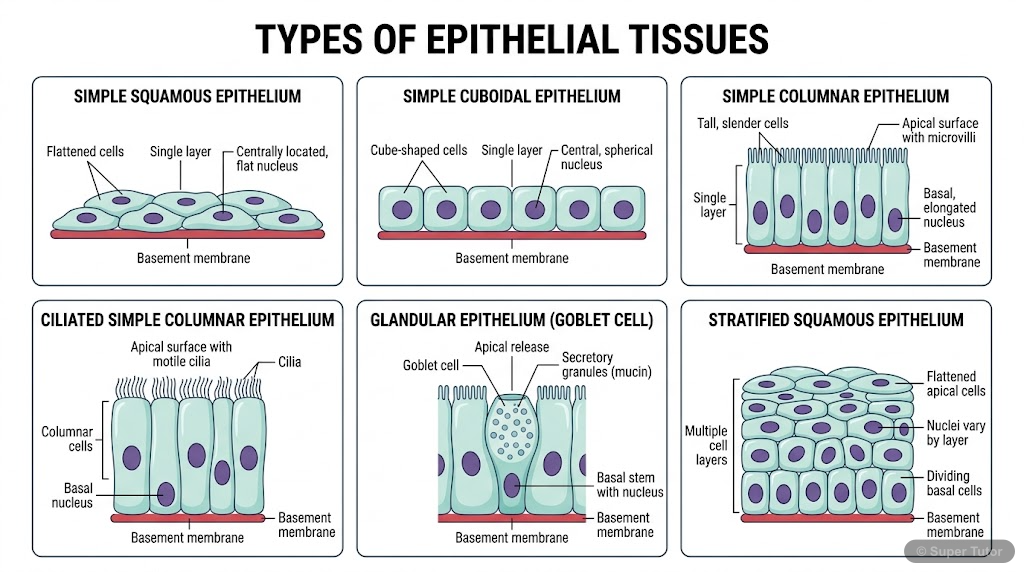
One of 6 illustrations for How Forces Affect Motion in Super Tutor — alongside flashcards, concept maps and practice questions.
Classification of Plant Tissues
The map in words
- Plant Tissues
- Meristematic Tissue
- Apical Meristem
- At root and shoot tips
- Increases length
- Lateral Meristem
- Cambium
- Increases girth
- Intercalary Meristem
- At nodes
- Seen in grasses
- Apical Meristem
- Permanent Tissue
- Simple Permanent
- Parenchyma
- Chlorenchyma
- Aerenchyma
- Collenchyma
- Flexible support
- Sclerenchyma
- Dead cells
- Lignified walls
- Parenchyma
- Complex Permanent
- Xylem
- Tracheids
- Vessels
- Xylem Parenchyma
- Xylem Fibres
- Phloem
- Sieve Tubes
- Companion Cells
- Phloem Parenchyma
- Phloem Fibres
- Xylem
- Protective Tissue
- Epidermis
- Stomata
- Cuticle
- Cork
- Suberin walls
- Dead cells
- Epidermis
- Simple Permanent
- Meristematic Tissue
Classification of Plant Tissues
The map in words
- Plant Tissues
- Meristematic Tissue
- Apical Meristem
- Tips of roots and stems
- Increases length
- Lateral Meristem
- Cambium
- Increases girth
- Intercalary Meristem
- Near nodes
- Found in grasses
- Apical Meristem
- Permanent Tissue
- Simple Permanent Tissue
- Parenchyma
- Thin walled
- Living cells
- Food storage
- Collenchyma
- Corner thickened
- Living cells
- Flexibility
- Sclerenchyma
- Thick lignified walls
- Dead cells
- Rigidity
- Parenchyma
- Complex Permanent Tissue
- Xylem
- Tracheids
- Vessels
- Xylem Parenchyma
- Xylem Fibres
- Water transport
- Phloem
- Sieve Tubes
- Companion Cells
- Phloem Parenchyma
- Phloem Fibres
- Food transport
- Xylem
- Simple Permanent Tissue
- Meristematic Tissue
Complete Classification of Plant and Animal Tissues
The map in words
- Tissues
- Plant Tissues
- Meristematic
- Apical
- Tip of stem and root
- Increases length
- Lateral
- Cambium
- Increases girth
- Intercalary
- Near nodes
- Apical
- Permanent
- Simple
- Parenchyma
- Food storage
- Chlorenchyma
- Aerenchyma
- Collenchyma
- Flexibility
- Living cells
- Sclerenchyma
- Dead cells
- Lignin walls
- Hard and stiff
- Parenchyma
- Complex
- Xylem
- Tracheids
- Vessels
- Parenchyma
- Fibres
- Phloem
- Sieve tubes
- Companion cells
- Phloem fibres
- Parenchyma
- Xylem
- Simple
- Meristematic
- Animal Tissues
- Epithelial
- Squamous
- Cuboidal
- Columnar
- Ciliated
- Glandular
- Connective
- Blood
- Bone
- Cartilage
- Ligament
- Tendon
- Areolar
- Adipose
- Muscular
- Striated Voluntary
- Smooth Involuntary
- Cardiac
- Nervous
- Neurons
- Dendrites
- Axon
- Cell body
- Neurons
- Epithelial
- Plant Tissues
Forces change motion by creating net force and acceleration, and Newton's laws explain how objects respond
The map in words
- Forces change motion by creating net force and acceleration, and Newton's laws explain how objects respond
- Force
- Balanced forces
- Unbalanced forces
- Friction
- Newton's first law of motion
- Inertia
- Newton's second law of motion
- Momentum
Explore these maps interactively
Explore DiagramsFrequently Asked Questions
What are the important topics in How Forces Affect Motion for CBSE Class 9 Science?
What do the concept maps for How Forces Affect Motion show?
How should I revise How Forces Affect Motion for Class 9 exams?
Sources & Official References
- NCERT Official — ncert.nic.in
- CBSE Academic — cbseacademic.nic.in
- CBSE Official — cbse.gov.in
- National Education Policy 2020 — education.gov.in
Content is aligned to the official syllabus. Refer to the board website for the latest curriculum.
More resources for How Forces Affect Motion
Practice Quiz
Test yourself with a quick quiz
Important Questions
Exam-style questions with answers
Revision Notes
Key points for last-minute revision
Chapter Summary
Understand the chapter at a glance
Study Plan
Step-by-step plan for this chapter
Flashcards
Quick-fire cards for active recall
Syllabus
What topics to cover
NCERT Solutions
Every textbook question solved step by step
For serious students
Get the full How Forces Affect Motion chapter — start free.
Quizzes, flashcards, an AI doubt solver and a study plan for CBSE Class 9 Science. Free to start, no card needed.