How Forces Affect Motion — Revision Notes
CBSE · Class 9 · Science
How Forces Affect Motion revision notes for CBSE Class 9 Science: 4 topics in quick points. Part of the CBSE Class 9 Science syllabus.
Interactive on Super Tutor
Studying How Forces Affect Motion? Get the full interactive chapter.
Quizzes, flashcards, AI doubt-solver and a step-by-step study plan — built for revision notes and more.
Free trial, no card needed.
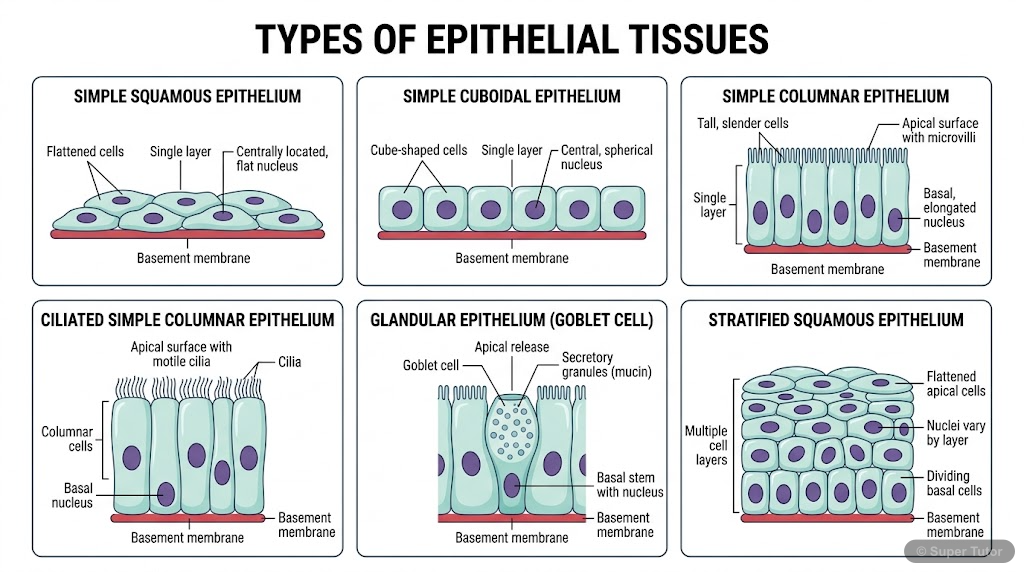
One of 6 illustrations for How Forces Affect Motion in Super Tutor — alongside flashcards, concept maps and practice questions.
Key Topics to Revise
1. Concept of Force
- Force can make an object move from rest.
- Force can change the speed of a moving object.
- Force can change the direction of motion.
2. Balanced and Unbalanced Forces
- When two forces are equal in magnitude and opposite in direction on the same object, they are balanced forces.
- Balanced forces give zero net force.
- If net force is zero, acceleration is zero.
3. Friction and Motion
- Friction acts opposite to the direction of motion.
- Friction opposes the applied force when a box is pushed.
- Air exerts friction on moving objects, but its magnitude is often negligible.
4. Newton's First Law of Motion and Inertia
- Newton's first law says an object at rest remains at rest and an object in motion continues with constant velocity unless a net force acts on it.
- Constant velocity means no change in speed or direction.
- If net force is zero, acceleration is zero.
Get complete notes with diagrams and examples
Full NotesKey Concepts
Frequently Asked Questions
What are the important topics in How Forces Affect Motion for CBSE Class 9 Science?
How should I revise How Forces Affect Motion for Class 9 exams?
Sources & Official References
- NCERT Official — ncert.nic.in
- CBSE Academic — cbseacademic.nic.in
- CBSE Official — cbse.gov.in
- National Education Policy 2020 — education.gov.in
Content is aligned to the official syllabus. Refer to the board website for the latest curriculum.
More resources for How Forces Affect Motion
Practice Quiz
Test yourself with a quick quiz
Important Questions
Exam-style questions with answers
Chapter Summary
Understand the chapter at a glance
Concept Maps
See how topics connect
Study Plan
Step-by-step plan for this chapter
Flashcards
Quick-fire cards for active recall
Syllabus
What topics to cover
NCERT Solutions
Every textbook question solved step by step
For serious students
Get the full How Forces Affect Motion chapter — start free.
Quizzes, flashcards, an AI doubt solver and a study plan for CBSE Class 9 Science. Free to start, no card needed.