Atomic Foundations of Matter — Concept Maps
CBSE · Class 9 · Science
4 concept maps of Atomic Foundations of Matter for CBSE Class 9 Science, each also written out as a text outline.
Interactive on Super Tutor
Studying Atomic Foundations of Matter? Get the full interactive chapter.
Quizzes, flashcards, AI doubt-solver and a step-by-step study plan — built for concept maps and more.
Free trial, no card needed.
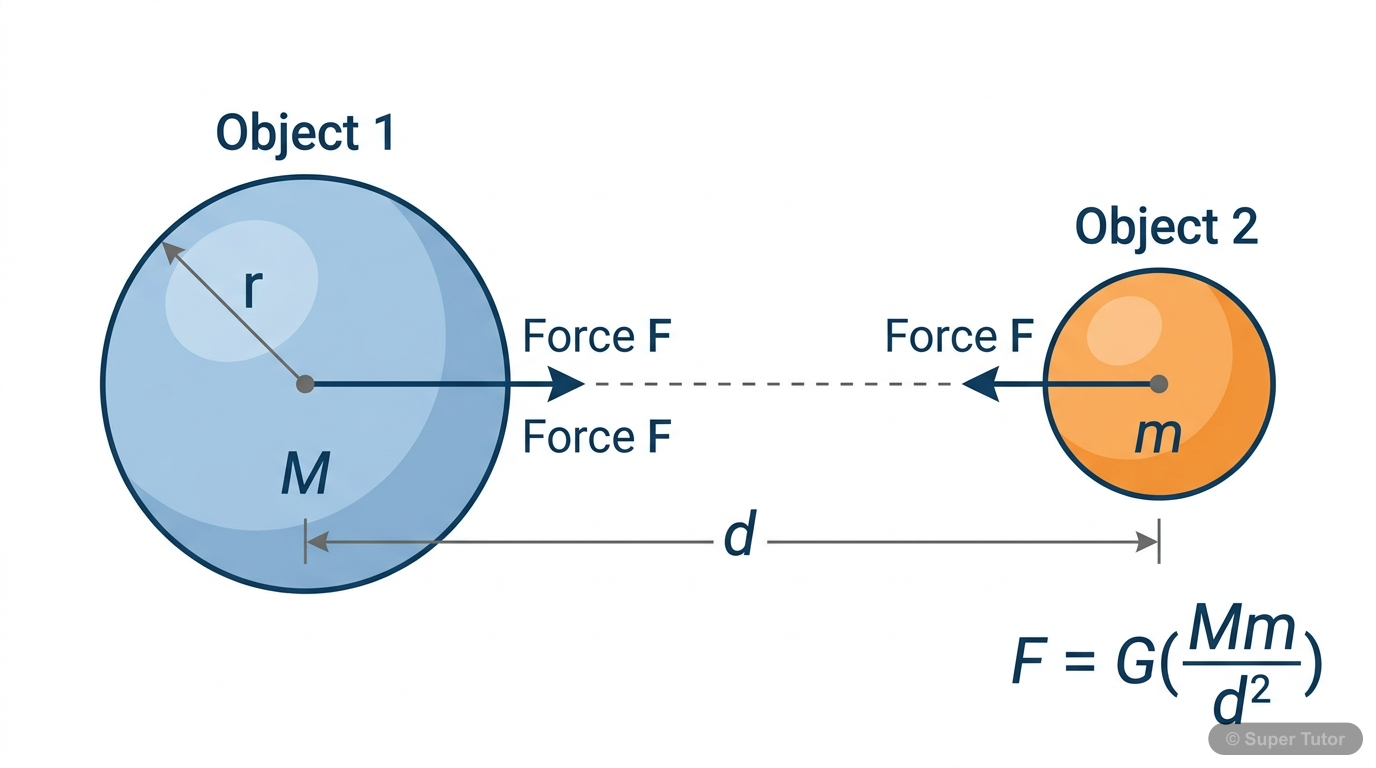
Learn better with visuals Super Tutor pairs illustrations like this with notes and quizzes for Atomic Foundations of Matter.
Chapter 9 Gravitation — Complete Concept Map
The map in words
- Gravitation
- Universal Law
- Every object attracts every other
- F = GMm divided by d squared
- G = 6.674 x 10 to minus 11
- Inverse Square Law
- Free Fall
- Only gravity acts
- Acceleration = g
- g = GM divided by R squared
- g = 9.8 m per s squared
- Mass and Weight
- Mass
- Amount of matter
- Constant everywhere
- Unit = kg
- Weight
- Force of attraction
- W = mg
- Varies with location
- Unit = N
- Weight on Moon
- One sixth of Earth weight
- Mass
- Thrust and Pressure
- Thrust = Perpendicular Force
- Pressure = Thrust per Area
- Unit = Pascal
- Larger Area = Lower Pressure
- Buoyancy
- Upward force by fluid
- Depends on fluid density
- Archimedes Principle
- Buoyant force = weight of fluid displaced
- Applications
- Ships and Submarines
- Lactometer
- Hydrometer
- Float or Sink
- Density less than liquid = floats
- Density more than liquid = sinks
- Universal Law
Gravitation Chapter — Complete Concept Map
The map in words
- Gravitation
- Universal Law
- Formula F = Gm1m2 divided by d squared
- G = 6.674 x 10 to minus 11
- Discovered by Cavendish
- Applies to all objects
- Free Fall
- Only gravity acts
- g = 9.8 m per s squared
- Independent of mass
- Galileo proved it
- Mass vs Weight
- Mass is constant everywhere
- Weight = m times g
- Weight varies by location
- Moon weight = 1 sixth Earth
- Pressure
- P = Force divided by Area
- Unit is Pascal Pa
- Larger area = less pressure
- Applications in daily life
- Buoyancy
- Upward force by fluid
- Archimedes Principle
- Buoyant force = weight displaced
- Less dense objects float
- Universal Law
Chapter 9 Gravitation — Concept Overview
The map in words
- Gravitation
- Universal Law
- F = GMm divided by d squared
- G = 6.674 x 10 power -11
- Applies universally
- Cavendish measured G
- Free Fall
- Only gravity acts
- g = 9.8 m per s squared
- g = GMₑ divided by Rₑ squared
- Independent of mass
- Equations of motion
- Mass and Weight
- Mass in kg constant
- Weight = mg in Newtons
- Weight varies with location
- Moon weight = Earth weight by 6
- Thrust and Pressure
- Thrust perpendicular force
- Pressure = Force by Area
- Unit Pascal
- Small area more pressure
- Buoyancy
- Upward force by fluid
- Float if density less than fluid
- Sink if density more than fluid
- Archimedes Principle
- Buoyancy = weight displaced
- Ships and submarines
- Lactometer and hydrometer
- Universal Law
Atoms combine and rearrange according to fixed laws to form molecules, ionic compounds, and stable substances
The map in words
- Atoms combine and rearrange according to fixed laws to form molecules, ionic compounds, and stable substances
- Law of Conservation of Mass
- Law of Constant Proportions
- Dalton's Atomic Theory
- Molecules
- Chemical Bond
- Covalent Bonding
- Ionic Bonding
- Formula Writing
Explore these maps interactively
Explore DiagramsFrequently Asked Questions
What are the important topics in Atomic Foundations of Matter for CBSE Class 9 Science?
What do the concept maps for Atomic Foundations of Matter show?
How should I revise Atomic Foundations of Matter for Class 9 exams?
Sources & Official References
- NCERT Official — ncert.nic.in
- CBSE Academic — cbseacademic.nic.in
- CBSE Official — cbse.gov.in
- National Education Policy 2020 — education.gov.in
Content is aligned to the official syllabus. Refer to the board website for the latest curriculum.
More resources for Atomic Foundations of Matter
Practice Quiz
Test yourself with a quick quiz
Important Questions
Exam-style questions with answers
Revision Notes
Key points for last-minute revision
Formula Sheet
The chapter's formulas in one place
Chapter Summary
Understand the chapter at a glance
Study Plan
Step-by-step plan for this chapter
Flashcards
Quick-fire cards for active recall
Syllabus
What topics to cover
NCERT Solutions
Every textbook question solved step by step
For serious students
Get the full Atomic Foundations of Matter chapter — start free.
Quizzes, flashcards, an AI doubt solver and a study plan for CBSE Class 9 Science. Free to start, no card needed.