Work, Energy, and Simple Machines — Practice Quiz
CBSE · Class 9 · Science
Try a 4-question quiz on Work, Energy, and Simple Machines for CBSE Class 9 Science: tap an answer to check it and see why.
Interactive on Super Tutor
Studying Work, Energy, and Simple Machines? Get the full interactive chapter.
Quizzes, flashcards, AI doubt-solver and a step-by-step study plan — built for practice quiz and more.
Free trial, no card needed.
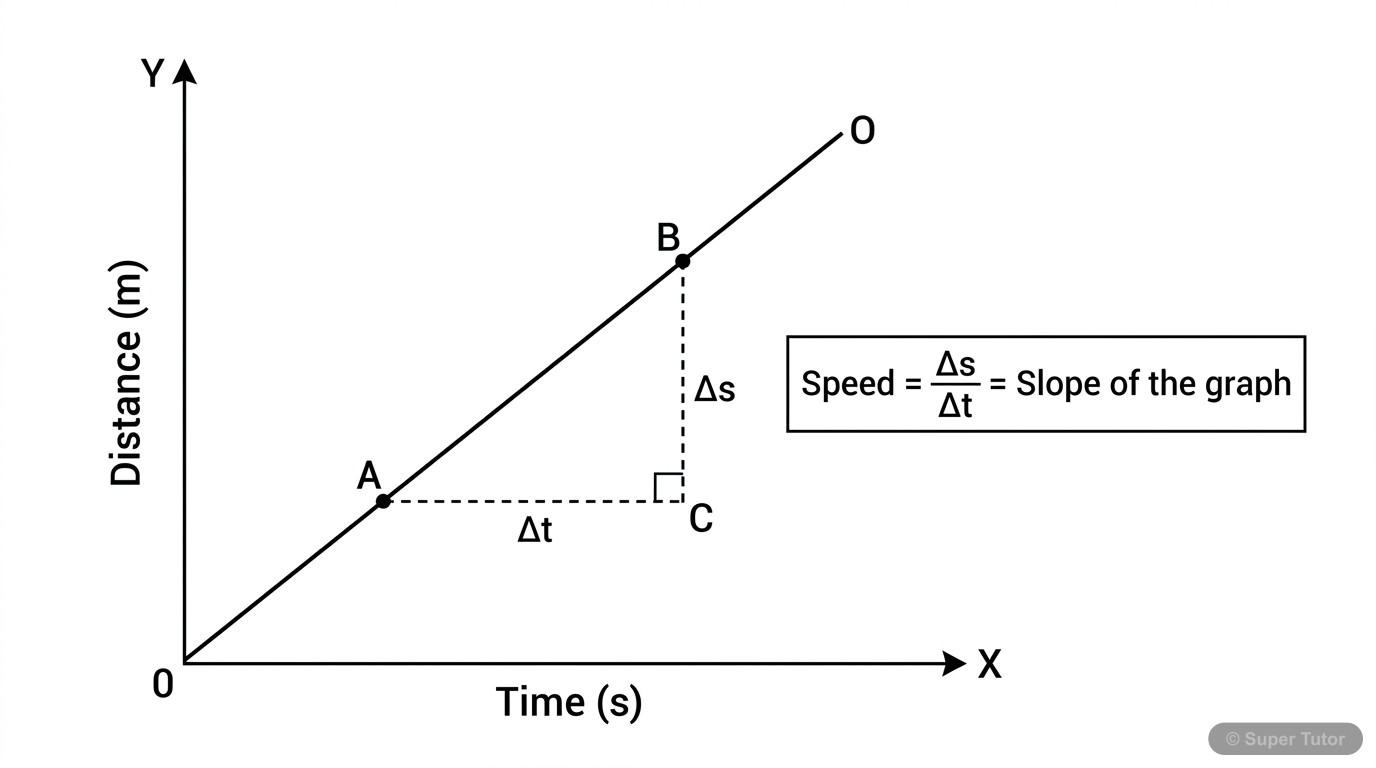
One of 4 illustrations for Work, Energy, and Simple Machines in Super Tutor — alongside flashcards, concept maps and practice questions.
Quick Quiz: Work, Energy, and Simple Machines
0/4Tap an answer to check it instantly. No sign-up needed for these 4.
A truck of mass 10000 kg moves at 72 km h^-1 and stops on an escape ramp after rising 10 m vertically. What is the initial kinetic energy of the truck?
A truck of mass 10000 kg starts with speed 72 km h^-1 and stops on an escape ramp where sand exerts 50000 N opposite to motion. If the ramp length is 20 m and the truck rises 10 m vertically, what is the final gravitational potential energy gained?
A weightlifter lifts a 75 kg mass through 2 m in 5 s. Taking g = 10 m s^-2, what power is required?
A car of mass 1000 kg starts from rest and reaches 72 km h^-1 in 10 s. What is the work done by the engine?
Sample Questions
A car of mass 1000 kg starts from rest and reaches 72 km h^-1 in 10 s. What is the power of the engine?
Show answer
20,000 W
From the previous calculation, work done is 200,000 J. Power = W/t = 200,000/10 = 20,000 W.
A cricket ball of mass 0.2 kg is bowled at 154.8 km h^-1. What is its kinetic energy?
Show answer
184.9 J
Convert speed: 154.8 km h^-1 = 43 m s^-1. Then K = 1/2 mv^2 = 1/2 × 0.2 × 43^2 = 0.1 × 1849 = 184.9 J.
A cricket ball of mass 0.2 kg is thrown so that it reaches a height of 10 m. Taking g = 10 m s^-2, what is its gravitational potential energy at the top?
Show answer
20 J
Use U = mgh = 0.2 × 10 × 10 = 20 J.
A child slides down from a height of h and reaches the bottom with speed v, neglecting friction. If h = 5 m and g = 10 m s^-2, what is the speed at the bottom?
Show answer
10 m s^-1
Use conservation of mechanical energy: mgh = 1/2 mv^2. Mass cancels, so v = sqrt(2gh) = sqrt(2 × 10 × 5) = sqrt(100) = 10 m s^-1.
+76 more questions on Work, Energy, and Simple Machines (CBSE Class 9 Science)
Practise AllFrequently Asked Questions
What are the important topics in Work, Energy, and Simple Machines for CBSE Class 9 Science?
How many practice questions are there for Work, Energy, and Simple Machines?
Sources & Official References
- NCERT Official — ncert.nic.in
- CBSE Academic — cbseacademic.nic.in
- CBSE Official — cbse.gov.in
- National Education Policy 2020 — education.gov.in
Content is aligned to the official syllabus. Refer to the board website for the latest curriculum.
More resources for Work, Energy, and Simple Machines
Important Questions
Exam-style questions with answers
Revision Notes
Key points for last-minute revision
Formula Sheet
The chapter's formulas in one place
Chapter Summary
Understand the chapter at a glance
Concept Maps
See how topics connect
Study Plan
Step-by-step plan for this chapter
Flashcards
Quick-fire cards for active recall
Syllabus
What topics to cover
NCERT Solutions
Every textbook question solved step by step
For serious students
Get the full Work, Energy, and Simple Machines chapter — start free.
Quizzes, flashcards, an AI doubt solver and a study plan for CBSE Class 9 Science. Free to start, no card needed.