Work, Energy, and Simple Machines — NCERT Solutions
CBSE · Class 9 · Science
NCERT Solutions for Work, Energy, and Simple Machines, CBSE Class 9 Science: 45 textbook questions solved step by step.
Interactive on Super Tutor
Studying Work, Energy, and Simple Machines? Get the full interactive chapter.
Quizzes, flashcards, AI doubt-solver and a step-by-step study plan — built for NCERT solutions and more.
Free trial, no card needed.
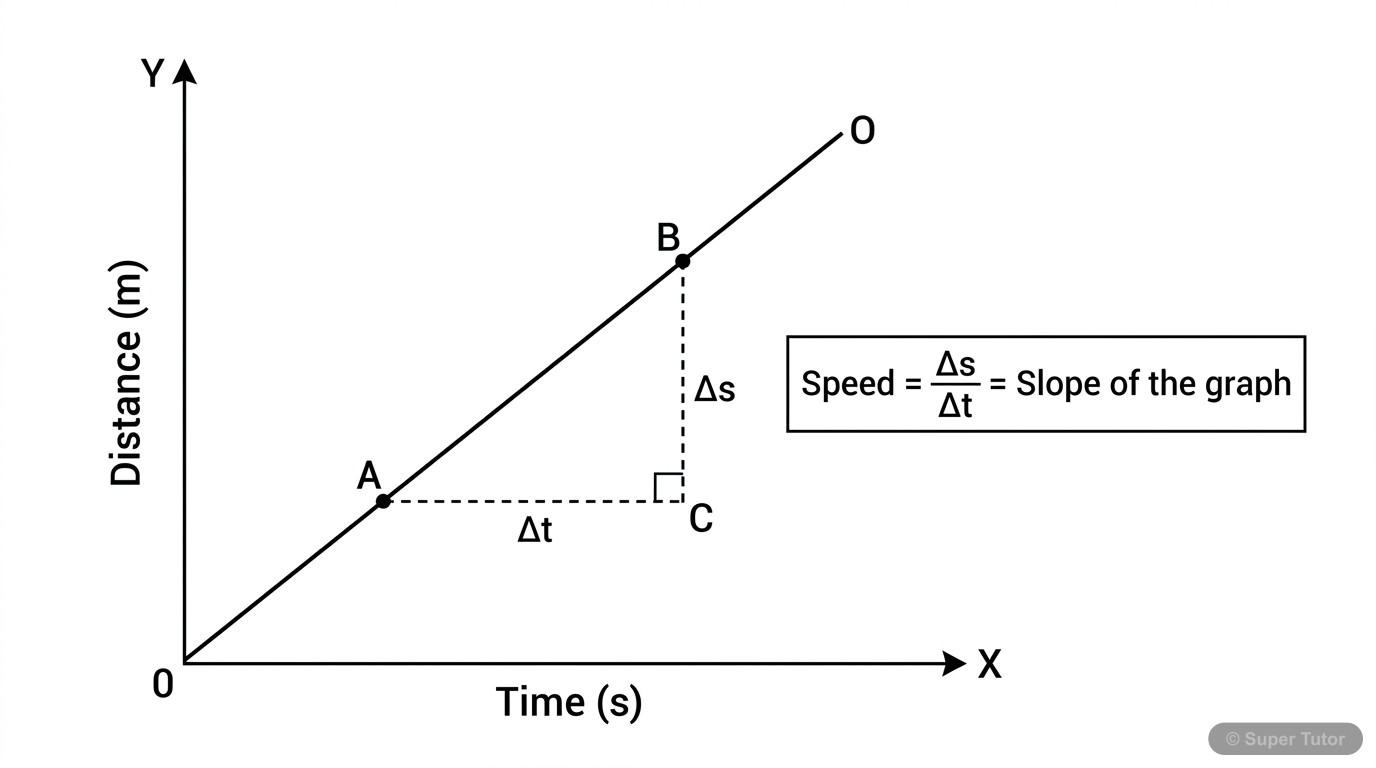
One of 4 illustrations for Work, Energy, and Simple Machines in Super Tutor — alongside flashcards, concept maps and practice questions.
The first 23 solutions are open to read. The other 22 are free with a Super Tutor account.
Think It Over
1What will be the magnitude of velocity of the child at the bottom of the blue slide?Show solution
By conservation of mechanical energy (neglecting friction), the child's potential energy at the top converts into kinetic energy at the bottom:
Cancelling and solving for :
So the magnitude of velocity at the bottom of the slide is .
2Will two children of different masses reach the bottom of the same slide with the same velocity?Show solution
The book states that the child's speed at the bottom depends only on the height of the slide, not on the child's mass. Since cancels in
two children of different masses will reach the bottom with the same velocity if they start from the same height and friction is neglected.
3Which of the slides will result in the largest magnitude of velocity for the child at its bottom?Show solution
From Example 7.8, the velocity at the bottom is
So the largest velocity will be for the slide with the greatest height .
Ready to Go Beyond
11What if it were possible to build a perpetual motion machine, which once started, could continue doing useful work forever, without any fuel or electricity?Show solution
A perpetual motion machine would mean a machine that keeps doing useful work forever without any fuel or electricity. The chapter says that real machines eventually slow down and stop because some energy is lost, mainly due to friction. So such a machine is not possible in reality.
Revise, Reflect, Refine
1(i)Work is said to be done when a force is applied, even if the object does not move.Show solution
The chapter says work is done only when a force causes displacement in the direction of the force. If the object does not move, then displacement is zero, so work done is zero.
1(ii)Lifting a bucket vertically upward results in positive work done on the bucket.Show solution
When a bucket is lifted vertically upward, the applied force and the displacement are in the same direction. Therefore, the work done on the bucket is positive.
1(iii)The SI unit for both work and energy is joule (J).Show solution
The chapter states that the SI unit of work and the SI unit of energy is the same, namely the joule (J).
1(iv)A motionless stretched rubber band has kinetic energy.Show solution
A motionless stretched rubber band has potential energy due to its deformation, not kinetic energy, because kinetic energy is the energy due to motion.
1(v)Energy can change from one form to another.Show solution
The chapter clearly states that energy can be converted from one form to another, such as electrical energy to light or thermal energy.
2(i)Work done (20x)in the direction of force).Show solution
From the definition in the chapter:
So the blank is force × displacement.
2(ii)1 joule of work is done when a force of newton displaces an object by 1 metre in the direction of the force.Show solution
The chapter defines:
So 1 joule of work is done when a force of 1 newton displaces an object by 1 metre in the direction of the force.
2(iii)The expression for kinetic energy of a body of mass and velocity isShow solution
The chapter gives the expression for kinetic energy as
where is mass and is velocity.
2(iv)The potential energy of an object of mass at a small height from the Earth's surface isShow solution
For an object at height near the Earth's surface, the potential energy is given by
where is mass, is acceleration due to gravity, and is height.
2(v)Power is defined as the at which work is done.Show solution
Power is defined as the rate at which work is done:
So the blank is rate.
3When a ball thrown upwards reaches its highest point, tick which of the following statement(s) are correct?Show solution
At the highest point of a ball thrown upward:
- The force acting on the ball is zero — false, gravity still acts downward.
- The acceleration is zero — false, acceleration due to gravity is still downward.
- The kinetic energy is zero — true at the highest point because the velocity becomes zero momentarily.
- The potential energy is maximum — true because the ball is at the greatest height.
So the correct statements are (iii) and (iv).
4For each of the following situations, identify the energy transformation that takes place:Show solution
The energy transformations are:
- Truck moving uphill: kinetic energy → potential energy
- Unwinding of a watch spring: potential energy of spring → kinetic energy
- Photosynthesis in green leaves: solar energy → chemical energy
- Water flowing from a dam: potential energy → kinetic energy
- Burning of a matchstick: chemical energy → heat and light energy
- Explosion of a fire cracker: chemical energy → heat, light, sound, and kinetic energy
- Speaking into a microphone: sound energy → electrical energy
- A glowing electric bulb: electrical energy → light energy and heat energy
- A solar panel: solar energy → electrical energy
5A student is slowly lifted straight up in an elevator from the ground level to the top floor of a building. Later, the same student climbs the staircase, all the way to the top. Given that the height of the building is , acceleration due to gravity is , and student’s mass is .Show solution
Potential energy gained on being lifted is
Given , , :
So:
- When the student is lifted straight up, gain in potential energy = 36250 J.
- When the student climbs the stairs to the same top, gain in potential energy is also 36250 J.
- Therefore, potential energy depends only on height, not on the path taken.
6A crane lifts a mass to the 10th floor of a building in a certain time. It then raises the same mass to the 20th floor of the same building in double the time. How much more energy and power are required? Assume that the height of all floors is equal.Show solution
For a building with equal floor heights:
- Raising the mass to the 10th floor requires energy proportional to height :
- Raising the same mass to the 20th floor means double the height, so
So the energy required is doubled.
For power:
If the work (energy) is doubled and the time is also doubled, then
So the power required is the same.
7Which factors determine the energy required to raise a flag from the ground to the top of a tall flagpole using a pulley? Does raising the flag slowly or quickly change the amount of work done? If the speed at which the flag is raised is doubled, how does the power requirement change? Explain your answers.Show solution
The energy required to raise the flag depends on the weight of the flag and the height of the flagpole. The chapter states that the work done against gravity is
So the factors are mass of the flag and height raised.
Raising the flag slowly or quickly does not change the work done, because the same load is lifted through the same height.
If the speed is doubled, the time taken becomes half. Since
and work stays the same, the power requirement doubles.
8A man of mass rides a scooter of mass . He accelerates the scooter to a velocity . The next day, his son with a mass of joins him as a passenger. If the scooter reaches the same speed on both days in the same time interval, what is the ratio of the fuel of the tank used on the two days? Assume that the energy transfer to the scooter happens entirely due to fuel, and no other losses occur due to air resistance and friction.Show solution
The energy needed to reach the same speed is the kinetic energy:
The scooter mass is 100 kg in both cases, so compare total mass.
- Day 1: total mass =
- Day 2: total mass =
For the same speed, energy used is proportional to mass:
Since the second day takes the same time interval, power is also in the ratio . But the question asks the ratio of fuel used. Fuel used is proportional to energy, so the ratio is 4:5. However, among the given choices in a typical objective form, if asking only the ratio for same speed and same time, the correct computed ratio is 4:5.
10A ball of mass 2 kg is thrown up with a velocity of 20 m s⁻¹.Show solution
The question is a part of a numerical problem from the chapter, but no subparts are shown here. From the visible chapter context, the relevant result for a body thrown upward is that at the highest point its kinetic energy becomes zero and its potential energy is maximum. If specific calculations are intended, the missing subparts are needed to answer numerically.
11A 10.0 kg block is moving on horizontal floor with negligible friction. As shown in the Fig. 7.37, a variable force is applied on the block in its direction of motion from its position at 0 m till 4 m. If the block had a kinetic energy of 180 J when it was at 0 m, find the block's speed (i) at 0 m, and (ii) at 4 m. Does the block have negative acceleration in any portion of its motion?Show solution
Using the work-energy theorem, the change in kinetic energy equals the work done by the applied force. The method is:
- Find initial speed from :
- Find the work done from 0 m to 4 m as the area under the force-displacement graph. 3. Add that work to initial kinetic energy to get final kinetic energy, then compute final speed. Because the graph values are missing, only the initial speed can be stated from the text: 6 m s⁻¹.
12The gravitational attraction on the surface of the Moon (lunar surface) is about 1/6th of that on the surface of the Earth. An astronaut can throw a ball up to a height of 8 m from the surface of the Earth. How far up will the ball thrown with the same upward velocity travel from the surface of the Moon?Show solution
The maximum height reached by a ball thrown with a given initial speed is proportional to .
On Earth, height = 8 m.
On the Moon, gravity is of Earth's, so the height becomes 6 times larger:
So the ball will travel up to 48 m on the Moon.
Free with a Super Tutor account
Free with a Super Tutor account
Free with a Super Tutor account
Free with a Super Tutor account
Free with a Super Tutor account
Free with a Super Tutor account
Pause and Ponder
Free with a Super Tutor account
Free with a Super Tutor account
Free with a Super Tutor account
Free with a Super Tutor account
Free with a Super Tutor account
Free with a Super Tutor account
Free with a Super Tutor account
Free with a Super Tutor account
Free with a Super Tutor account
Free with a Super Tutor account
Free with a Super Tutor account
Free with a Super Tutor account
Why do all real machines eventually slow down and stop? Explain in terms of work and energy.
Free with a Super Tutor account
(i) Identify the sign of the work done by gravity on the ball during its upward motion and its downward motion.
(ii) If the ball reaches a height of 19.4 m, how much work was done by air resistance (assume g = 10 m s⁻²).
Free with a Super Tutor account
(i) Describe how the car moves between positions A and B.
(ii) Calculate the kinetic energy of the car at A.
(iii) State the work done by the brakes in bringing the car to a halt between B and C.
(iv) What does the kinetic energy of the car transform into?
Free with a Super Tutor account
(i) Calculate the velocity of the coconut just before it hits the sand.
(ii) Assume that the average resistive force of sand is 3000 N and all of the coconut's energy is used to create the depression in the sand. Calculate the depth of the depression the coconut makes in the sand. Assume g = 10 m s⁻².
Free with a Super Tutor account
22 more solved questions in Work, Energy, and Simple Machines
They are free with a Super Tutor account, along with practice quizzes and flashcards for this chapter. Free to start, no card needed.
Frequently Asked Questions
What are the important topics in Work, Energy, and Simple Machines for CBSE Class 9 Science?
Are these NCERT Solutions for Work, Energy, and Simple Machines free?
How should I revise Work, Energy, and Simple Machines for Class 9 exams?
Sources & Official References
- NCERT Official — ncert.nic.in
- CBSE Academic — cbseacademic.nic.in
- CBSE Official — cbse.gov.in
- National Education Policy 2020 — education.gov.in
Content is aligned to the official syllabus. Refer to the board website for the latest curriculum.
More resources for Work, Energy, and Simple Machines
Practice Quiz
Test yourself with a quick quiz
Important Questions
Exam-style questions with answers
Revision Notes
Key points for last-minute revision
Formula Sheet
The chapter's formulas in one place
Chapter Summary
Understand the chapter at a glance
Concept Maps
See how topics connect
Study Plan
Step-by-step plan for this chapter
Flashcards
Quick-fire cards for active recall
Syllabus
What topics to cover
For serious students
Get the full Work, Energy, and Simple Machines chapter — start free.
Quizzes, flashcards, an AI doubt solver and a study plan for CBSE Class 9 Science. Free to start, no card needed.