Metals and Non-metals — Concept Maps
Gujarat Board · Class 10 · Science
3 concept maps of Metals and Non-metals for Gujarat Board Class 10 Science, each also written out as a text outline.
Interactive on Super Tutor
Studying Metals and Non-metals? Get the full interactive chapter.
Quizzes, flashcards, AI doubt-solver and a step-by-step study plan — built for concept maps and more.
Free trial, no card needed.
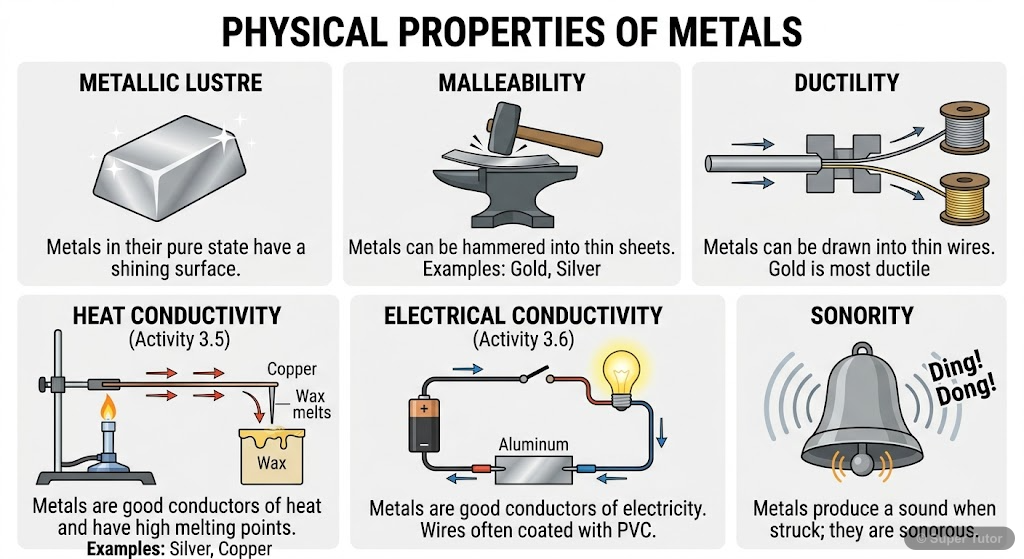
One of 16 illustrations for Metals and Non-metals in Super Tutor — alongside flashcards, concept maps and practice questions.
Metals and Non-metals – Complete Chapter Overview
The map in words
- Metals and Non-metals
- Physical Properties
- Metals
- Lustre
- Malleable
- Ductile
- Sonorous
- Good Conductors
- Solid except Mercury
- Non-metals
- Non-lustrous except Iodine
- Brittle
- Bad Conductors
- Graphite exception
- Bromine is liquid
- Metals
- Chemical Properties
- With Oxygen
- Metal Oxides Basic
- Non-metal Oxides Acidic
- Amphoteric Al2O3 and ZnO
- With Water
- K and Na violent
- Ca moderate
- Al Fe Zn with steam
- Cu Ag Au no reaction
- With Acids
- Salt and H2 gas
- HNO3 no H2 produced
- Displacement Reactions
- Reactivity Series
- More reactive displaces less
- With Oxygen
- Ionic Compounds
- Formation
- Metals lose electrons Cations
- Non-metals gain electrons Anions
- Properties
- High melting point
- Soluble in water
- Conducts when molten
- Hard and brittle
- Formation
- Extraction of Metals
- Low Reactivity
- Simple heating
- Cu Hg Ag Au Pt
- Medium Reactivity
- Roasting or Calcination
- Carbon reduction
- Zn Fe Pb
- High Reactivity
- Electrolytic reduction
- K Na Ca Mg Al
- Refining
- Electrolytic refining
- Anode impure cathode pure
- Low Reactivity
- Corrosion
- Rusting needs air and water
- Silver tarnishes
- Copper turns green
- Prevention
- Painting oiling
- Galvanisation zinc
- Alloying
- Alloys
- Brass Cu and Zn
- Bronze Cu and Sn
- Solder Pb and Sn
- Stainless Steel Fe Ni Cr
- Amalgam contains mercury
- Physical Properties
Metals and Non-metals Classification and Properties
The map in words
- Elements
- Metals
- Physical Properties
- Lustre
- Malleability
- Ductility
- Conductivity
- Chemical Properties
- Basic oxides
- Displace H from acids
- Lose electrons
- Extraction
- Low reactivity heating
- Medium reactivity reduction
- High reactivity electrolysis
- Applications
- Conductors
- Construction
- Jewelry
- Physical Properties
- Non-metals
- Physical Properties
- Non-lustrous
- Brittle
- Poor conductors
- Low melting point
- Chemical Properties
- Acidic oxides
- Gain electrons
- Form hydrides
- Examples
- Carbon
- Oxygen
- Sulfur
- Nitrogen
- Applications
- Insulators
- Gas exchange
- Industrial
- Physical Properties
- Metals
Metals and Non-metals Classification
The map in words
- Metals and Non-metals
- Metals
- Physical Properties
- Lustrous appearance
- Malleable
- Ductile
- Good conductors
- Sonorous
- Chemical Properties
- Form positive ions
- Basic oxides
- React with water
- React with acids
- Reactivity Series
- High reactivity
- Medium reactivity
- Low reactivity
- Extraction
- Electrolysis method
- Reduction method
- Physical Properties
- Non-metals
- Physical Properties
- Dull appearance
- Not malleable
- Not ductile
- Poor conductors
- Not sonorous
- Chemical Properties
- Form negative ions
- Acidic oxides
- Do not react with water
- Form hydrides
- Examples
- Oxygen
- Carbon
- Sulphur
- Physical Properties
- Applications
- Corrosion prevention
- Alloy making
- Extraction processes
- Metals
Explore these maps interactively
Explore DiagramsFrequently Asked Questions
What are the important topics in Metals and Non-metals for Gujarat Board Class 10 Science?
What do the concept maps for Metals and Non-metals show?
How should I revise Metals and Non-metals for the Gujarat Board Class 10 board exam?
Sources & Official References
Content is aligned to the official syllabus. Refer to the board website for the latest curriculum.
More resources for Metals and Non-metals
Practice Quiz
Test yourself with a quick quiz
Important Questions
Exam-style questions with answers
Revision Notes
Key points for last-minute revision
Formula Sheet
The chapter's formulas in one place
Chapter Summary
Understand the chapter at a glance
Flashcards
Quick-fire cards for active recall
Syllabus
What topics to cover
For serious students
Get the full Metals and Non-metals chapter — start free.
Quizzes, flashcards, an AI doubt solver and a study plan for Gujarat Board Class 10 Science. Free to start, no card needed.