Metals and Non-metals — Revision Notes
Gujarat Board · Class 10 · Science
Metals and Non-metals revision notes for Gujarat Board Class 10 Science: 4 topics in quick points. Part of the Gujarat Board Class 10 Science syllabus.
Interactive on Super Tutor
Studying Metals and Non-metals? Get the full interactive chapter.
Quizzes, flashcards, AI doubt-solver and a step-by-step study plan — built for revision notes and more.
Free trial, no card needed.
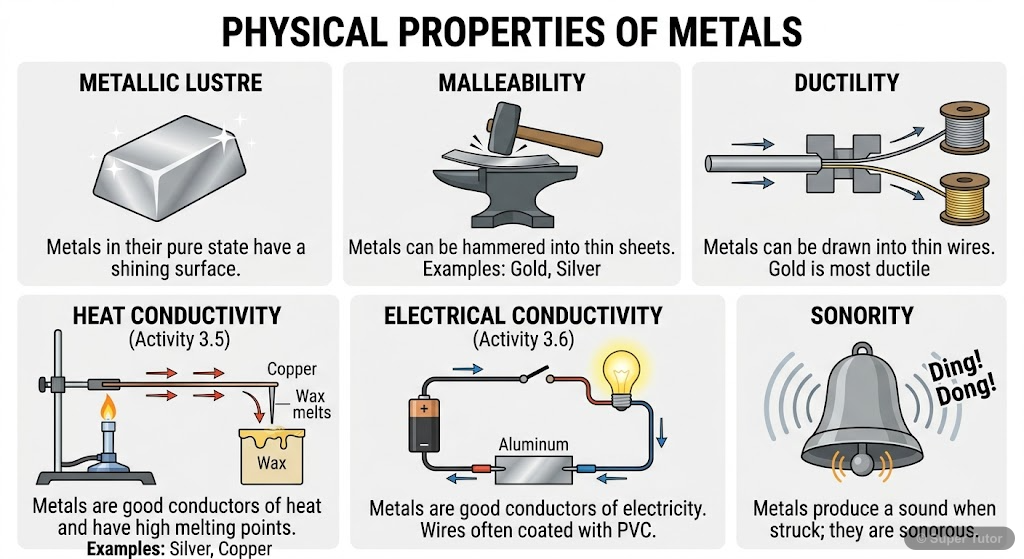
One of 16 illustrations for Metals and Non-metals in Super Tutor — alongside flashcards, concept maps and practice questions.
Key Topics to Revise
Physical Properties of Metals and Non-metals
- Metals have a shining surface called metallic lustre (visible after rubbing with sandpaper).
- Metals are generally hard (exception: sodium and potassium are soft, can be cut with a knife).
- Malleability: Metals can be beaten into thin sheets. Gold and silver are the most malleable metals.
Chemical Properties of Metals
- Metals react with oxygen to form metal oxides: Metal + Oxygen → Metal Oxide.
- Most metal oxides are basic in nature.
- Amphoteric oxides (Al₂O₃, ZnO) react with both acids AND bases.
How Metals and Non-metals React – Ionic Compounds
- Metals tend to LOSE electrons to form positive ions (cations). E.g., Na → Na⁺ + e⁻
- Non-metals tend to GAIN electrons to form negative ions (anions). E.g., Cl + e⁻ → Cl⁻
- The driving force for this electron transfer is the tendency to achieve a stable noble gas configuration (completely filled outermost shell).
Occurrence and Extraction of Metals
- Minerals: Elements or compounds occurring naturally in Earth's crust.
- Ores: Minerals from which a metal can be profitably extracted.
- Gangue: Impurities (soil, sand, etc.) mixed with the ore. Must be removed before extraction.
Get complete notes with diagrams and examples
Full NotesKey Concepts
Frequently Asked Questions
What are the important topics in Metals and Non-metals for Gujarat Board Class 10 Science?
How should I revise Metals and Non-metals for the Gujarat Board Class 10 board exam?
Sources & Official References
Content is aligned to the official syllabus. Refer to the board website for the latest curriculum.
More resources for Metals and Non-metals
For serious students
Get the full Metals and Non-metals chapter — start free.
Quizzes, flashcards, an AI doubt solver and a study plan for Gujarat Board Class 10 Science. Free to start, no card needed.