Metals and Non-metals — Flashcards
Gujarat Board · Class 10 · Science
32 flashcards for Metals and Non-metals (Gujarat Board Class 10 Science) to test yourself on key terms and facts.
Interactive on Super Tutor
Studying Metals and Non-metals? Get the full interactive chapter.
Quizzes, flashcards, AI doubt-solver and a step-by-step study plan — built for flashcards and more.
Free trial, no card needed.
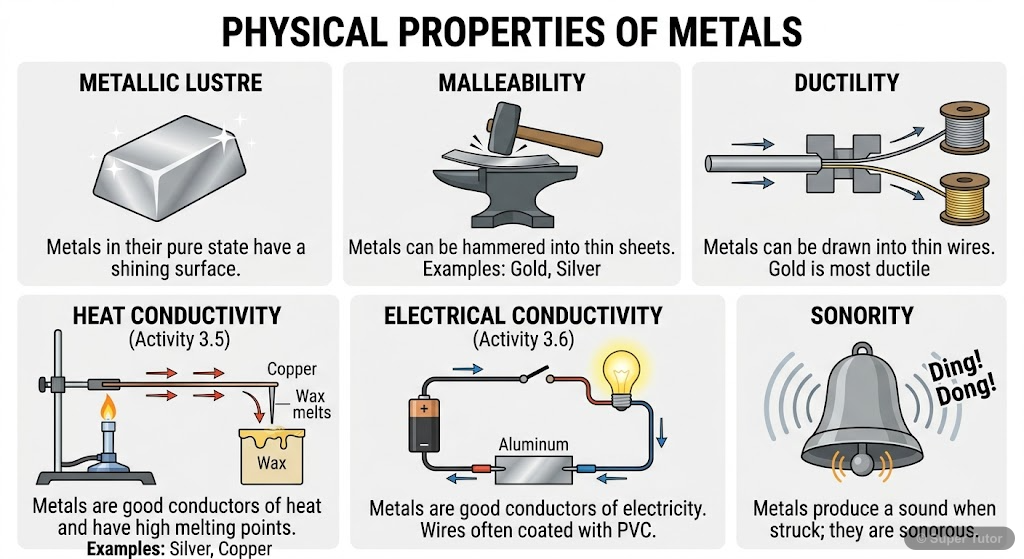
One of 16 illustrations for Metals and Non-metals in Super Tutor — alongside flashcards, concept maps and practice questions.
A shiny metal sample conducts electricity when it is molten, but not when it is solid. Which metal could this be? Explain why its conductivity changes.
Answer
This is likely an ionic compound or a pure metal like copper or sodium. In solid state, ions are fixed in rigid lattice structure and cannot move. When molten, the heat energy overcomes electrostatic …
Why is sodium metal stored under kerosene oil and not exposed to air?
Answer
Sodium is highly reactive with both oxygen and water. It reacts vigorously with oxygen in air to form sodium oxide (Na₂O), and explosively with water: 2Na + 2H₂O → 2NaOH + H₂ (gas that catches fire).
Describe the malleability and ductility of metals. Give practical examples of how these properties are used in daily life.
Answer
Malleability: Ability of metals to be beaten into thin sheets (e.g., aluminum foil, gold leaves for decoration). Ductility: Ability to be drawn into thin wires (e.g., copper wires for electrical circu…
A student performs Activity 3.5 with an aluminum wire and observes the pin falling after heating. What property of aluminum is being demonstrated? Explain the observation.
Answer
This demonstrates thermal conductivity of metals. Heat energy travels along the aluminum wire from the heated end toward the clamp. When the wax holding the pin melts, the pin falls. Aluminum is a goo…
Why are non-metals poor conductors of electricity compared to metals? Explain at the atomic level.
Answer
Metals have free electrons in their outer shells that move easily throughout the structure, creating conduction paths. Non-metals have electrons tightly bound to their atoms in covalent bonds. These e…
When magnesium burns in air, it forms a white ash. What is this ash? Write the balanced chemical equation for this reaction.
Answer
The white ash is magnesium oxide (MgO). Balanced equation: 2Mg + O₂ → 2MgO. This is a combustion reaction where magnesium combines with oxygen. The high reactivity of magnesium causes it to burn with …
Compare the reactions of sodium, magnesium, and copper with cold water. Arrange them in order of decreasing reactivity.
Answer
Order: Na > Mg > Cu. Sodium reacts violently and explosively (2Na + 2H₂O → 2NaOH + H₂↑, hydrogen ignites). Magnesium reacts slowly with cold water but vigorously with hot water (Mg + 2H₂O → Mg(OH)₂ + …
A student adds zinc powder to dilute hydrochloric acid and observes vigorous bubbling. What gas is produced? Write the balanced equation and explain why this reaction is exothermic.
Answer
The gas is hydrogen (H₂). Balanced equation: Zn + 2HCl → ZnCl₂ + H₂↑. This reaction is exothermic because breaking metal-metal bonds and H-Cl bonds requires energy, but forming Zn-Cl bonds and H-H bon…
+24 more flashcards
Practise AllFrequently Asked Questions
What are the important topics in Metals and Non-metals for Gujarat Board Class 10 Science?
How many flashcards are available for Metals and Non-metals?
How should I revise Metals and Non-metals for the Gujarat Board Class 10 board exam?
Sources & Official References
Content is aligned to the official syllabus. Refer to the board website for the latest curriculum.
More resources for Metals and Non-metals
Practice Quiz
Test yourself with a quick quiz
Important Questions
Exam-style questions with answers
Revision Notes
Key points for last-minute revision
Formula Sheet
The chapter's formulas in one place
Chapter Summary
Understand the chapter at a glance
Concept Maps
See how topics connect
Syllabus
What topics to cover
For serious students
Get the full Metals and Non-metals chapter — start free.
Quizzes, flashcards, an AI doubt solver and a study plan for Gujarat Board Class 10 Science. Free to start, no card needed.