Metals and Non-metals — Syllabus
Gujarat Board · Class 10 · Science
What Metals and Non-metals covers in Gujarat Board Class 10 Science: 4 topics, for the 2026-27 session. Topics include Physical Properties of Metals.
Interactive on Super Tutor
Studying Metals and Non-metals? Get the full interactive chapter.
Quizzes, flashcards, AI doubt-solver and a step-by-step study plan — built for syllabus and more.
Free trial, no card needed.
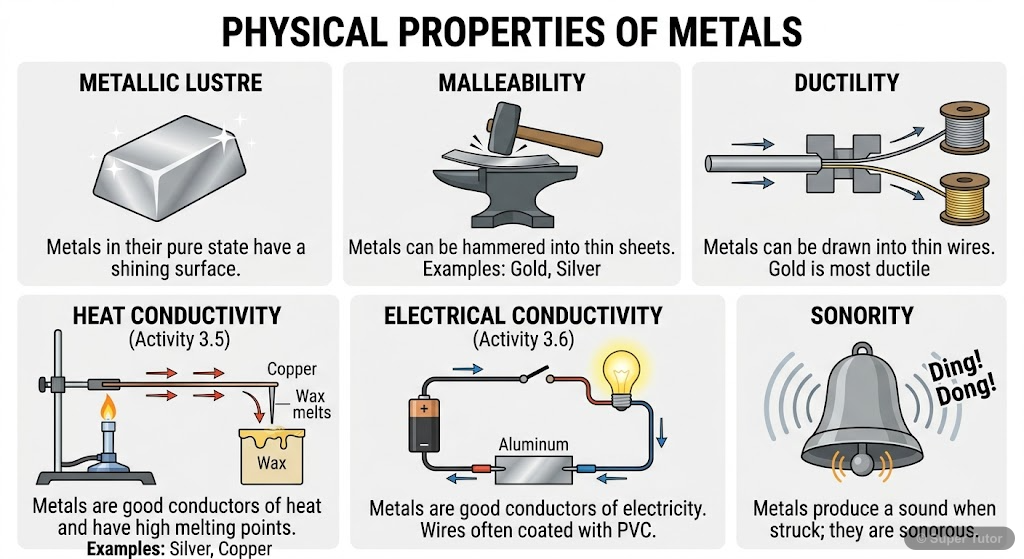
One of 16 illustrations for Metals and Non-metals in Super Tutor — alongside flashcards, concept maps and practice questions.
Topics in Metals and Non-metals
Physical Properties of Metals and Non-metals
- Metals have a shining surface called metallic lustre (visible after rubbing with sandpaper).
- Metals are generally hard (exception: sodium and potassium are soft, can be cut with a knife).
- Malleability: Metals can be beaten into thin sheets. Gold and silver are the most malleable metals.
Chemical Properties of Metals
- Metals react with oxygen to form metal oxides: Metal + Oxygen → Metal Oxide.
- Most metal oxides are basic in nature.
- Amphoteric oxides (Al₂O₃, ZnO) react with both acids AND bases.
How Metals and Non-metals React – Ionic Compounds
- Metals tend to LOSE electrons to form positive ions (cations). E.g., Na → Na⁺ + e⁻
- Non-metals tend to GAIN electrons to form negative ions (anions). E.g., Cl + e⁻ → Cl⁻
- The driving force for this electron transfer is the tendency to achieve a stable noble gas configuration (completely filled outermost shell).
Occurrence and Extraction of Metals
- Minerals: Elements or compounds occurring naturally in Earth's crust.
- Ores: Minerals from which a metal can be profitably extracted.
- Gangue: Impurities (soil, sand, etc.) mixed with the ore. Must be removed before extraction.
Key Concepts
Work through every topic in Metals and Non-metals with notes and quizzes
Start This ChapterFrequently Asked Questions
What are the important topics in Metals and Non-metals for Gujarat Board Class 10 Science?
How should I revise Metals and Non-metals for the Gujarat Board Class 10 board exam?
Sources & Official References
Content is aligned to the official syllabus. Refer to the board website for the latest curriculum.
More resources for Metals and Non-metals
Practice Quiz
Test yourself with a quick quiz
Important Questions
Exam-style questions with answers
Revision Notes
Key points for last-minute revision
Formula Sheet
The chapter's formulas in one place
Chapter Summary
Understand the chapter at a glance
Concept Maps
See how topics connect
Flashcards
Quick-fire cards for active recall
For serious students
Get the full Metals and Non-metals chapter — start free.
Quizzes, flashcards, an AI doubt solver and a study plan for Gujarat Board Class 10 Science. Free to start, no card needed.