Carbon and its Compounds — Syllabus
Gujarat Board · Class 10 · Science
What Carbon and its Compounds covers in Gujarat Board Class 10 Science: 4 topics, for the 2026-27 session. Topics include 1 Bonding in Carbon.
Interactive on Super Tutor
Studying Carbon and its Compounds? Get the full interactive chapter.
Quizzes, flashcards, AI doubt-solver and a step-by-step study plan — built for syllabus and more.
Free trial, no card needed.
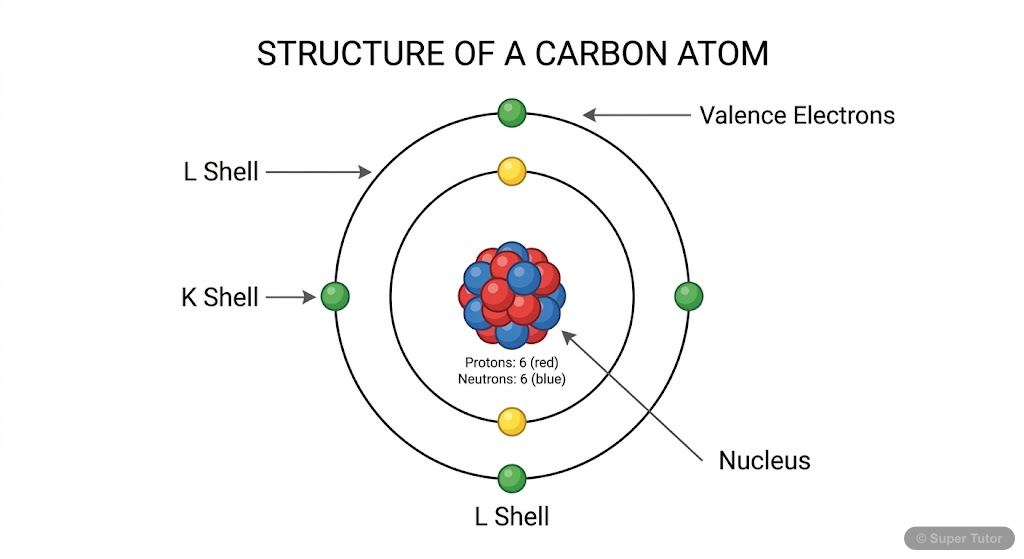
One of 22 illustrations for Carbon and its Compounds in Super Tutor — alongside flashcards, concept maps and practice questions.
Topics in Carbon and its Compounds
4.1 Bonding in Carbon – The Covalent Bond
- Carbon has atomic number 6 and electronic configuration 2, 4 — so it has 4 valence electrons.
- Carbon cannot form C⁴⁺ (requires too much energy) or C⁴⁻ (nucleus cannot hold 10 electrons) ions.
- Carbon achieves noble gas configuration by SHARING electrons — forming COVALENT BONDS.
4.2 Versatile Nature of Carbon
- Two special properties make carbon form millions of compounds: (1) CATENATION and (2) TETRAVALENCY.
- CATENATION: Carbon's unique ability to form bonds with OTHER carbon atoms, creating long chains, branched chains, and rings.
- TETRAVALENCY: Carbon has valency of 4, so it can bond with 4 other atoms (C, H, O, N, S, Cl, etc.).
4.3 Chemical Properties of Carbon Compounds
- COMBUSTION: Carbon compounds burn in oxygen/air to produce CO₂ and H₂O along with heat and light. These are oxidation reactions.
- Saturated hydrocarbons burn with a CLEAN BLUE FLAME (complete combustion with sufficient air).
- Unsaturated hydrocarbons burn with a YELLOW SOOTY FLAME (incomplete combustion, carbon particles deposited).
4.4 Important Carbon Compounds – Ethanol and Ethanoic Acid
- ETHANOL (C₂H₅OH): Commonly called alcohol. Liquid at room temperature. Boiling point = 351 K.
- Ethanol is the active ingredient in all alcoholic drinks. It is also used as a solvent in medicines (tincture iodine, cough syrups).
- Ethanol is completely miscible with water (soluble in all proportions).
Key Concepts
Work through every topic in Carbon and its Compounds with notes and quizzes
Start This ChapterFrequently Asked Questions
What are the important topics in Carbon and its Compounds for Gujarat Board Class 10 Science?
How should I revise Carbon and its Compounds for the Gujarat Board Class 10 board exam?
Sources & Official References
Content is aligned to the official syllabus. Refer to the board website for the latest curriculum.
More resources for Carbon and its Compounds
For serious students
Get the full Carbon and its Compounds chapter — start free.
Quizzes, flashcards, an AI doubt solver and a study plan for Gujarat Board Class 10 Science. Free to start, no card needed.