Carbon and its Compounds — Flashcards
Gujarat Board · Class 10 · Science
25 flashcards for Carbon and its Compounds (Gujarat Board Class 10 Science) to test yourself on key terms and facts.
Interactive on Super Tutor
Studying Carbon and its Compounds? Get the full interactive chapter.
Quizzes, flashcards, AI doubt-solver and a step-by-step study plan — built for flashcards and more.
Free trial, no card needed.
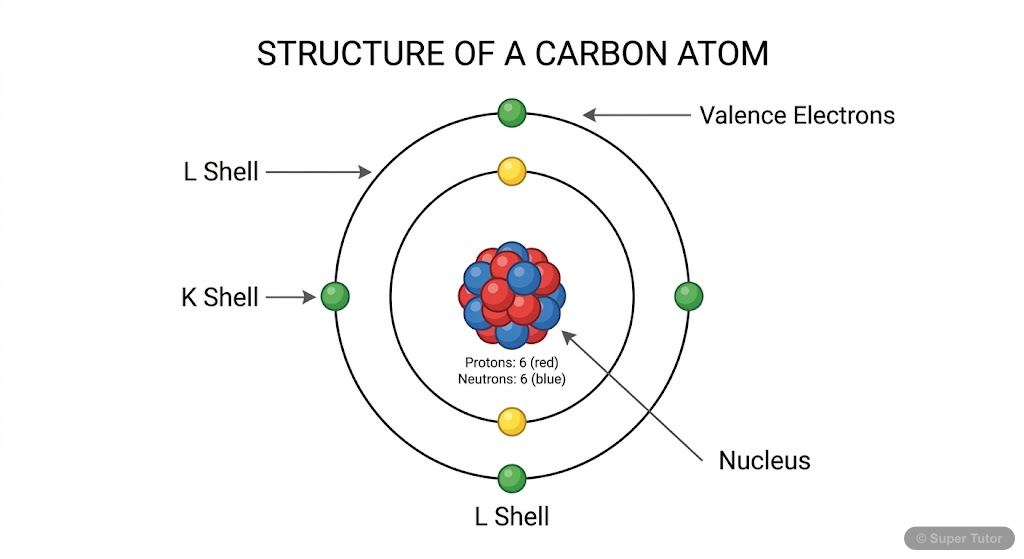
One of 22 illustrations for Carbon and its Compounds in Super Tutor — alongside flashcards, concept maps and practice questions.
What is the electron configuration of carbon, and why can't it form ionic compounds easily?
Answer
Carbon (atomic number 6) has configuration 2,4 with 4 valence electrons. To achieve noble gas configuration, it would need to gain 4 electrons (forming C⁴⁻) or lose 4 electrons (forming C⁴⁺). Both req…
Compare the properties of ionic compounds (like NaCl) and covalent compounds (like CH₄). Why are carbon compounds gases or liquids at room temperature while ionic compounds are solids?
Answer
Ionic compounds: High melting/boiling points (e.g., NaCl = 1074 K), conduct electricity when molten, strong electrostatic forces between ions. Covalent compounds: Low melting/boiling points (e.g., met…
Draw the electron dot structure for H₂ molecule and explain how covalent bonding works.
Answer
H₂ structure: H:H (two dots between H atoms represent shared electron pair). Each hydrogen atom contributes 1 electron; the pair is shared so each atom achieves helium's electron configuration (2 elec…
What is the difference between single, double, and triple bonds? Give examples of each.
Answer
Single bond: 1 shared pair of electrons (e.g., H-H, C-H in methane CH₄). Double bond: 2 shared pairs of electrons (e.g., O=O in oxygen, C=C in ethene C₂H₄). Triple bond: 3 shared pairs of electrons (e…
Explain the property of catenation in carbon. Why don't other elements show this property to the same extent?
Answer
Catenation is carbon's ability to form long chains with other carbon atoms through strong C-C bonds. Reasons: (1) Carbon-carbon bonds are very strong due to carbon's small size, allowing effective orb…
What are saturated and unsaturated hydrocarbons? Give structural examples of each.
Answer
Saturated hydrocarbons: Contain only single bonds between carbon atoms (alkanes, formula CₙH₂ₙ₊₂). Examples: CH₄ (methane), C₂H₆ (ethane), C₃H₈ (propane). These are less reactive and burn with clean b…
Problem: Balance the combustion equations for (a) CH₄ + O₂ and (b) C₂H₅OH + O₂
Answer
(a) CH₄ + 2O₂ → CO₂ + 2H₂O (Methane burns completely in sufficient oxygen). (b) C₂H₅OH + 3O₂ → 2CO₂ + 3H₂O (Ethanol requires 3 molecules of O₂). Both release heat and light. If oxygen is limited, inco…
What happens when unsaturated hydrocarbons (like ethene) are hydrogenated? Why is this reaction industrially important?
Answer
Addition reaction: C₂H₄ + H₂ → C₂H₆ (ethene becomes ethane). The double bond breaks, and hydrogen atoms add across it, creating a saturated hydrocarbon. Requirements: catalyst (Ni or Pd) and heat. Ind…
+17 more flashcards
Practise AllFrequently Asked Questions
What are the important topics in Carbon and its Compounds for Gujarat Board Class 10 Science?
How many flashcards are available for Carbon and its Compounds?
How should I revise Carbon and its Compounds for the Gujarat Board Class 10 board exam?
Sources & Official References
Content is aligned to the official syllabus. Refer to the board website for the latest curriculum.
More resources for Carbon and its Compounds
For serious students
Get the full Carbon and its Compounds chapter — start free.
Quizzes, flashcards, an AI doubt solver and a study plan for Gujarat Board Class 10 Science. Free to start, no card needed.