Chemical Bonding — Concept Maps
ICSE · Class 10 · Chemistry
4 concept maps of Chemical Bonding for ICSE Class 10 Chemistry, each also written out as a text outline. Part of the ICSE Class 10 Chemistry syllabus.
Interactive on Super Tutor
Studying Chemical Bonding? Get the full interactive chapter.
Quizzes, flashcards, AI doubt-solver and a step-by-step study plan — built for concept maps and more.
Free trial, no card needed.
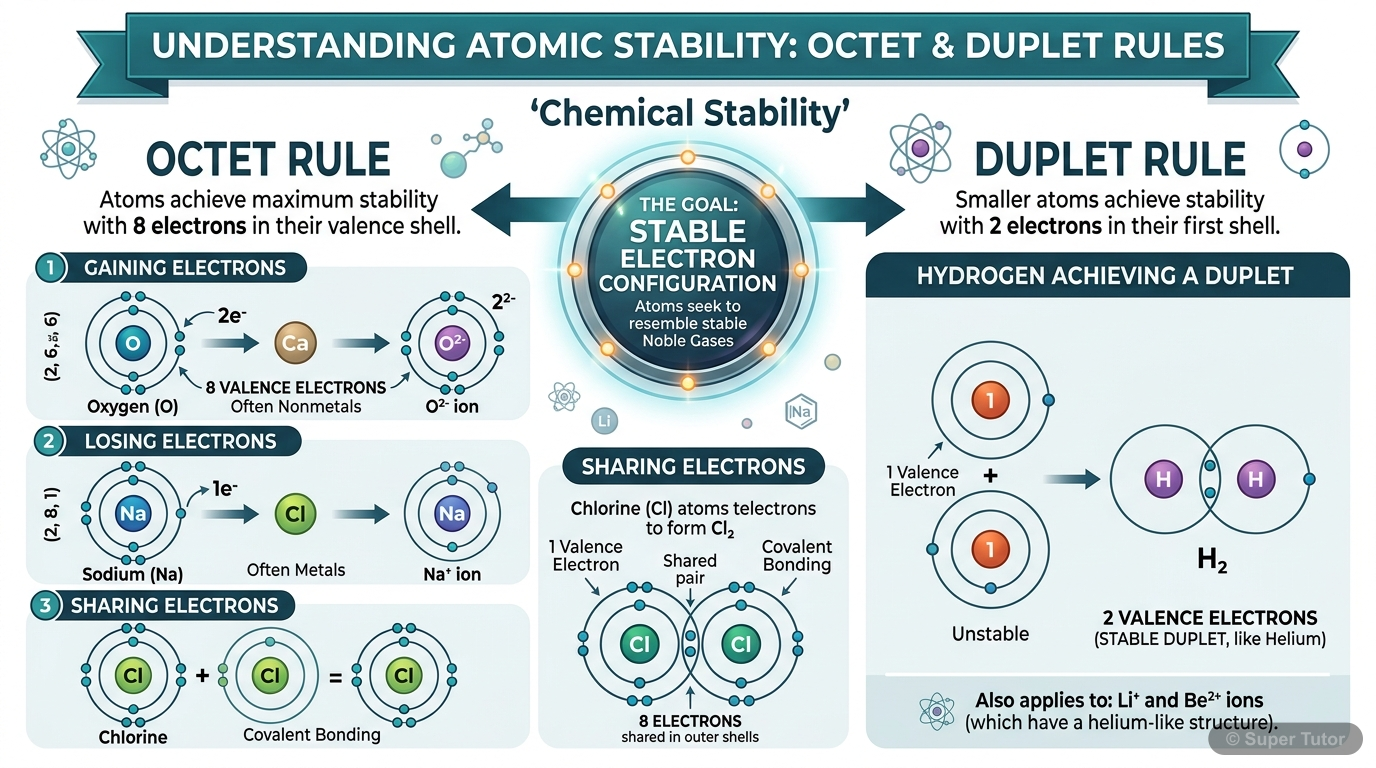
One of 18 illustrations for Chemical Bonding in Super Tutor — alongside flashcards, concept maps and practice questions.
See them allDoes an Ionic Compound Conduct Electricity? — State-by-State Decision
The map in words
- Ionic Compound
- What is its state?
- Solid State: Ions FIXED in Lattice
- No Current Flows
- Poor Conductor in Solid State
- No Current Flows
- Molten State: Ions are FREE to Move
- Current Flows - Good Conductor
- Electrolysis Possible
- Current Flows - Good Conductor
- Dissolved in Water: Ions are FREE to Move
- Current Flows - Good Conductor
- Solid State: Ions FIXED in Lattice
- What is its state?
Overview of Chemical Bonding
The map in words
- Chemical Bonding
- Why Atoms Bond
- Acquire Stability
- Minimum Energy
- Noble Gas Configuration
- Octet Rule
- Duplet Rule H and Li
- Electrovalent Bond
- Complete Electron Transfer
- Metal loses electrons
- Cation formed
- Non-metal gains electrons
- Anion formed
- Electrostatic Attraction
- Examples
- NaCl
- MgCl2
- CaO
- KCl
- Covalent Bond
- Mutual Sharing
- Non-polar
- H2
- Cl2
- O2
- N2
- Polar
- HCl
- H2O
- NH3
- Single Bond
- Double Bond O2
- Triple Bond N2
- Examples
- CH4
- CCl4
- NH3
- H2O
- Coordinate Bond
- One-sided Donation
- Donor has lone pair
- Acceptor short of electrons
- Arrow notation
- Examples
- NH4 plus
- H3O plus
- OH minus
- Why Atoms Bond
Chemical Bonding - Full Chapter Concept Hierarchy
The map in words
- Chemical Bonding
- Cause of Bond Formation
- Acquire Stability
- Minimum Energy State
- Noble Gas Configuration
- Octet Rule 8 electrons
- Duplet Rule H and Li
- Acquire Stability
- Types of Bonds
- Electrovalent Bond
- Electron Transfer
- Cation and Anion
- Electrostatic Attraction
- Covalent Bond
- Electron Sharing
- Single Bond
- Double Bond
- Triple Bond
- Coordinate Bond
- Lone Pair Donation
- Donor and Acceptor
- Electrovalent Bond
- Electrovalent Compounds
- Examples
- NaCl
- MgCl2
- CaO
- KCl
- Properties
- Crystalline Solid
- High MP and BP
- Conducts in Molten State
- Soluble in Water
- Examples
- Covalent Compounds
- Non Polar
- H2
- Cl2
- N2
- O2
- CH4
- CCl4
- Polar
- HCl
- H2O
- NH3
- Properties
- Low MP and BP
- Poor Conductor
- Soluble in Organic Solvents
- Non Polar
- Coordinate Compounds
- Ammonium Ion NH4 plus
- N donates lone pair to H plus
- Hydronium Ion H3O plus
- O donates lone pair to H plus
- Hydroxide Ion OH minus
- Self ionisation of water
- Ammonium Ion NH4 plus
- Cause of Bond Formation
Chemical bonding as the force that holds atoms together through electron transfer, sharing, or coordinate donation to achieve stable electronic configuration
The map in words
- Chemical bonding as the force that holds atoms together through electron transfer, sharing, or coordinate donation to achieve stable electronic configuration
- Cause of chemical combination
- Kossel and Lewis approach
- Octet rule
- Types of chemical bonds
- Electrovalent or ionic bonding
- Ionic compounds
- Structures of ionic compounds
- Covalent bonding
Explore these maps interactively
Explore DiagramsFrequently Asked Questions
What are the important topics in Chemical Bonding for ICSE Class 10 Chemistry?
What do the concept maps for Chemical Bonding show?
How should I revise Chemical Bonding for the ICSE Class 10 board exam?
Sources & Official References
Content is aligned to the official syllabus. Refer to the board website for the latest curriculum.
More resources for Chemical Bonding
Practice Quiz
Test yourself with a quick quiz
Important Questions
Exam-style questions with answers
Revision Notes
Key points for last-minute revision
Formula Sheet
The chapter's formulas in one place
Chapter Summary
Understand the chapter at a glance
Study Plan
Step-by-step plan for this chapter
Flashcards
Quick-fire cards for active recall
Syllabus
What topics to cover
For serious students
Get the full Chemical Bonding chapter — start free.
Quizzes, flashcards, an AI doubt solver and a study plan for ICSE Class 10 Chemistry. Free to start, no card needed.