Chemical Bonding — Chapter Summary
ICSE · Class 10 · Chemistry
Summary of Chemical Bonding for ICSE Class 10 Chemistry. Key concepts: Atoms are usually less stable, During the formation and An ionic bond is.
Interactive on Super Tutor
Studying Chemical Bonding? Get the full interactive chapter.
Quizzes, flashcards, AI doubt-solver and a step-by-step study plan — built for chapter summary and more.
Free trial, no card needed.
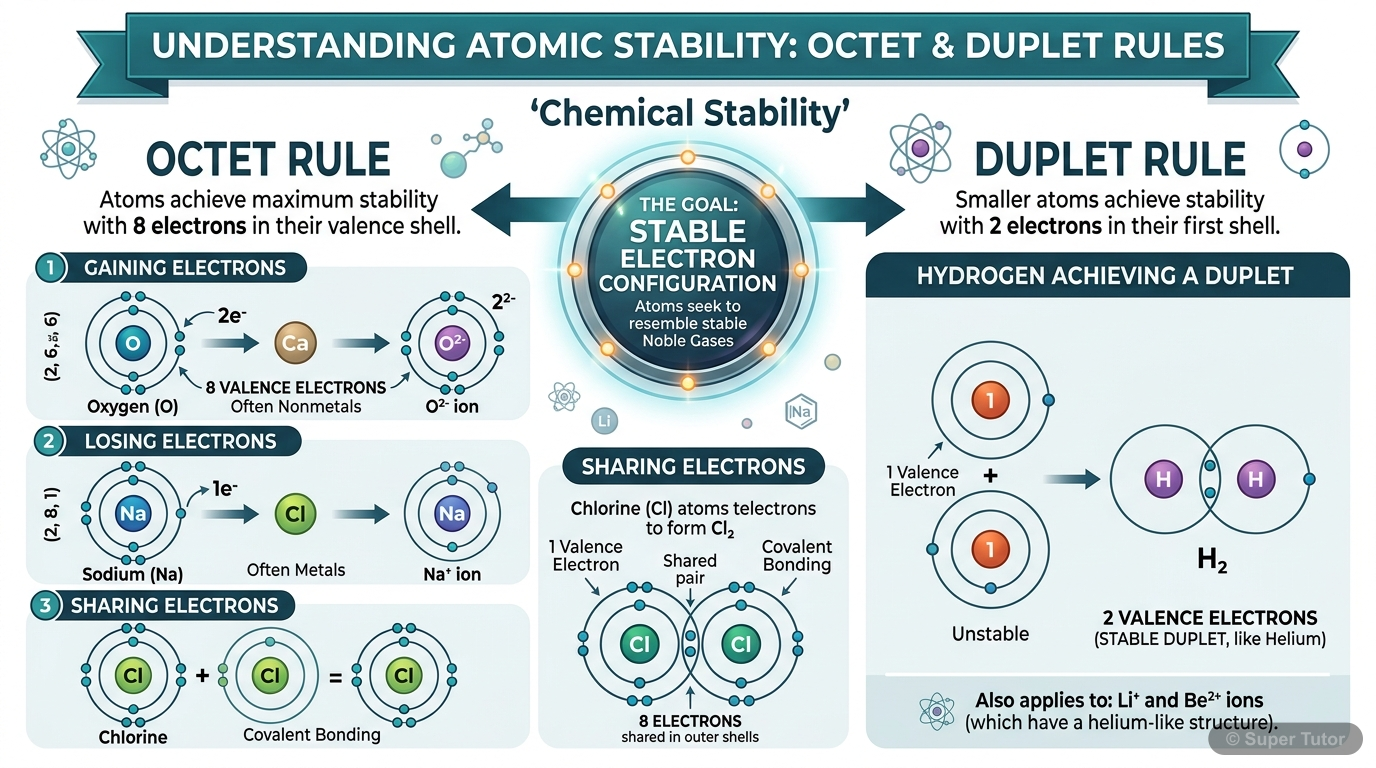
One of 18 illustrations for Chemical Bonding in Super Tutor — alongside flashcards, concept maps and practice questions.
See them allOverview
Chemical bonding is the force of attraction that holds atoms together in compounds and molecules. Atoms combine to become more stable by gaining, losing, or sharing electrons so that their outermost shell becomes like a noble gas. The main types of chemical bond are ionic, covalent, coordinate, and
Key Concepts
Atoms are usually less stable than
Atoms are usually less stable than noble gases. They combine to attain a more stable arrangement and lower energy state.
During the formation of a molecule
During the formation of a molecule, an atom gains, loses or shares electrons until it acquires a stable configuration of eight electrons in its valenc
An ionic bond is the electrostatic
An ionic bond is the electrostatic force of attraction between ions formed by complete transfer of one or more electrons from an electropositive atom
In NaCl
In NaCl, sodium loses one electron to form Na+ and chlorine gains one electron to form Cl-. In MgCl2, one Mg atom gives two electrons to two chlorine
Ionic compounds are crystalline solids
Ionic compounds are crystalline solids, have high melting and boiling points, are hard and brittle, conduct electricity in molten or dissolved state,
Learning Objectives
- Understand why atoms combine to form chemical bonds
- Explain the octet rule and its exceptions
- Describe the formation of ionic bonds with examples such as NaCl, MgCl2, CaO and KCl
- Describe covalent bonding in H2, Cl2, O2, N2, H2O, NH3, CCl4 and CH4
- Distinguish between polar and non-polar covalent bonds and molecules
Frequently Asked Questions
What are the important topics in Chemical Bonding for ICSE Class 10 Chemistry?
How should I revise Chemical Bonding for the ICSE Class 10 board exam?
Sources & Official References
Content is aligned to the official syllabus. Refer to the board website for the latest curriculum.
More resources for Chemical Bonding
Practice Quiz
Test yourself with a quick quiz
Important Questions
Exam-style questions with answers
Revision Notes
Key points for last-minute revision
Formula Sheet
The chapter's formulas in one place
Concept Maps
See how topics connect
Study Plan
Step-by-step plan for this chapter
Flashcards
Quick-fire cards for active recall
Syllabus
What topics to cover
For serious students
Get the full Chemical Bonding chapter — start free.
Quizzes, flashcards, an AI doubt solver and a study plan for ICSE Class 10 Chemistry. Free to start, no card needed.