Chemical Bonding — Flashcards
ICSE · Class 10 · Chemistry
50 flashcards for Chemical Bonding (ICSE Class 10 Chemistry) to test yourself on key terms and facts. Sample: "What is a chemical bond?"
Interactive on Super Tutor
Studying Chemical Bonding? Get the full interactive chapter.
Quizzes, flashcards, AI doubt-solver and a step-by-step study plan — built for flashcards and more.
Free trial, no card needed.
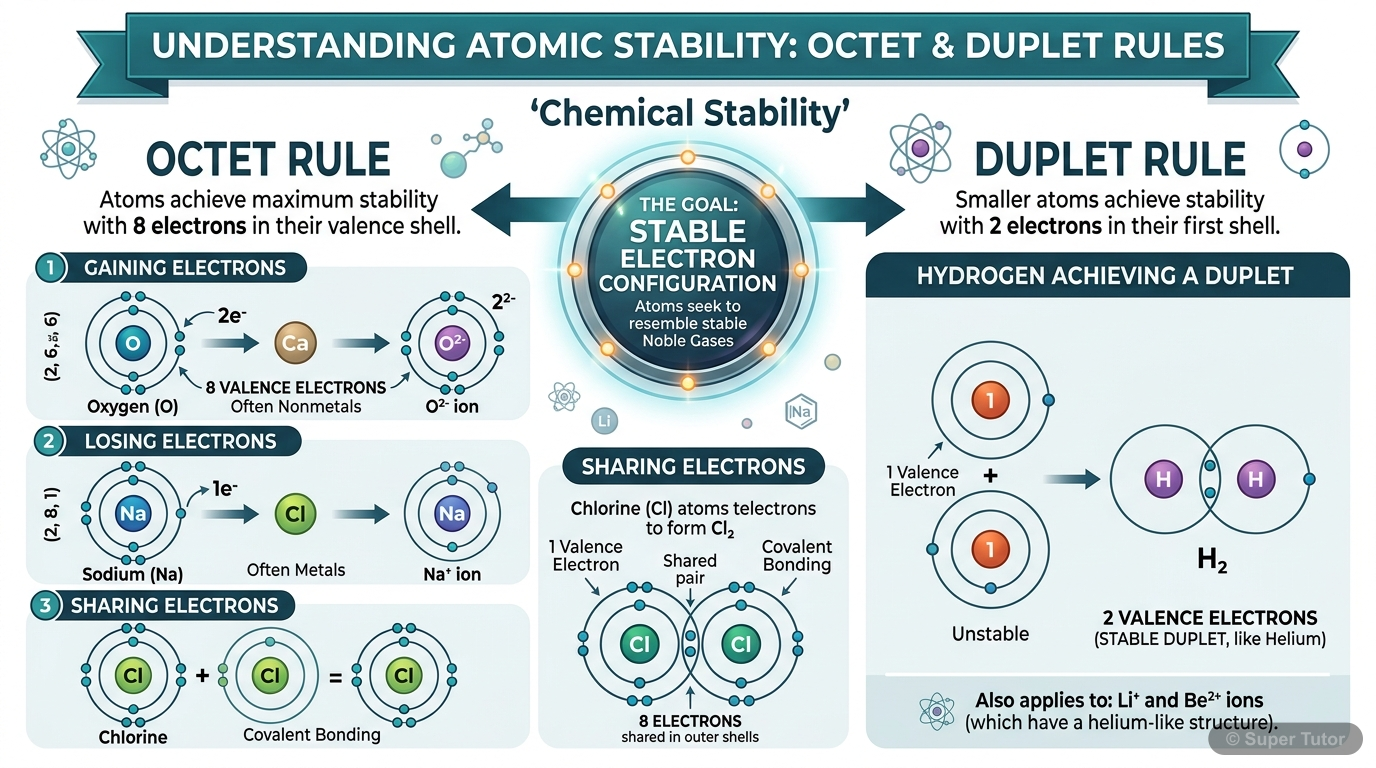
One of 18 illustrations for Chemical Bonding in Super Tutor — alongside flashcards, concept maps and practice questions.
See them allWhat is a chemical bond?
Answer
A chemical bond is actually some sort of interatomic attraction which holds the two atoms together. A chemical bond may be ionic, covalent, coordinate or metallic in nature.
Why do atoms combine to form compounds?
Answer
Atoms combine to acquire stability and a state of minimum energy. They gain, lose, or share electrons to achieve a stable electronic configuration similar to noble gases.
What is the octet rule?
Answer
During the formation of a molecule, an atom of a particular element gains, loses or shares electrons until it acquires a stable configuration of eight electrons in its valence shell.
Which atoms do not obey the octet rule?
Answer
The octet rule is not valid for H and Li atoms. They tend to acquire only two electrons, a duplet, similar to helium.
What is incomplete octet? Give examples.
Answer
In BeF2, BF3, AlCl3, the central atoms Be, B and Al have incomplete octet with 4, 6, 6 electrons respectively.
What is expanded octet? Give examples.
Answer
In PCl5, SF6, IF7, the central atoms P, S and I have expanded octet with 10, 12 and 14 electrons respectively.
What is an electrovalent or ionic bond?
Answer
Electrovalent bond or ionic bond between two atoms is the electrostatic force of attraction which holds together the ions of the combining atoms formed by the complete transfer of one or more electron…
What is electrovalency?
Answer
The number of electrons donated or accepted by the valence shell of an atom of an element to achieve stable electronic configuration is called electrovalency of that element.
+42 more flashcards
Practise AllFrequently Asked Questions
What are the important topics in Chemical Bonding for ICSE Class 10 Chemistry?
How many flashcards are available for Chemical Bonding?
How should I revise Chemical Bonding for the ICSE Class 10 board exam?
Sources & Official References
Content is aligned to the official syllabus. Refer to the board website for the latest curriculum.
More resources for Chemical Bonding
Practice Quiz
Test yourself with a quick quiz
Important Questions
Exam-style questions with answers
Revision Notes
Key points for last-minute revision
Formula Sheet
The chapter's formulas in one place
Chapter Summary
Understand the chapter at a glance
Concept Maps
See how topics connect
Study Plan
Step-by-step plan for this chapter
Syllabus
What topics to cover
For serious students
Get the full Chemical Bonding chapter — start free.
Quizzes, flashcards, an AI doubt solver and a study plan for ICSE Class 10 Chemistry. Free to start, no card needed.