Study of Acids, Bases and Salts — Concept Maps
ICSE · Class 10 · Chemistry
4 concept maps of Study of Acids, Bases and Salts for ICSE Class 10 Chemistry, each also written out as a text outline.
Interactive on Super Tutor
Studying Study of Acids, Bases and Salts? Get the full interactive chapter.
Quizzes, flashcards, AI doubt-solver and a step-by-step study plan — built for concept maps and more.
Free trial, no card needed.
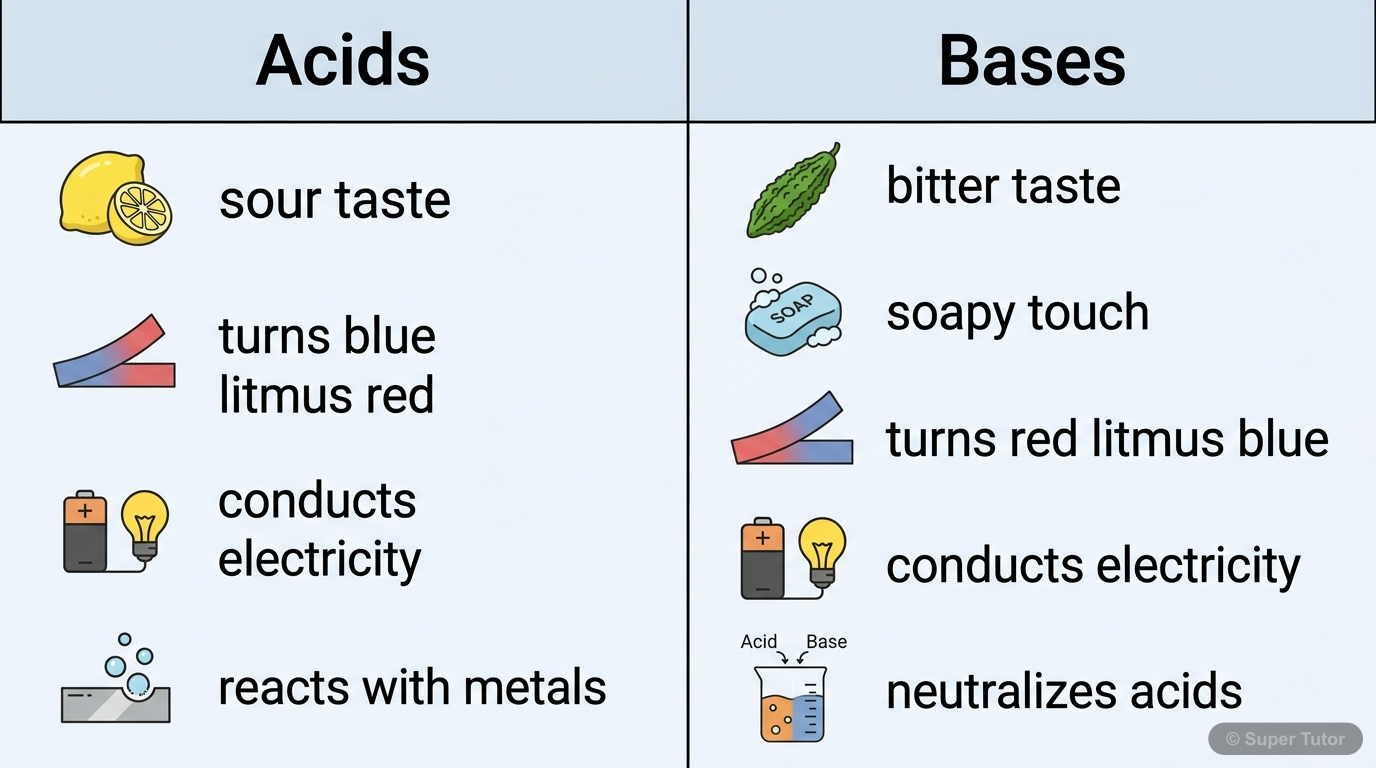
One of 15 illustrations for Study of Acids, Bases and Salts in Super Tutor — alongside flashcards, concept maps and practice questions.
See them allAcids, Bases & Salts Classification
The map in words
- Acids Bases Salts
- Acids
- Strong
- HCl HNO3 H2SO4
- Complete ionization
- Weak
- CH3COOH H2CO3
- Partial ionization
- Monobasic
- HCl fornmic acid
- One H+ ion
- Dibasic
- H2SO4 H2CO3
- Two H+ ions
- Tribasic
- H3PO4
- Three H+ ions
- Strong
- Bases
- Alkalis
- NaOH KOH
- Soluble in water
- Non-Alkalis
- Cu(OH)2 Fe(OH)3
- Insoluble in water
- Monoacidic
- NaOH NH4OH
- One OH- ion
- Diacidic
- Ca(OH)2 Ba(OH)2
- Two OH- ions
- Triacidic
- Al(OH)3 Fe(OH)3
- Three OH- ions
- Alkalis
- Salts
- Normal
- NaCl Na2SO4
- Complete replacement
- Acid
- NaHSO4 KHCO3
- Partial H+ replacement
- Basic
- Cu(OH)Cl Pb(OH)NO3
- Partial OH- replacement
- Double
- Mohrs salt Potash alum
- Two salts combined
- Mixed
- NaKCO3
- Multiple cations anions
- Complex
- K4Fe(CN)6
- Complex ion present
- Normal
- Acids
Strength vs Concentration of Acids — How to Tell Them Apart
The map in words
- Given Acid Solution
- B
- Yes - Almost Complete: STRONG ACID
- E
- High amount: G
- Example: Conc HCl
- Dilute HCl is NOT a weak acid
- Example: Conc HCl
- Low amount: H
- Example: Dilute HCl
- High amount: G
- E
- No - Partial: WEAK ACID
- F
- High amount: I
- Example: Conc CH3COOH
- Conc CH3COOH is NOT strong
- Example: Conc CH3COOH
- Low amount: J
- Example: Dilute CH3COOH
- High amount: I
- F
- Yes - Almost Complete: STRONG ACID
- B
- completely
- is
- Strong
- Weak
Complete Chapter Concept Map: Acids, Bases and Salts
The map in words
- Acids Bases and Salts
- Acids
- Definition
- Gives H3O plus ions in water
- Turns blue litmus red
- Sour taste
- Types by Source
- Mineral Acids
- HCl HNO3 H2SO4
- Corrosive and Strong
- Organic Acids
- CH3COOH HCOOH
- Weak and Less Corrosive
- Mineral Acids
- Types by Strength
- Strong Acids
- Complete Ionisation
- HCl H2SO4 HNO3
- Weak Acids
- Partial Ionisation
- CH3COOH H2CO3
- Strong Acids
- Basicity
- Monobasic - HCl
- Dibasic - H2SO4
- Tribasic - H3PO4
- Chemical Reactions
- With Metals gives H2
- With Bases Neutralisation
- With Carbonates gives CO2
- With Sulphides gives H2S
- With Sulphites gives SO2
- Definition
- Bases
- Definition
- Reacts with H3O plus ions
- Forms salt and water
- Oxide or Hydroxide of metal
- Alkalis
- Water Soluble Bases
- Give OH minus ions only
- NaOH KOH Ca OH 2
- Types by Strength
- Strong Bases - NaOH KOH
- Weak Bases - NH4OH
- Acidity of Base
- Monoacidic - NaOH
- Diacidic - Ca OH 2
- Triacidic - Al OH 3
- Chemical Reactions
- Neutralisation with Acids
- With CO2 gives Carbonates
- With Metallic Salts
- With Ammonium Salts
- Definition
- Salts
- Definition
- Ionic Compound
- Replacement of H ions of acid
- Types
- Normal Salt - NaCl Na2SO4
- Acid Salt - NaHSO4 NaHCO3
- Basic Salt - Cu OH Cl
- Double Salt - Mohr Salt
- Mixed Salt - NaKCO3
- Complex Salt - K4 Fe CN 6
- Methods of Preparation
- Direct Combination
- Displacement
- Precipitation
- Neutralisation
- Decomposition
- Properties
- Water of Crystallisation
- Efflorescence
- Deliquescence
- Hydrolysis
- Solubility
- Definition
- pH Scale
- Range 0 to 14
- pH 7 Neutral
- pH below 7 Acidic
- pH above 7 Alkaline
- Formula pH equals minus log H3O plus
- Indicators
- Litmus pH 5 to 8
- Methyl Orange pH 3.1 to 4.5
- Phenolphthalein pH 8 to 9.8
- Universal Indicator
- pH Paper
- Acids
Acids, bases and salts and their behaviour in water, reactions, classifications, pH, indicators, solubility, hydrolysis, crystallisation and preparation methods
The map in words
- Acids, bases and salts and their behaviour in water, reactions, classifications, pH, indicators, solubility, hydrolysis, crystallisation and preparation methods
- Acids
- Bases and alkalis
- Salts
- pH and indicators
- Preparation of salts
- Water and ionisation
Explore these maps interactively
Explore DiagramsFrequently Asked Questions
What are the important topics in Study of Acids, Bases and Salts for ICSE Class 10 Chemistry?
What do the concept maps for Study of Acids, Bases and Salts show?
How should I revise Study of Acids, Bases and Salts for the ICSE Class 10 board exam?
Sources & Official References
Content is aligned to the official syllabus. Refer to the board website for the latest curriculum.
More resources for Study of Acids, Bases and Salts
Practice Quiz
Test yourself with a quick quiz
Important Questions
Exam-style questions with answers
Revision Notes
Key points for last-minute revision
Formula Sheet
The chapter's formulas in one place
Chapter Summary
Understand the chapter at a glance
Study Plan
Step-by-step plan for this chapter
Flashcards
Quick-fire cards for active recall
Syllabus
What topics to cover
For serious students
Get the full Study of Acids, Bases and Salts chapter — start free.
Quizzes, flashcards, an AI doubt solver and a study plan for ICSE Class 10 Chemistry. Free to start, no card needed.