Elasticity of Demand — Concept Maps
ICSE · Class 10 · Economics
4 concept maps of Elasticity of Demand for ICSE Class 10 Economics, each also written out as a text outline. Part of the ICSE Class 10 Economics syllabus.
Interactive on Super Tutor
Studying Elasticity of Demand? Get the full interactive chapter.
Quizzes, flashcards, AI doubt-solver and a step-by-step study plan — built for concept maps and more.
Free trial, no card needed.
One of 3 illustrations for Elasticity of Demand in Super Tutor — alongside flashcards, concept maps and practice questions.
See them allElasticity of Demand - Complete Concept Map
The map in words
- Elasticity of Demand
- Price Elasticity
- Percentage Method
- Formula Ed = DQ/DP x P/Q
- Ratio of percentage changes
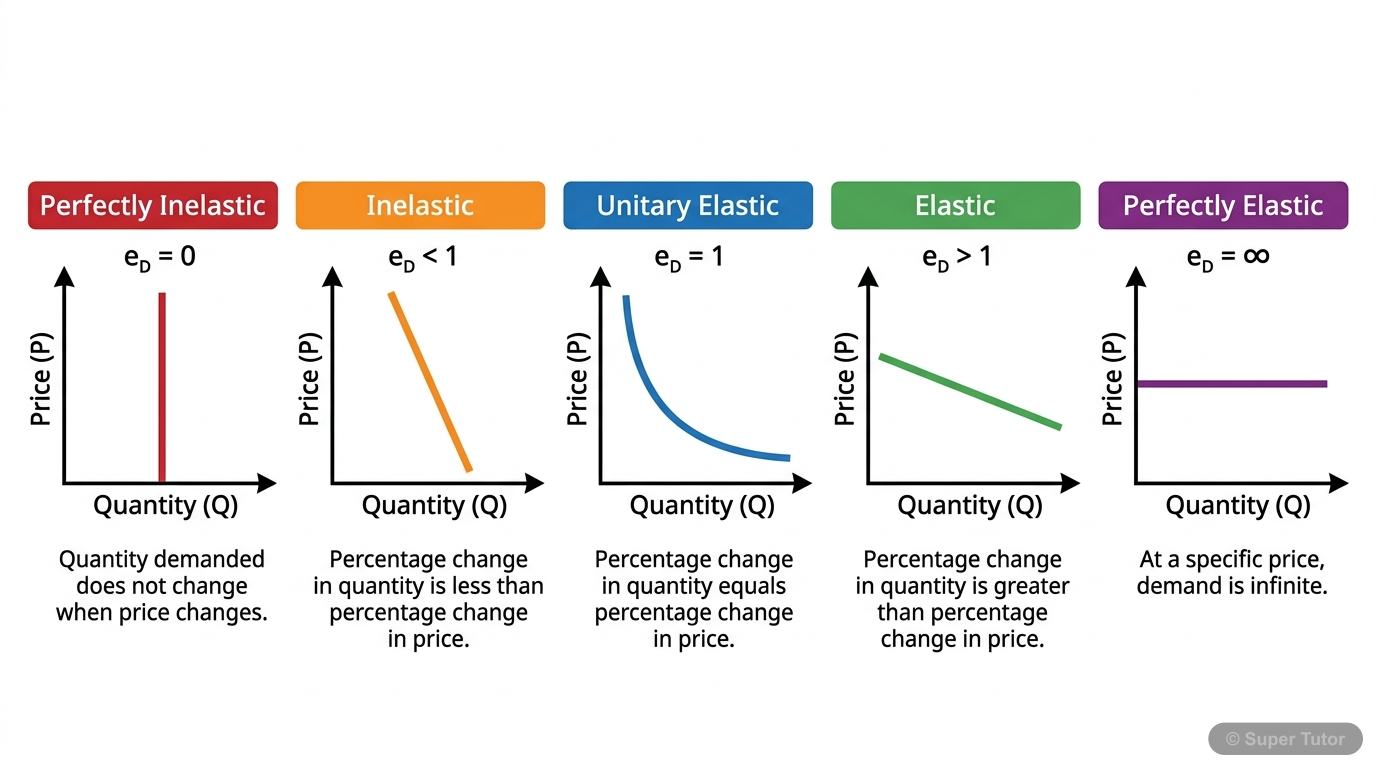
- Five Degrees
- Perfectly Inelastic Ed = 0
- Inelastic Ed less than 1
- Unit Elastic Ed = 1
- Elastic Ed greater than 1
- Perfectly Elastic Ed = infinity
- Demand Curve Shapes
- Vertical line
- Steep curve
- Rectangular Hyperbola
- Flat curve
- Horizontal line
- Percentage Method
- Income Elasticity
- Positive
- Normal goods
- Demand rises with income
- Negative
- Inferior goods
- Demand falls with income
- Zero
- No change in demand
- Positive
- Cross Elasticity
- Positive
- Substitute goods
- Tea and Coffee
- Negative
- Complementary goods
- Pen and Ink
- Zero
- Unrelated goods
- Milk and Cloth
- Positive
- Factors Affecting Elasticity
- Nature of commodity
- Necessities Inelastic
- Luxuries Elastic
- Availability of substitutes
- More substitutes More elastic
- Number of uses
- More uses More elastic
- Postponement possible
- Postponable Elastic
- Share in budget
- Small share Inelastic
- Habits
- Habitual goods Inelastic
- Time period
- Long run More elastic
- Joint demand
- Linked to main good
- Nature of commodity
- Price Elasticity
Correct vs Incorrect: Reading Elasticity from Demand Curve Shape
The map in words
- Look at the Demand Curve Shape
- What is the slope?
- Vertical Line: WRONG: Elastic
- Vertical Line: CORRECT: Perfectly Inelastic\nEd = 0
- Horizontal Line: WRONG: Inelastic
- Horizontal Line: CORRECT: Perfectly Elastic\nEd = Infinity
- Steep Curve: WRONG: More Elastic
- Steep Curve: CORRECT: Less Elastic\nEd less than 1
- Flat Curve: WRONG: Less Elastic
- Flat Curve: CORRECT: More Elastic\nEd greater than 1
- Rectangular Hyperbola: CORRECT: Unit Elastic\nEd = 1
- What is the slope?
Elasticity of Demand — Complete Concept Map
The map in words
- Elasticity of Demand
- Price Elasticity Ed
- Formula Ed = DeltaQ over DeltaP times P over Q
- Percentage Method
- Q above P always
- 5 Degrees
- Perfectly Inelastic Ed equals 0
- Vertical Demand Curve
- Inelastic Ed less than 1
- Steep Demand Curve
- Unit Elastic Ed equals 1
- Rectangular Hyperbola
- Elastic Ed greater than 1
- Flat Demand Curve
- Perfectly Elastic Ed equals Infinity
- Horizontal Demand Curve
- Perfectly Inelastic Ed equals 0
- Income Elasticity Ei
- Q over Y fraction
- Positive Normal Goods
- Negative Inferior Goods
- Zero No Change
- Cross Elasticity Ec
- X Demand vs Y Price
- Positive Substitutes
- Negative Complements
- Zero Unrelated Goods
- Factors Affecting Ed
- Nature Necessity vs Luxury
- Substitutes Available or Not
- Number of Uses
- Postponement Possible
- Proportion of Income
- Habits
- Time Period
- Joint Demand
- Price Elasticity Ed
Elasticity of Demand
The map in words
- Elasticity of Demand
- Meaning of Elasticity of Demand
- Percentage Method
- Degrees of Price Elasticity
- Factors Affecting Price Elasticity
- Types of Elasticity of Demand
- Examples and Applications
Explore these maps interactively
Explore DiagramsFrequently Asked Questions
What are the important topics in Elasticity of Demand for ICSE Class 10 Economics?
What do the concept maps for Elasticity of Demand show?
How should I revise Elasticity of Demand for the ICSE Class 10 board exam?
Sources & Official References
Content is aligned to the official syllabus. Refer to the board website for the latest curriculum.
More resources for Elasticity of Demand
Practice Quiz
Test yourself with a quick quiz
Important Questions
Exam-style questions with answers
Revision Notes
Key points for last-minute revision
Formula Sheet
The chapter's formulas in one place
Chapter Summary
Understand the chapter at a glance
Study Plan
Step-by-step plan for this chapter
Flashcards
Quick-fire cards for active recall
Syllabus
What topics to cover
For serious students
Get the full Elasticity of Demand chapter — start free.
Quizzes, flashcards, an AI doubt solver and a study plan for ICSE Class 10 Economics. Free to start, no card needed.